

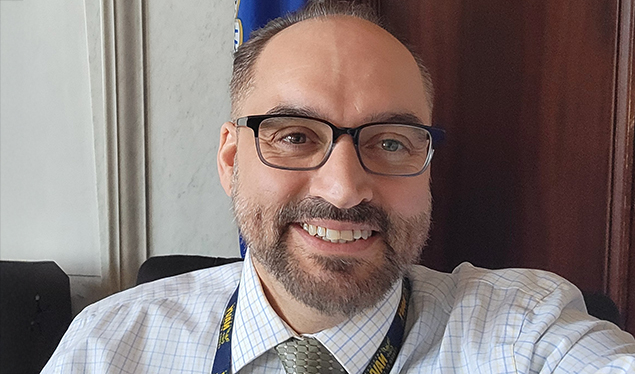
Christopher Gilbert (3LW) balances weekend law school with full-time work as an Assistant Clerk in the Connecticut Superior Court’s Criminal Division. Driven by a lifelong commitment to advocacy, he brings real courtroom experience into the classroom while pursuing a career in criminal law rooted in service, justice, and community impact.
What inspired you to pursue a legal career, and why did you choose the weekend program at Seton Hall Law?
From a young age I have been civically and politically engaged. At the same time, I have always worked to stand up for those who have had trouble standing up, or have not been able to stand up, for themselves. I have many stories from my childhood or adolescence that end with me advocating for sick animals, bullied friends, the environment, and much more. When COVID caused a collapse in my business teaching English in Italy, coming home and starting a JD program was a no-brainer. In the end, I have always fought for what is right and just.
Coming back to Seton Hall was an easy choice as well. As an alumnus of what was the College of Arts and Sciences on the South Orange campus, I knew what it meant to be a Pirate already.
While I had other law schools to choose from, the Weekend Program stood out, allowing me the greatest flexibility and best chance for a good work-life balance. As much as I understood the demands of law school, being able to attend classes on the weekend and have my weekdays to focus on work and family made an easy choice even more simple.
Finally, the inclusivity of the Seton Hall Community, while staying true to our Catholic roots, was a factor that could not be ignored. Once I realized that my vocation was to become a lawyer, I knew that the Seton Hall Community and the Catholic Tradition would be the best way to guide me along my path.
Can you describe your role as an Assistant Clerk at the Connecticut Superior Court and the types of responsibilities you handle?
As an Assistant Clerk I touch on all aspects of the Connecticut Superior Court system in the criminal and motor vehicle office. Our primary responsibility is to be the keepers of the record for everything that happens in court. Whether it is recording the outcomes of infraction files, or reading jury verdicts on the record, everything we do keeps the courthouse running and helping victims and defendants reach the most just outcomes for their situations.
Mostly, my job seems very mundane, like data entry and filing paper. There is interfacing with the public, answering their questions about the dockets which impact them.
However, as one of my colleagues has said, we are “the quarterbacks of the court.” In that we initiate everything in our courthouse. We coordinate with the Prosecutors, Public Defenders, Private Defense Attorneys, the Judges, Probation, Bail Commission, Family Relations, Victims Services, the Judicial Marshalls, every office in the court. They all rely on us for information and paperwork. While mistakes will always happen, when our office makes a mistake it causes downstream consequences for everyone. This makes our jobs much more stressful, but it is a point of pride to keep errors to a minimum.
When I get called into the courtroom, I might be recording the happenings of Plea hearings or keeping track of the voir dire on a jury panel, or marking exhibits and keeping them safe during the trial, and preparing them for shipment to the appellate division on request.
No matter what I do on any given day, it is a demanding and challenging environment, requiring attention, accuracy, and speed. Doing all this in the busiest Judicial District in the Great State of Connecticut is fulfilling.
How did your prior experience as a Judicial Intern and in law libraries prepare you for your current position?
As an Intern in the Law Library I got to learn how to research without Lexis+ or Westlaw. I gained a better understanding of why citations are the way they are, and how truly voluminous legal texts are.
The law library was my first Everyday look into the workings of a courthouse, and I was able to see what really goes into real-world legal research. There was also a fair amount of dealing with the public and learning how to deal with pro se defendants’ questions and demands.
As much as my previous work history gave me plenty of customer service experience, interacting with the people and personalities in a courthouse was something none of my previous experience could have prepared me for. That is my greatest take-away from that experience.
What skills or lessons from your professional and academic experiences have been most valuable in your legal training?
I think that working as an Assistant Clerk in the Criminal and Motor Vehicle office is the reason I did so well in Criminal Law and Evidence. To be able to see what Professors Lewis and McLoughlin were talking about in real time was priceless. As great as both professors were, I doubt I would have done as well in those courses without the addition of my professional experience occurring in parallel.
The ability to take in the why of what is happening at work and apply it to analogous situations in class has helped me to retain the lessons I need to learn in our courses.
How has balancing weekend law school and full-time professional responsibilities shaped your approach to time management?
One of the hardest things to do for me is find personal time for things like working out and personal development outside of studies. I have found new ways to slot in the other important things in life. An hour lunch becomes a 15 minute lunch, some time to change, and a 30 minute run around Downtown New Haven. Sacrifices must be made, TV time is now study time. Most of all, when there are family obligations, or emergencies, plans must be made and readily altered to make sure all work gets done.
However, I am lucky that my current position is expressly created for Law Students, so when I need to make time because life has thrown a curveball and I get behind with studies, I can take time off of work.
What insights into the criminal justice system have you gained from working in the Connecticut Superior Court?
While our system is called “adversarial” the truth is our criminal justice system is a collaborative process, at least on the State level. While the Prosecutors and Defense Attorneys are obviously looking for different outcomes, it requires them both doing their part to the best of their abilities, listening to each other, the judges, the clerks, and the different support offices to make sure the process moves forward efficiently and effectively.
Very few matters ever see trial, the vast majority of our business is resolved through alternative dispute resolution methods like plea bargaining, or through different State-offered Rehabilitative Programs.
The most amazing part of the process is; while it seems, from an individual perspective, to move at a glacial pace, everything moves fast. The need for precision under pressure while moving quickly is almost impossible to achieve if you are looking at the other offices as competitors instead of teammates.
Looking back, what has been one of your proudest accomplishments as a weekend law student?
Individually, my proudest accomplishment to date was my first real client interview as part of the District of New Jersey Settle Conference Practicum headed by Professor White. It was my first real-world lawyering experience, and I am grateful and proud of being selected for that opportunity and of being able to interview real-world clients, with real-world problems they are looking to solve.
Generally, I’m also proud of my classmates though, we have such a diverse group of personalities, and yet we perform like a team. In what is generally considered the highly competitive world of law school, we are collaborative and are always looking-out for one another. I doubt I would have done as well as I have without them there to help me along the way. We genuinely enjoy each other’s company and I have never heard one of my classmates with a bad word to say about anyone else.
How have your extracurricular involvements, such as the Student Bar Association and Rodino Italian-American Society, influenced your law school experience?
It is difficult to participate in extracurricular activities as a Weekend Student living out-of-state, but it has definitely helped me have a fulfilling life outside of law school proper.
The first two years on the SBA helped me find my law school voice. I made sure to advocate for the needs of my class, and make sure their concerns were addressed by the administration when needed. It also greatly improved my law school network.
Being on the E-board for the Student Animal Legal Defense Fund helped me stay in touch with animal rights issues in the tri-state area, and meet some great full-time students I would not have otherwise had the chance to interact with.
Unfortunately, I have not been able to regularly attend any Rodino events, but I do get to talk to some of the people involved, and it helps me keep in mind my roots. Being a dual-national is a privilege and it is important to honor both nations and my family’s heritage.
All the student organizations I participate in, no matter how much or how little, help me to connect to that part of me, and to others who share the same circumstance, affinity, or background.
How do you see your current experiences shaping your post-graduation goals or career trajectory?
My hope is to stay in Criminal Law, specifically, I will be applying at both the State’s Attorney and Public Defender offices in my courthouse soon. I will look elsewhere, as well, but my desire is to work in my community, helping justice be served for the people of the Great State of Connecticut, and the Greater-New Haven area specifically.
Things like the DNJ/SDNY Practicum help me learn valuable legal interviewing skills. I have some amazing experiences coming this semester which will teach me Crisis Negotiation Skills from a former FBI Crisis Negotiator. I will see how the International Criminal Court operates in The Netherlands, and my doctrinal courses will keep giving me more background and knowledge in the theory and operation of different aspects of law, any of which I may encounter in any criminal court system, because many of the crimes we encounter often have a civil aspect to them as well.
All of this will make me a more well-rounded lawyer, and give me an excellent foundation to deal with the high-pressure, fast-paced world of state courthouses.
What advice would you give to students considering weekend law school or juggling professional work with law school commitments?
This has been the greatest challenge of my life. The biggest piece of advice I think I could offer is make sure the people in your life understand that law school is going to take up a huge portion of your life. Late nights reading, studying, completing assignments. There is sacrifice and compromise, and you are going to need the support of the people around you.
I could not possibly do this without the support of my family and friends. Asking for their patience and help is absolutely a must. I am going to owe so many favors when this is done. However, fear not, this is the greatest scholastic experience and I would not trade this time, all the good and the bad of the last, almost three years, for anything.


