

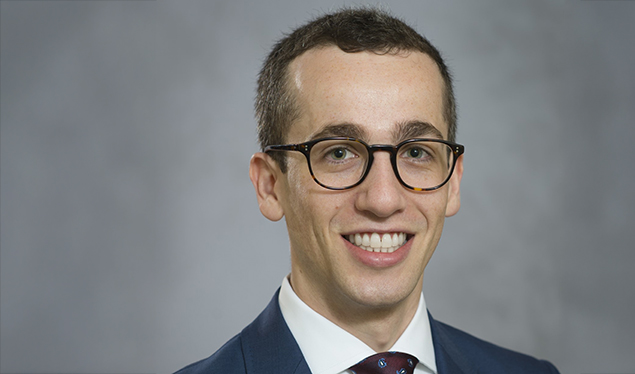
Elliott Liebling (3LW) brings his public health expertise and leadership as a Director at RWJBarnabas Health into his legal studies with a deep commitment to health justice. This summer, he’s advancing that mission as a research assistant for Professor Jacob Elberg, exploring emerging issues in healthcare fraud.
What inspired you to pursue a career in health law, and how did your background in public health influence that decision?
During my undergraduate and graduate studies in public health, I learned how to formally structure my thinking around social determinants of health, which Healthy People 2030 groups into five domains: economic stability, education access and quality, health care access and quality, neighborhood and built environment, and social and community context. This framework informs my work as a public health professional—from cataloguing HIV criminalization laws and recovery support services for Medicaid beneficiaries to publishing research on substance use and access to care. In my law school application personal statement, I quoted public health professor Dr. Melody Goodman, who posited, “Your ZIP Code is a better predictor of your health than your genetic code.” Only a few months later, Seton Hall Law assigned The Color of Law: A Forgotten History of How Our Government Segregated America by Richard Rothstein as summer reading for incoming students. That coincidence reaffirmed my decision to combine my public health background with a legal education in Newark so I can better serve New Jerseyans—and the communities in which I live and work—by reforming the legal framework underpinning the War on Drugs, removing barriers to care by bringing legal expertise to health systems, and advocating for health justice for all.
You’re currently ranked first in your class—what study habits or mindset strategies have helped you excel?
I dedicate time at the beginning of every semester and unit to organize my workflow for each course. Once I receive a syllabus, I enter assignments as tasks in Microsoft To Do. I still refer to the syllabus and Canvas for extra detail, but having all of my responsibilities in one place helps me see the big picture and plan ahead. When a new unit starts, I prepare my virtual workspace: I download any handouts and PowerPoints from Canvas and open tabs for the videos and quizzes. Checking off tasks and closing tabs helps me visualize my progress and stay motivated. I also scroll through the assigned casebook pages and create an outline in OneNote based on the section headings. With that structure in place, I can focus on reading and notetaking.
Can you share a memorable moment or lesson learned from your work as a Director at RWJBarnabas Health?
Last summer, I joined a group of Institute for Prevention and Recovery staff to assemble 15,000 harm reduction kits. Peer recovery specialists distribute these kits—with naloxone and drawstring backpacks containing personal care products—to patients across the health system. Assembly week marked the end of a months-long purchasing project that I helped coordinate, and it was incredibly rewarding to put together kits knowing that they will save lives.
What has been the most interesting or surprising aspect of your summer research on healthcare fraud?
My research focused on direct-to-consumer prescribing models—you may have seen commercials or ads on the PATH for various telehealth companies. The rapid changes in the field surprised me. The FDA removed semaglutide injection products from its drug shortage list, which affected compounders. Novo Nordisk and Hims & Hers announced a partnership, and a couple of months later it ended. Eli Lilly filed lawsuits against several telehealth companies. These and other developments make regulation challenging, but that challenge is part of what draws me to health law. Diseases, medicine, laws, and regulations are constantly changing, and there is always something new to learn.
How has being part of the Seton Hall Law Review and Health Law Forum shaped your law school experience?
Whether through the Socratic method in doctrinal classes, group negotiations in Lawyering, or oral arguments in Appellate Advocacy, so much of law school is about learning from your classmates. One of the most compelling aspects of the part-time weekend program is working alongside students with nontraditional academic, professional, and personal experiences. On the other hand, extracurriculars like the Seton Hall Law Review and Health Law Forum are my primary opportunities to meet full-time students who provide invaluable guidance on curriculum planning, school resources, and employment opportunities.
What skills from your public health career have translated most effectively into law school success?
My training in epidemiology and health services research underpins my approach to law school. While I learned to conduct literature reviews through PubMed and Google Scholar instead of using LexisNexis and Westlaw, identifying search terms and constructing a research plan are transferrable skills. To publish my public health research, I developed competency in academic writing. My familiarity with the usual format of Introduction, Methods, Results, Discussion, and Conclusion prepared me for CREAC in legal writing.
If you could give one piece of advice to incoming law students who also work full-time, what would it be?
Have transparent conversations with people in your support system; this is a change for them too. You will need to prioritize and make sacrifices to balance work and school effectively. That might mean missing an event on a class weekend or needing a favor during finals. Mutually setting expectations about your availability—and your social, emotional, and logistical needs—will make the transition smoother. Also, start banking sleep now.
Outside of work and school, what activities or hobbies help you recharge and stay balanced?
With time at a premium, a simple activity like walking my dog helps me be present in the moment and gets me outside year-round. Also, recharging doesn’t always mean completely disconnecting, which I encourage but know can be difficult. If I need a break between work and school or run out of steam at the end of the day, I’ll watch a webinar, listen to a podcast, or read an article to stay engaged at a lower intensity.
Who has been a mentor or major influence in your professional journey, and how have they impacted you?
I’m fortunate to have had professors and supervisors—experts in their fields—serve as mentors, and I’ve participated in several structured mentorship programs. But I encourage students and early career professionals to look for mentors in less formal places. For example, one of my classmates at the Brown School of Public Health shared my interest in healthcare administration and was one year ahead of me. By talking to him about his recent experiences—classes, internships, job searches—I could begin to visualize my own journey. Even once he started working at a hospital on the other side of the country, we still talked about our ongoing projects and shared best practices.
Looking ahead, what are your career goals in health law, and how do you envision making an impact in the field?
Next summer, I plan to work as a summer associate at a New Jersey law firm with a strong health law practice. I’m grateful that my coursework, extracurriculars, and professional experiences allow me to build skills in transactional and regulatory healthcare law. No matter where my career leads—whether academia, community-based organizations, hospitals and health systems, or law firms—I will continue working to remove barriers to care and advocate for health justice for all.


