

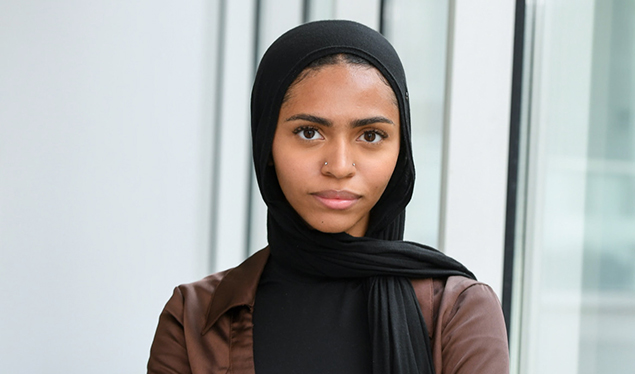
Meet Inaayah Bint Muhammad, our LEO Spotlight. A 2L, Inaayah reflects in her interview on balancing three summer internships, including work with The Honorable Michael Jimenez at the Hudson County Superior Court, Civil Division, and supporting Solangel Maldonado and the Seton Hall University Summer Institute for Pre-Legal Studies program.
Can you share a bit about your background and what led you to pursue a career in law?
“I come from a big family” is a bit of an understatement. I am one of seven siblings and the first in my family to go to law school. As an American Egyptian Muslim woman, my journey has not come without its challenges. But facing challenges is an inevitable part of all our lives. It is how we navigate and learn from these challenges that presents the opportunity for growth.
At a very young age, I learned to be resourceful, adapt quickly, and find solutions in difficult situations. These skills have transferred to my professional life, where I bring a practical and innovative approach to tasks. That experience also allowed me to recognize that every individual’s story is unique, which gives me a sense of empathy and understanding toward others. I really wanted to become a lawyer to bring this resilient mindset to the field of law.
What motivated you to join the Legal Education Opportunity (LEO) Fellowship program, and how has it shaped your law school experience so far?
Entering law school as a first-generation professional is a big challenge. I joined the LEO Fellowship program to get a head start on my legal career. LEO offered a two-week summer program prior to law school where we were exposed to 1L courses, took mock exams, and wrote a mini memorandum in preparation for 1L.
LEO also provided me with a 2L and 3L mentor who helped guide me through my first year of law school. Honestly, the LEO program has been like a family for me. The LEO Director, Professor Perez-Vellios, has really been a guiding light for me in my path to 1L and now my path to 2L, and she has made LEO feel like my home away from home. I think it is important to have a support system in law school—especially as a first-generation law student—and LEO provided me that.
This summer you balanced multiple roles — can you share what you’ve learned from your internships and assistantships?
Throughout my undergraduate career at the University of Miami and now at Seton Hall, I have typically had to balance multiple roles at once—whether it be an organization, volunteering, or my academics. I don't take on so many tasks at once just because I am good at time management. I do it because in all my internships and extracurricular activities, I am learning something new.
And learning is how we expand our knowledge and our horizons. It allows me to think outside of the box in any situation—something that I pride myself on.
What has been the most rewarding aspect of your work with the Hudson County Superior Court’s Civil Division?
The most rewarding aspect of my work with the Hudson County Superior Court’s Civil Division has been the practical experience I gained. During my time with the court, I had the opportunity to observe trials and hearings, which gave me first-hand insight into courtroom dynamics and judicial reasoning.
Aside from the courtroom, I often drafted memoranda to influence the judge’s rulings, which required me to analyze case law, synthesize arguments, and present clear and concise recommendations. I also engaged with litigants—most of whom were pro se (litigating on their own behalf). Having to communicate with a lawyer with 40 years of experience versus a pro se litigant who has no knowledge of the law really developed my interpersonal skills.
As a research assistant for Professor Maldonado, what topic or insight has stood out to you most?
As a research assistant for Professor Maldonado, I explored how the Dobbs decision is affecting women post-Dobbs, particularly regarding access to reproductive healthcare. This was a new area of law for me, and diving into it required me to navigate a mix of constitutional and family law—courses I have not yet taken. But of course, I love a challenge.
Having to track shifting legal standards across jurisdictions, analyze case law and statutes, and synthesize that information into clear, concise reports sharpened my legal research and writing skills. Being a research assistant taught me how to approach complex, sensitive issues, which I know will translate well into legal practice and the remainder of my time in law school.
What was your favorite part about mentoring and working with students in the Summer Institute for Pre-Legal Studies?
As a graduate assistant for the Summer Institute for Pre-Legal Studies, I worked closely with students in an accelerated first-year program taking foundational law courses taught by sitting judges. My favorite part of the program has been connecting with the students.
I attended classes alongside them, helped develop lesson plans and study strategies, and provided academic and professional support in all aspects of the program. It is good knowing that you played a part in another person’s future. This experience gave me a unique perspective on legal education from both the student and instructor point of view, and it strengthened my ability to break down complex legal concepts into terms that someone who had not been exposed to the legal environment would understand.
What has been your proudest achievement in law school to date?
My proudest achievement in law school has been the improvement in my writing. I come from a writing background—I love writing poetry and short books. But legal writing is entirely different from creative writing. It requires a different approach.
For me, Lawyering was my favorite class because it was the class in which I learned the most. I strongly believe that the course helped me improve not only professionally, but personally too. I have Professor Stuart to thank for that.
Which extracurricular activities or organizations have had the biggest impact on your personal and professional growth?
The organization that has had the biggest impact on my personal and professional growth is the Black Law Students Association. As an E-board member of BLSA, I was introduced to many opportunities that I may not have had prior to joining the organization. I attended conferences, volunteered at clinics, and represented BLSA in the Student Bar Association.
I think it is important for first-year students to try to get involved wherever they can in order to build and maintain the community that they identify with—and even those that they do not identify with.
What advice would you give to incoming 1Ls about making the most of their time at Seton Hall Law?
Have fun. Yes, academics are very important—especially in your first year of law school. But your mental health always comes first. The key is to be able to balance it all. Get your work done and take some time for yourself. Relax, go out with your friends, and don’t forget to laugh.
You are all in the same boat. We all have the same 24 hours in a day—it is up to you to make the most of it.
Outside of law school, what hobbies, interests, or passions keep you grounded and inspired?
Throughout my journey, I have learned the importance of giving back to the community, whether that be through mentorship opportunities or community outreach. I have always been passionate about youth, and outside of law school you can typically find me at a local high school or elementary school guiding students through academic or socioeconomic hurdles that may stand in the way of their education.
Aside from mentoring, as a member of Alpha Kappa Alpha Sorority, I am involved in community cleanups, poverty and hunger alleviation, and voter registration workshops.


