

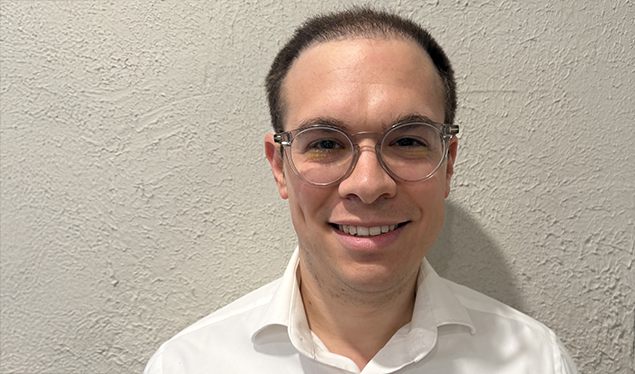
Isaac Shulman (2L) brings a client-centered lens to public defense shaped by his summer at the Hamilton County Public Defender’s Office and pro bono work with Seton Hall’s Criminal Defense Clinic. After careers at Goldman Sachs and Sumitomo Mitsui, Isaac is committed to challenging systemic inequities through transformative, community-focused advocacy.
Can you share a bit about your journey before law school and what ultimately led you to pursue a career in public defense?
I come from a well-off Orthodox Jewish community, and I grew up highly sheltered from much of the inequity and harshness of our legal and economic systems. As I came to learn about those realities, I became disillusioned with my own role in perpetuating those inequalities by working at large international banks. Returning to law school was an opportunity for me to center clients—particularly those who have been so marginalized by our racist and unequal society. I view public defense not only as client-centered work that can empower resource-starved community members, but also as a way of resisting the criminal punishment system itself.
How did your summer internship with the Hamilton County Public Defender’s Office shape or reaffirm your career goals?
I’m incredibly grateful for the opportunity to have worked at the Hamilton County Public Defender’s Office. I saw the inner workings of the criminal punishment system up close, forged relationships with incredible public defenders and clients, began developing trial and advocacy skills, and built on my first-year research and writing foundation. Because Ohio’s rules of legal practice allow law students to practice as attorneys after completing their first year (OH ST GOVT BAR Rule 2), I was engaged in substantive, on-the-record work—including leading two misdemeanor trials (both acquittals!) and sitting second chair on a third. The work was both exhilarating and challenging, and I’m excited to continue learning and improving this semester at the New Jersey Office of the Public Defender in the Bergen County office. The experience also pushed me to think more critically about how public defender offices are structured and how they interact with the communities they serve, a topic I plan to explore further in a law review comment.
What has been the most memorable or meaningful experience so far in your pro bono work with the Criminal Defense Clinic?
Working with Professor Misdary in the Criminal Defense and Community Advocacy Clinic has been the most intensely educational experience of my life. Every conversation or meeting with them forces me to rethink legal and factual issues in deeper ways. In one assignment, I worked through a police complaint to identify issues ripe for evidentiary discovery. Professor Misdary’s approach is both abolitionist and practical—by starting with a conceptual framework that seeks to eliminate, or at least minimize, the narrative power of police and delegitimize it at every turn in public defense advocacy, they draw out the most crucial factual issues at play.
Transitioning from a career in banking and market risk to law is a big leap—what skills from your finance background have helped you the most?
I worked in a fairly hierarchical role at the bank, but one that offered significant exposure to senior professionals across teams. That required me to be sharp and confident in presenting complex ideas while maintaining a narrative focus on the big picture that emerges from seemingly small details. Those skills are critical not only in law school, but also for a trial attorney who needs to tell a concise and compelling story to a jury or judge. Whether summarizing complicated facts during a cold call, responding to a prosecutor’s objection during cross-examination, or writing a brief, the ability to synthesize information accurately and succinctly is invaluable.
Who or what has been your biggest source of inspiration during your legal journey?
I’ve been most inspired by community members who face the enormous power of police, prosecutors, judges, parole agents, and correctional officers. Many have endured immense violence and received very little assistance from punitive legal, economic, and social institutions. Yet they remain patient, caring, funny, and respectful—qualities that are deeply moving given the systemic violence they and their families endure. I don’t know that I could experience what many of them have and still retain such humanity, fighting spirit, warmth, and kindness.
What advice would you give to students considering a career in public interest law?
A career in public interest law allows you to choose work that aligns with your values. While some industries offer financial benefits, they rarely create harmony between your inner hopes and dreams and your day-to-day work.
How do you balance the demands of law school with extracurricular commitments and community service?
It’s very difficult, and honestly, I often feel like I’m not doing a great job of it. I’m married and have two children, so much of my “extracurricular” life is about making sure I preserve enough family time. I also try to integrate community service into my law school experience, which is why I worked pro bono in the Criminal Defense and Community Advocacy Clinic last spring and am working with the New Jersey Office of the Public Defender in Bergen County this fall.
What is one challenge you’ve faced in your legal education so far, and how did you overcome it?
While legal reasoning came more easily to me during my first year, legal research did not. I spent significant time working to improve those skills and pushed myself further by serving as a research assistant for Professor Glynn this summer. Sometimes, going headfirst into a challenge is the best way to overcome it.
Outside of law, what are some hobbies or interests that keep you grounded and energized?
I’m not sure about grounded—my commitment to a specific career path in law probably does that—but I love playing tennis and going to stand-up comedy shows.
Looking ahead, what are your aspirations for your legal career after graduation?
I hope to become a strong public defender who vindicates the rights of community members facing charges. At the same time, I want to use my legal and advocacy training to push defender offices toward more transformative and community-centered defense strategies


