

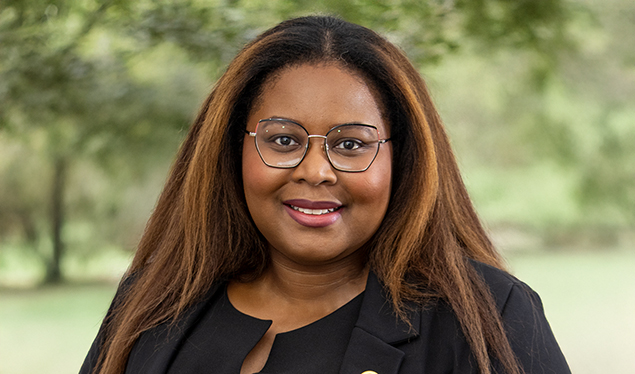
Meet Rosa Rowe, a 3L whose journey into patent law blends engineering curiosity with innovation. As our Adventures in Employment Spotlight, Rosa shares how her 1L summer at Accenture and her role as a patent law clerk at McCarter & English shaped her path—and why she’s excited to return post-graduation.
Can you share a bit about your path to law school and what initially sparked your interest in pursuing a legal career?
I decided to go to law school in high school after I developed an interest in public policy, and I believed I would be a good attorney and advocate. At the time, my favorite subject in high school was chemistry, and I was seriously considering a career in chemical engineering. I found myself at an academic crossroads. One of my mom’s best friends, a chemical engineer, told me a bit about the field and assured me that people from all professions go to law school. She explained that undergraduate study and law school are two different levels of education, and that I could study whatever I wanted and still become a lawyer.
I pursued my undergraduate education in biosystems engineering and Spanish, worked in the engineering industry after graduation, and then came to Seton Hall Law to pursue an education and career in law.
You earned degrees in both Biosystems Engineering and Spanish before law school. How did that academic background influence your decision to explore patent law?
As I neared the end of undergrad and expressed my interest in pursuing a legal education, admissions professionals would often follow up to ask whether I was interested in intellectual property and patent law. I had a general idea of what patents were, but when I began researching patent law, I realized it could be of interest to me.
As an engineering student and professional, I was accustomed to learning new concepts and staying up to date with the state of the art. Language is a living, fluctuating art that also requires maintenance. In patent law, as new technologies emerge, the laws and regulations that govern patent prosecution are continually updated and adapted to reflect the realities of modern innovation. I felt like my academic background prepared me to do that within the realm of patent law.
Additionally, patent attorneys seeking to prosecute patents before the USPTO must pass the patent bar exam. There are different ways to qualify to sit for the patent bar, but one of the more well-known pathways is to have an educational background in STEM subjects.
During your 1L summer, you interned at Accenture. What was that experience like, and how did it shape your understanding of legal work in a corporate or technology-driven environment?
My experience at Accenture as a Bill Moore intern was exceptional. While Accenture is a huge, multinational consulting firm, every team I worked with was incredibly capable, welcoming, and eager to show me how their practice area of law impacts not only Accenture, but also its clients.
I worked remotely in a rotational internship program, with the option to commute to my regional office in New York City. Day-to-day, I attended presentations hosted by different legal departments to introduce us to their work, and at the end of our informational sessions, we were given a research project to complete and submit to the department head.
My time at Accenture was incredibly informative, and it showed me how fast-paced and forward-looking technology-driven environments are. Consulting firms that develop the technologies that patent prosecutors protect are setting a new standard for innovation and industry. They are shaping how society will look and function five, ten, maybe even twenty years into the future.
The attorneys who work in corporate, technology-driven environments analyze the history of laws, research current laws, determine what concerns lawmakers and members of society may have about emerging technologies, and advise the firm about what internal policies and launch strategies should be for never-before-seen technologies that will widely benefit clients and the public.
My experience at Accenture showed me that attorneys in corporate roles are legal and technical experts who have their finger on the pulse of the law and their eye on its future implications, and it was exciting to be part of that.
What drew you to intellectual property and patent law specifically?
Intellectual property law ranges from being creative to technical. If you love expression through the arts, you can help protect artists’ imaginings through copyright law. If you believe that reputation and identity should be protected when people attach parts of themselves to their brands, you can become a trademark attorney. If you value rewarding inventors for driving innovation forward, you can be a patent attorney.
Intellectual property affects limitless industries like healthcare, fashion, sports, technology, art, literature, and business. There are opportunities to impact a wide range of industries through intellectual property, and I found it interesting that there is always something new to learn or explore in the realm of intellectual property law.
I love patent law specifically for many of the same reasons. Clients tend to file patents within their respective industries. However, when a law firm serves multiple clients, patent prosecutors are exposed to an unlimited range of technologies and industries. I have never felt pigeonholed in any one category of creation, and I have learned that even technologies stemming from similar practice areas have wildly different applications, so there is always something new to consider.
While patent law has been challenging, I believe that the challenge only adds to its appeal, and I definitely do not fear becoming bored anytime soon.
Can you describe your experience working as a Patent Law Clerk at McCarter & English and what your day-to-day work looks like?
My experience at McCarter & English has been phenomenal. I work with attorneys, paralegals, legal assistants, and docket specialists who are incredibly experienced, well-versed in the law, amazing mentors, and great to work with. McCarter & English has an amazing working culture, and I have enjoyed my time there immensely. The firm and the partners I work with are incredibly accommodating and allow me to work around my academic schedule at Seton Hall Law.
If I have morning classes, I walk over to the office in the afternoon and work until early evening. If I have afternoon classes, I work in the morning until I have class. Typically, once a week, I sit down with the partners and go over what work they will bring me in on.
Different partners give me different types of work, so I have the opportunity to assist with a variety of patent matters. If an assignment or course of work is completely new to me, the partners will give me reference materials or research to do, and then send the work over. If I have any questions, I can ask a senior associate how they typically handle the work, or I can go to the partners for guidance.
After I submit my work, the partners redline my deliverables and explain the rationale behind their changes. I revisit my work, capture their amendments, and move on to my next assignment. I often assist partners with drafting applications and responses to office actions, as well as updating internal recordkeeping.
So far, almost everything has been challenging and a learning curve, but taking things one day at a time definitely helps keep my progress in perspective. At the end of my workday, I log my billable hours before I leave the office. In the evenings or earlier in the morning before class or work, I read for my doctrinal classes and complete any outstanding deliverables I need to submit to my professor in the CSJ clinic.
How did your 2L summer internship at McCarter & English help solidify your interest in returning to the firm post-graduation?
As a part-time law clerk at McCarter & English, I am in the office for about 15–20 hours each week. Working part-time has been an excellent opportunity to get my feet wet, learn more about important concepts in patent prosecution, and assist with projects and client work.
As a 2L summer associate, I meaningfully assisted with patent prosecution and also had the opportunity to support other partners across practice groups because I was in the office full-time. I was able to network with my peers, attend helpful lunch-and-learns alongside associates, visit other offices, and speak with attorneys across the firm about what they do and why they chose McCarter & English.
My 2L summer gave me a more holistic perspective and offered a preview of what life could look like as a first-year associate and beyond. I was fairly confident that I wanted to return to McCarter after working part-time during my 2L spring, but after my 2L summer, I feel really excited about life after law school and my future at McCarter & English.
What skills from your engineering background have been most valuable in your patent law work?
Being confident, curious, and an effective communicator have been invaluable qualities in both my engineering and patent work. Both fields have taught me that no professional knows everything, and that valuable professionals can independently learn complex concepts, simplify complex processes for others, and apply their knowledge to provide meaningful solutions.
In both engineering and patent law, you must do your due diligence in a way that ensures you have drafted work product that achieves your clients’ goals while upholding their best interests.
The best engineers I worked under could take highly sensitive and scientific processes and make them digestible for a layperson, business development manager, or city manager. Likewise, in patent prosecution, partners engage with clients in ways that make a complex patenting system attainable for inventors. STEM professionals are underrated communicators. Studies, design plans, and specifications are all complex modes of communication, and I do not think society appreciates how skilled engineers must be at communicating to gain approval and bring intricate ideas to life.
My engineering background definitely colors my communication style in the legal world and has been an incredibly important part of my journey.
Looking back, what was one unexpected challenge or learning moment during your employment journey in law school?
One challenge has been learning how “due diligence” looks in a billable environment. Educators often talk about doing your due diligence in a way that is not always helpful when you are expected to log billable hours that a client must pay for.
The time to ask questions is not always after you have done everything possible on your own. Sometimes postponing a question can be more harmful than helpful, because you may waste time going down a path that could have been avoided with early direction.
You should be efficient and thoughtful by first using resources such as the MPEP, legal research platforms like Lexis, or even Google for guidance or templates. However, if something does not seem right, it is okay to ask for clarification before continuing. Associates and partners often have templates, preferences, and extensive experience. There is a delicate balance between being an independent worker and creating unnecessary difficulty by waiting too long to ask meaningful questions.
What advice would you give to students who are interested in patent law or considering a nontraditional path into legal practice?
If you are interested in patent law, especially patent prosecution, take the patent bar as early as you can. The summer before law school, 1L summer, or 2L summer are ideal times. As a 3L, I am now studying for the patent bar while also preparing for the UBE. If you can complete the patent bar earlier, it can significantly reduce stress later on. It is also an extremely valuable and profitable certification.
Additionally, speak directly with patent attorneys about their day-to-day practice. Ask about their educational backgrounds, how closely their education aligns with their current work, and whether they continue to learn new technologies and industries. Be sure you understand the difference between intellectual property litigators and patent prosecutors.
For nontraditional paths, there may not always be many institutional resources, so you must be proactive in finding mentors and professionals who can guide you. In less traditional areas of law, you have to be especially strategic and intentional about your trajectory.
As you prepare for graduation and your next step at McCarter & English, what are you most excited about professionally?
I am incredibly excited about the opportunity to work at McCarter & English after graduation. Professionally, I am most excited to continue learning from and working with such talented legal professionals.
When I see other associates in the office, they are doing meaningful work and genuinely enjoy their teams and professional opportunities. Senior associates and partners are often lifers, which speaks to the firm’s culture. Graduating from law school and joining McCarter & English marks the beginning of a career I have worked toward for a very long time. Seeing my professional goals come to fruition is an amazing experience, and I am ready to bring that excitement and work ethic to the firm.


