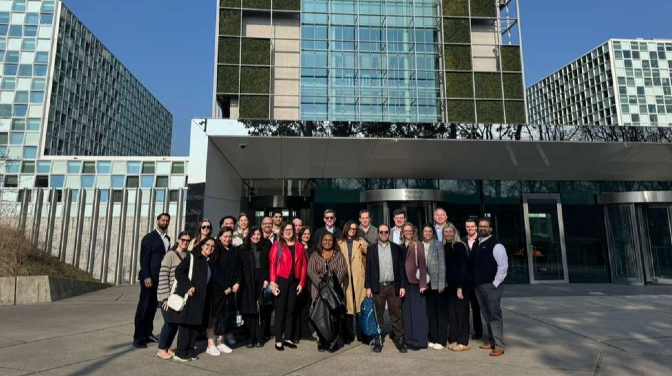
Photo provided by Jonathan Hafetz.
For 26 of us at Seton Hall Law, spring break offered a rare opportunity to step away
from exams and textbooks and experience the world’s most prestigious international
courtrooms firsthand. We traveled from Newark to The Hague, Netherlands, for the Spring
2026 International Criminal Justice and Human Rights Program, led by Professor Jonathan
Hafetz, an expert in constitutional law, human rights and international criminal law
who has served before the International Criminal Court.
During the weeklong program, we visited major international courts and legal institutions
in The Hague, widely regarded as the world’s center for international justice. Meetings
with judges, prosecutors, defense counsel and legal experts gave us firsthand insight
into how international law is applied in cases involving war crimes, human rights
abuses and global conflict.
At the ICC, the courtroom was packed with EU law students, media representatives and
journalists. We observed practitioners at the forefront of international criminal
law and gained a rare view of how legal systems respond to some of the world’s gravest
crimes.
One hearing involved Khaled Mohamed Ali El Hishri, accused of war crimes and crimes
against humanity while serving as a senior official at Mitiga Prison in Libya. His
lawyer spoke in Arabic, the judges responded in French, and the prosecutor addressed
discovery issues in English. Live translations were handled by two linguists per language.
When the hearing moved to a private session, sound was cut, yet we continued to watch
in amazement.
“The flow of the proceedings was striking,” said Imran Rabbani. “As someone who intends to work in public defense, the facilitation of due process is critical. Observing it at an international level was both powerful and inspiring.”
We also visited offices addressing conflicts in specific regions, including Kosovo
and Rwanda. Alan Tieger, senior prosecutor at the Specialist Prosecutor’s Office of
the Kosovo Specialist Chambers, shared how growing up as a child of Holocaust survivors
inspired him to follow in the footsteps of the Nuremberg prosecutors. He emphasized
connecting with victims as if they were family and restoring their humanity.
Melinda Taylor, defense counsel at the ICC, joined us virtually from the United Arab
Emirates, delayed by the ongoing U.S.-Iran conflict. She described the challenges
ICC attorneys face: balancing complex legal work with securing funding and persuading
states that financing a fair judicial process does not guarantee convictions.
“Early on, I managed on just 200 euros a month and limited resources,” Taylor said. “States often refuse to cooperate with defense, and representing those accused of atrocities carries serious public relations challenges.” We noted that her remarks highlighted how due process and the right of witnesses to be heard remain fundamental rights at the ICC.
“When Taylor explained the obstacles defense attorneys face while conducting emotionally intense work aimed at achieving justice after horrific war crimes, my appreciation for these attorneys grew exponentially,” said Tanya Panossian-Lesser.
After days of observing proceedings and meeting international jurists, we paused at
a quiet bar called Three Sisters, not far from the courts. Over stroopwafels and Dutch
spirits, we reflected on the lessons of the week and shared a rare moment of camaraderie—more
than 3,600 miles from Seton Hall Law, yet feeling surprisingly like home.

Imran Rabbani, a 3L weekend student, member of the Seton Hall Trial Team, works full
time with the Wrongful Conviction Unit at The Legal Aid Society. He will join the
Federal Defenders of New Jersey this summer. He aspires to practice international
criminal law.
 Tanya Panossian-Lesser, a 4L weekend student, represented tenants in the Center for
Social Justice Civil Litigation Clinic and competed on the Moot Court Board. She serves
as an articles editor for the Journal of Legislation and Public Policy, where her
comment on student loan discharge will appear in Volume 50. After graduation, she
will clerk for the Honorable John F. Chiaia in Essex County Superior Court, Civil
Division. She previously worked as an educator and small-business owner.
Tanya Panossian-Lesser, a 4L weekend student, represented tenants in the Center for
Social Justice Civil Litigation Clinic and competed on the Moot Court Board. She serves
as an articles editor for the Journal of Legislation and Public Policy, where her
comment on student loan discharge will appear in Volume 50. After graduation, she
will clerk for the Honorable John F. Chiaia in Essex County Superior Court, Civil
Division. She previously worked as an educator and small-business owner.
For more information, please contact:
Office of Communications and Marketing
(973) 642-8714
[email protected]