

FUNERAL MASS
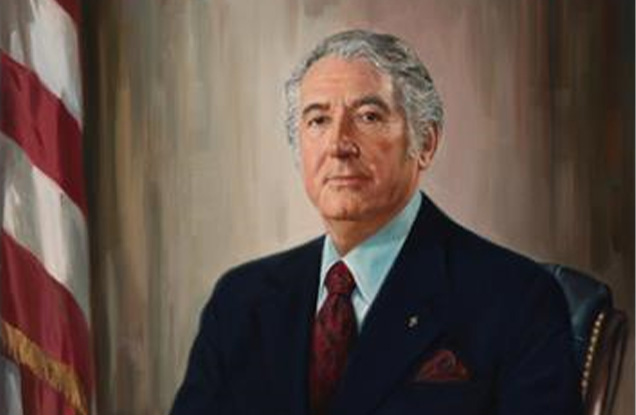
THE HONORABLE PETER W. RODINO, JR.
ST. LUCY CHURCH
MONDAY, MAY 16, 2005, 11:00 AM
READINGS:
Wisdom 3:1-9
Romans 8:14-23
Matthew 5:1-12a
HOMILY
The NBC television network will be pleased to hear me claim a place among the fans
of its award-winning weekly drama series, The West Wing. I confess that I am drawn in by the promise of a walk down the corridors of power,
an ear inside decision-making at the highest level, a look at how things get done
in our country, our world. Of course, the show is fiction, but the writers purposely
dramatize current events and issues.
In an episode this spring, one of the characters running for election to the presidency rebelled against pressure from religious groups to disclose his religious beliefs and practices. “If the American people begin to insist on knowing where and how often their leaders worship God,” he declares, “then, they are begging to be lied to.” Religion and politics are a volatile mix.
Since 1998, when I became chaplain at Seton Hall School of Law, I have had the privilege of knowing the Honorable Peter W. Rodino, Jr. The first time I attended the annual Rodino Law Society Dinner, I spotted the Congressman in the crowd and wrestled down my shyness to walk over and introduce myself. Not only was I aware of the heroic role he had played in our nation’s history, but I remembered hearing about him from my childhood, his name spoken by proud Italian American relatives who had been helped personally by him. To me he was a national icon, but also a bit of a “household god,” patron of the good name and self-respect of the vast number of Americans whose surnames end in a vowel.
That initial conversation lasted nearly an hour. Congressman Rodino remembered my great uncle who ran a business right outside St. Lucy’s Church, here at 7th Avenue and Cutler Street. I would discover over the years that Peter Rodino remembered everything. Young in his nineties, the Congressman could quote statesmen, historians, poets, even song lyrics—sometimes in another language. But most of all he remembered people.
In 1977, at the unveiling of the portrait of Congressman Rodino hanging in the chamber of the House Judiciary Committee, Vice President Walter Mondale suggested that Peter Rodino’s “life has stood and stands for ‘the love of country and the love of freedom kept pure by the tenderest humanity for all mankind.’”[1]
In other words, Congressman Rodino regarded his career in public service as a labor of love. He often quoted Thomas Paine’s axiom “for those who would enjoy the fruits of liberty, they must first undergo the fatigue of supporting it.”[2] As a little boy the Congressman once stood next to his mother listening to the music of the band at a religious festival. He began to wave his hands as if to conduct the band and continued to do so with glee for song after song. “Someday you will be a leader of men!” his mother told him. Peter Rodino, Sr., would remind his son of these words many years later.
Fr. Timothy Healy, President of Georgetown University, shortly after the events of Watergate had run their course, arrived at the heart of the matter when he said of Congressman Rodino, “It took our time of trouble to show us what he really is. As this nation rocked in shame, all of us watched Chairman Rodino manage our destiny. We came to know his calmness, his strength, his sense of order. We grew to trust his honesty. We watched the citizen-politician at work, and as we watched, we rediscovered in him the best of ourselves and of this Nation. Through long and bitter hours, to millions of Americans, Peter Rodino was America.” Fr. Healy concluded, “We have seen a just man doing justice”[3]
Is Peter W. Rodino, Jr., a saint? To the countless marks of distinction awarded him in this life—honorary degrees, orders of knighthood, eponymous institutes and chairs of learning—can we suppose him now to be also one of the elect in heaven? Of course, to God alone belongs such a judgment. Yet the Scripture proclaimed in this Mass of Resurrection clearly indicates, “The souls of the just are in the hand of God.” The Book of Wisdom explains, “As gold in the furnace, he proved them.” The Letter of St. Paul to the Romans echoes, “The Spirit itself bears witness with our spirit that we are children of God, and if children then heirs, heirs of God and joint heirs with Christ, if only we suffer with him, so that we may also be glorified with him.”
Congressman Rodino told me that he kept two texts next to his bed: the Bible and the Constitution of the United States of America. In a speech just this past October, he called the fifty-two words of the Preamble his “guiding light.”[4] He was passionate about the imperative found there “to secure the Blessings of Liberty.” “The Blessings of Liberty” was a favorite theme of his. The word “blessing” was as important to him as the word “liberty.” He firmly believed that the great nation of the United States of America would lose its way if it ceased to be aware that every good thing, and especially freedom, is bestowed according to the providence of a higher power.
For this reason, in 1954, he was a sponsor of the legislation which added the words “under God” to the Pledge of Allegiance. “We deliberately left the phrase short and vague so as to offend no creed and embrace all possible concepts of the higher power. The point is to preserve us from arrogance,” he explained to me.
Every day of his life, Congressman Rodino prayed the Prayer of St. Francis of Assisi.
Lord, make me an instrument of your peace.
Where there is hatred, let me sow your love.
Where there is injury, pardon;
doubt, faith;
despair, hope;
darkness, light;
sadness, joy.”
This prayer of the 13th century saint, co-patron of Italy, is itself a reflection on Matthew’s “Beatitudes” from Jesus’ Sermon on the Mount. Today, we heard the proclamation:
“Blessed are the poor in spirit...
they who mourn...
the meek...
they who hunger and thirst for righteousness...
the merciful...
the clean of heart...
the peacemakers...
they who are persecuted for righteousness’ sake....”
Can we not see how the Honorable Peter Rodino lived these texts in his life? Is it an accident that countless immigrants were given hope and a new start in a land of opportunity because of legislation he sponsored to remove unfair quotas? Is it a coincidence that this man of integrity evolved to serve a new constituency in his district in the 1960s, that he became a champion of civil rights and voting rights for all citizens regardless of race, color or creed, identifying himself with the persecuted and those hungering and thirsting for righteousness? Was he reciting St. Francis to himself and remembering the Beatitudes when he took part in disarmament conferences and the stability and security efforts of the parliamentary arm of NATO? “Make me an instrument of your peace....”
In his recent volume, Ordinary Heroes and American Democracy, in the chapter “Peter Rodino: A hero of the House,” Gerald M. Pomper writes, “Our concept of the democratic hero looks for heroism among ordinary people doing their customary work in the moments of crisis.” He dubs Peter Rodino a “workhorse” of the U.S. House of Representatives and reminds us of the messiness with which the work of democracy proceeds in that body, by compromise, consensus-building, careful and dexterous application of the rules.
I would like to suggest that Peter Rodino is also an ordinary hero of his faith. Like the character in The West Wing, he eschewed a flamboyant, pretentious, self-conscious politician’s instrumentalization of religious practice, which threatens democracy with theocracy. Instead, to paraphrase the prophet Micah, he knew the right, he did the right and he walked humbly with his God (Micah 6:8).
The Catholic funeral liturgy is a celebration of hope. Four days before his death, Congressman Rodino was sitting in his recliner chair when I visited him. His breathing was labored and he struggled to stay awake. At one point he forced his eyes wide open and asked, “What’s the world situation?” Sure I had heard wrong, I began naming a few comfort items I supposed he was wanting: Water? Juice? Another blanket? “Do you want me to get Joy?” I asked. “The world!” he reiterated, certainly annoyed with my narrow focus on conveniences. “Tell me about the world. What’s happening?” This man was not leaving his life, the world that had held him in endless fascination, one moment sooner than he absolutely had to.
Nor is he absent from us now. The Honorable Peter W. Rodino, Jr., is heir to the
promise made to all who are baptized into Christ, of life unending with his Creator.
May his be the blessings of a liberty far greater than we now know how to ask for
or imagine. With St. Francis we conclude, “For it is in giving that we receive, it
is in pardoning that we are pardoned, and it is in dying that we are born to eternal
life.”


