 Photo courtesy of Henna Shah
Henna Shah always believed the law could change lives. At Seton Hall, she learned
it could change her own, too.
When Henna Shah was in eighth grade, she raised her hand—the only one in class—to
say she wasn't interested in history. Her teacher, Mr. Gregory Zackaroff, smiled.
"It's a good thing this isn't a history class," he told her. "This is a civics class."
That moment, Shah says, launched everything.
Growing up in West Milford, N.J., Shah was the daughter of immigrants from the small
towns of Khambhat and Anand in Gujarat, India. “My grandparents did not even have
a high school education,” she said. “To think that, in just two generations, they
raised my parents, who then raised me to reach the doctoral level—it’s incredible.
It says everything about who they were and the sacrifices they made.”
Her parents arrived in America without wealth or connections, and while they pushed
her to succeed, a legal career wasn't the path they'd mapped out. "I wanted to be
a doctor—a pediatrician—which is also what my parents had dreamed for me," she says.
But Zackaroff’s class changed that. For her final project, Shah researched Tinker v. Des Moines, the landmark Supreme Court case in which students protesting the Vietnam War, by wearing armbands, were suspended and then fought back. With help from an ACLU lawyer, those students took their case all the way to the nation's highest court, establishing First Amendment protections for public school students. "These kids were maybe a few years older than me," Shah recalls, "and I thought, oh my gosh, these children, just like me, can make such a huge difference." She was 13. By year's end, she was passionate about civics and set on a path she didn't yet have a name for.

Henna Shah, second from right, with her family.
That path winds through Rowan University, then Rutgers—where Shah transferred seeking
greater academic rigor—and then to Seton Hall Law. The first lawyer she met was one
she interned for. During undergraduate internships at various family law practices,
she kept noticing something: the Seton Hall graduates stood out. "Their work were
the examples that I was given to work off of," she says. "And those attorneys loved
Seton Hall. I felt like they were part of a great alumni network. And they were proud
of their alma mater." She wanted that.
Her first year of law school (1L) tested that conviction. Shah commuted by bus—two
and a half hours each way, five hours a day—while navigating the hidden curriculum
of legal education. She had no family members or friends who had been through law
school, no one to explain what a brief was or what a good outline actually looked
like. "As much as you can theoretically understand that you have to outline, you don't
know what a good outline really looks like," she says. "Law school is really just
about being able to say: this is my goal, and I'm going to have the discipline to
achieve that goal."
Along the way, she found her people. Section A became home. A chance encounter at
orientation—Shah complimented an outfit on a second-year student—turned into a mentorship
with Emma Taylor, who became a model for what a Seton Hall student could be. Professor
Timothy Glynn, her civil procedure professor, cold-called her early and terrifyingly,
then made space for her to breathe before answering. He held small-group check-ins
with every 1L, never once talking about civil procedure. “He just talked about life
and asked how we were doing,” Shah said. “Those conversations created a bond that
otherwise would not have been there.” Professor John Kip Cornwell brought stuffed
animals and toy cars into the classroom to act out cases—unorthodox, she admits, but
those things stay with her. Dean Cascarano guided her through whether to run for Student
Bar Association (SBA) president without pushing her in any direction. "She's just
such a calming presence," Shah says. "She can help each student figure out what they
want."
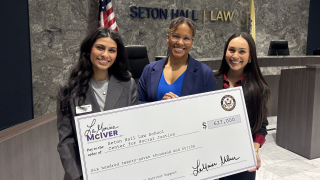
From left, Henna Shah '26, Family Law Clinic Professor Lissette Diaz and Kayla Bowie ’26.
Then there was the clinic, supervised by Professor Lissette Diaz, where Shah finally
got to be a lawyer. Diaz placed enormous trust in her students while holding them
to the highest ethical standards and, crucially, let them find their own voice. "I've
worked for partners before who want you to say things the specific way that they want
them to be said," Shah says. "Professor Diaz never did that. She always allowed us
to be our own attorneys." It was Diaz's license on the line the whole time. That generosity
wasn't lost on her.
She became SBA president, representing students to faculty, administrators and the
wider campus. When a dispute over the law school's free expression policy left students
worried their voices would be silenced, Shah helped navigate a solution. "My client
was the student body," she says. "Being able to be a part of that solution meant so
much to me."
After graduation, Shah plans to practice family law, the field she first encountered
as an undergraduate intern. "Giving a voice to real people is important to me," she
says. In a world where clients may increasingly turn to AI for answers, she believes
human connection remains irreplaceable—especially in family law, where clients arrive
at some of the worst moments of their lives.
She insists the achievement belongs to more than just her. “This success is not mine
alone,” she said. “It belongs to the people who supported me and made this possible.”
She may see herself as only one part of a larger story, but to the generations who
came before her, she is the realization of a dream they helped build.
For more information, please contact:
Office of Communications and Marketing
(973) 642-8714
[email protected]