 Photo by Sean Sime
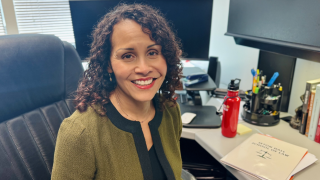
Dean Ronald Weich reads for pleasure the same way he leads: with an eye toward justice,
history and the human stakes of the law.
What does a law school dean read for fun? For Ronald Weich, dean of Seton Hall School
of Law, the answer is more law—but the kind that brings history, justice and storytelling
to life.
His summer reading list reflects that balance. In a recent conversation, Weich shared six titles that move between biography, legal drama and literature, offering a window into how he thinks about the law beyond the classroom and the courtroom.
“I spend so much of my professional life reading for work,” he said. “So I try to carve out time to read for pleasure.” That time often comes during his commute, when he turns to audiobooks. “I listen while I’m driving—that’s when I have the time,” he said. “And in some ways, it’s just as effective. You still absorb the material.”
Taken together, the books chart a path through America’s legal conscience, with an unexpected turn into a stark post-apocalyptic landscape. What connects them is a shared emphasis on understanding the law within a broader social and historical frame. “Law students and lawyers should want to understand law in context,” Weich said. “It’s not just about representing clients. It’s about understanding the role of law in our society.”
That perspective is reflected in his selections. Historical figures such as Thurgood Marshall and Peter Rodino, he said, demonstrate how the law can be used to advance justice and strengthen democratic institutions. Works by Scott Turow and Harper Lee bring the human stakes of the courtroom into focus, while Cormac McCarthy’s fiction offers a stark reminder of what can be lost when order and accountability break down.
Weich’s current reading extends beyond the summer list. He is listening to Jill Lepore’s Pulitzer Prize-winning “We the People: A History of the U.S. Constitution,” on the creation and amendment of the Constitution. But Weich is quick to point out that reading goes well beyond the law library. On his Kindle, he is reading “John and Paul: A Love Story,” which explores the creative partnership between John Lennon and Paul McCartney.
“I don’t only read about the law,” he said. “I have a lot of other interests.” It is a point he underscores with students as they begin law school. “Make time for friends and family. Go to museums, work out and root for your favorite sports team,” he said. “It’s important to have a well-rounded life.”
In that sense, the list is more than a set of recommendations. It reflects a broader philosophy: that a legal education—and a legal career—are strongest when grounded in curiosity, context and balance. His summer reading list makes the case with the following compelling titles.
NON-FICTION
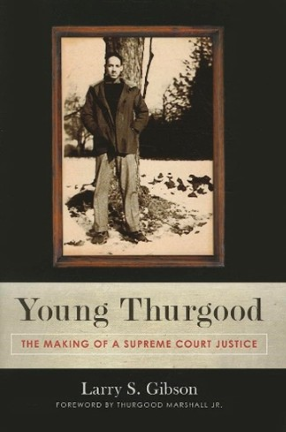 Young Thurgood: The Making of a Supreme Court Justice by Larry Gibson
Dean Weich’s connection to this book is deeply personal. Written by University of Maryland law professor Larry Gibson, “Young Thurgood” chronicles Thurgood Marshall’s early years as a practicing attorney in Baltimore, long before Brown v. Board of Education and his ascent to the Supreme Court.
“I’ve long been fascinated by Thurgood Marshall,” Weich said. “He became a lawyer at a time when African Americans did not have an easy path into the profession.”
The injustice was both stark and local. Marshall was denied admission to the University of Maryland School of Law under its segregation policy. “He earned his degree from Howard University School of Law in Washington D.C. and commuted by train,” Weich said. “It’s unbelievable that he was barred from attending that law school.” Marshall would later bring the case that integrated the very institution that rejected him. “He ultimately prevailed,” Weich said.
As a young lawyer, Marshall was resourceful and determined, taking on criminal cases and contract disputes while piecing together a living. “At one point, he worked in the city morgue to make ends meet,” Weich said. Guided by his mentor Charles Hamilton Houston at Howard, Marshall went on to litigate civil rights cases across the South, helping reshape the country.
For Weich, who lived and worked in Baltimore for years, the book offers an intimate
view of the neighborhoods where Marshall grew up and studied. It also carries a personal
connection. “I worked with his son, Thurgood Marshall Jr., in Senator Edward Kennedy’s
office in the 1990s,” he said. He met the justice once, while accompanying Kennedy
to the Supreme Court. “He was older then, but still a gifted storyteller,” Weich said.
“He and Senator Kennedy shared powerful memories from the civil rights era. It’s a
moment I’ve never forgotten.”
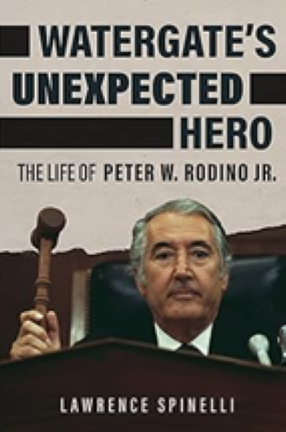 Watergate's Unlikely Hero: The Life of Peter W. Rodino, Jr. by Lawrence Spinelli
When Weich arrived at Seton Hall Law, he noticed that the library bears the name of Congressman Peter W. Rodino Jr. He realized there was more to learn.
“I knew he chaired the House Judiciary Committee during Watergate, but I didn’t know much beyond that,” Weich said.
Lawrence Spinelli’s biography fills in the story of a Newark-born lawyer who used the law in practice and in Congress to serve the public.
“He began as a practicing lawyer in Newark and then was elected to Congress,” Weich said. “He used the law to improve the lives of many New Jerseyans and was deeply engaged in civil rights and immigration reform.”
Rodino’s role in Watergate was both pivotal and measured. “He helped uncover the crimes committed by Richard Nixon and approached the impeachment process with great care,” Weich said. Nixon resigned before impeachment proceedings concluded, but Rodino’s leadership helped shape that outcome.
For Weich, the book complements a broader interest in legal figures tied to places
he has lived and worked. Just as “Young Thurgood” illuminates Baltimore, “Watergate’s
Unlikely Hero” brings Newark’s legal history into focus.
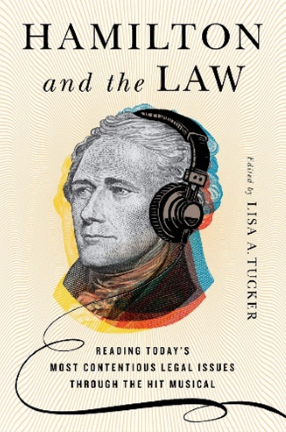 Hamilton and the Law: Reading Today's Most Contentious Legal Issues Through the Hit
Musical by Lisa Tucker
Hamilton and the Law: Reading Today's Most Contentious Legal Issues Through the Hit
Musical by Lisa Tucker
Framed by a Broadway phenomenon, this book is grounded in serious scholarship. A collection of essays by legal scholars, it uses Lin-Manuel Miranda’s “Hamilton” to examine some of the most contested issues in American law today. Weich came to it as a fan of the musical. “I love Hamilton,” he said. “That interest led me to explore Alexander Hamilton more deeply.”
That love deepened into an intellectual fascination with the historical Alexander Hamilton—a journey that included listening to Ron Chernow's full biography of Hamilton. "What an interesting figure in American history, and he played such a role in the development of the American Constitution."
The musical, Weich argued, is essentially about law from start to finish. "Everything about the musical is about law." The book’s essays explore that connection from every angle: issues ranging from immigration to race and slavery. “The Constitution deferred the question of slavery rather than resolving it, kicking it down the road,” Weich said.
One essay on the legal culture of dueling in the founding era delighted Weich. "There was a whole set of rules and regulations surrounding duels. Dueling was illegal in New York." In the musical, Hamilton and his son joke about crossing the river to duel in New Jersey because "everything is legal in New Jersey," Weich laughed. "We have to appreciate that."
His former colleague Liz Keyes, a professor at the University of Baltimore, contributed
an essay on immigration law through Hamilton's story. Her angle—that Hamilton was
"treated like an immigrant" even though the Caribbean islands he came from were British
colonies—resonates differently in today's political climate. "It reminds us how important
immigration was in the birth of the nation," Weich said. "We're a nation of immigrants.
The stew that is America, the great melting pot—the musical and this book illustrate
the importance of immigration in building the United States that we know today."
FICTION
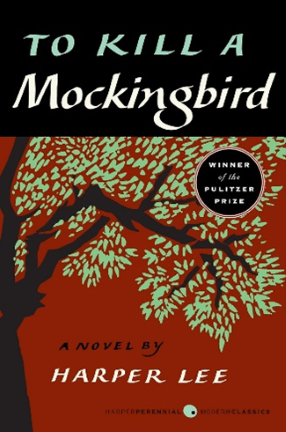 To Kill a Mockingbird by Harper Lee
Harper Lee's 1960 masterpiece “To Kill a Mockingbird” needs little introduction—but Weich's take on it reminds you why it still belongs on every reading list for what it reveals about the law’s moral dimension.
"It's the story of the law as a vehicle for morality," he said. Atticus Finch, the small-town Alabama lawyer who defends a Black man wrongly accused of rape in a Jim Crow courtroom, remains “a role model for young lawyers everywhere.” He's a fictional role model—Weich acknowledged the distinction— “but he represents the ideal of someone who does the right thing in a community that did not welcome his defense of that man. He had a quiet dignity. Atticus Finch was doing the right thing.”
The defendant is ultimately convicted—unjustly. But the novel doesn't flinch from
that reality, and neither does Weich. The power of Finch's example doesn't depend
on a happy verdict. Asked whether the book or the 1962 film adaptation with Gregory
Peck is better, Weich didn't hesitate: "I think the book really stands." He added,
"It's a deeply affective work by somebody who didn't replicate that success. And she
was a pioneering female author writing about this as a person who grew up in the South
herself. She understood the injustice that Atticus Finch was fighting. It's a beautiful
book and so touching in many ways."
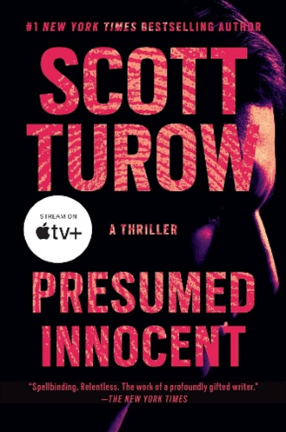 Presumed Innocent by Scott Turow
Scott Turow occupies a special place in Weich's literary world. "I've read several Scott Turow books," he said. "He's a great writer who writes with the insight of a practicing lawyer."
Presumed Innocent, published in 1987, is Turow's fiction debut—a courtroom thriller centers on a prosecutor accused of murder—unfolds as a tightly constructed courtroom drama.
What makes Turow different from other legal thriller writers, Weich argued, is authenticity. "You can tell he understands how the legal system works. It's very true to life. There's just a lot of legal maneuvering in the book that only a lawyer would know about—the complexity of a trial and of life."
Weich contrasted Turow favorably with John Grisham, the other titan of the genre. "Grisham is sort of Turow's partner in publishing books about the law. I've never quite gotten into Grisham since I find Turow’s plots more intricate."
“Presumed Innocent,” Weich said, captures something fundamental about what makes a trial dramatic: "No one writes the script for a trial. But Turow is able to show the trial strategy and unexpected results during a trial. There are many plot twists that make the book a very compelling read, but ultimately it's about the law as strategy, which I think is fascinating."
Weich also recommends a second Turow novel “Identical,” in which identical twins share
the burden of a murder conviction, alternating time in prison for the crime. "I remember
that one being intriguing," he said. Turow had also written “1L,” a nonfiction account
of his first year at Harvard Law School, which Weich called "worthwhile in itself."
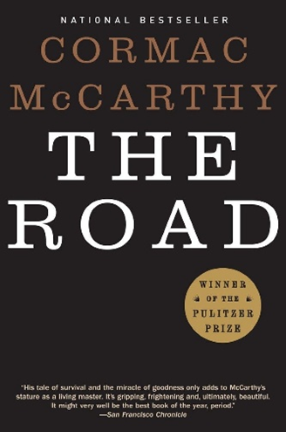
The outlier on the list—and perhaps the most surprising choice from a law school dean—is Cormac McCarthy's searing, Pulitzer Prize–winning novel about a father and son surviving in a post-apocalyptic America. There are no courtrooms here, no lawyers, no statutes. That, Weich said, is precisely the point.
"This is an odd one because it's not about the law at all. I included it because what it's about, in my view, is the absence of law.”
In the world of The Road, some unnamed catastrophe has destroyed civilization. The two protagonists wander through ash and ruin, encountering bandits and murderers, witnessing destruction at every turn. "It's imagining a world without law, and that is a horrible place," Weich said.
He reached for Hobbes—after a brief detour through Friedrich Nietzsche—to articulate what McCarthy is showing us: life without social contract is "nasty, brutish and short." In the novel, "the father tries to protect his son from brutish forces that are unconstrained by law. You realize the importance of law in establishing order and safety in our society—not just criminal law, but an understanding of how society is to be ordered. Otherwise, we're all on our own and selfish instincts lead to brutalization." He concluded, “I include that book to say: we need law. To me, it's a cautionary tale about what life could be like if we didn't have the law to guide our interactions with each other in this society.”
For more information, please contact:
Office of Communications and Marketing
(973) 642-8714
[email protected]