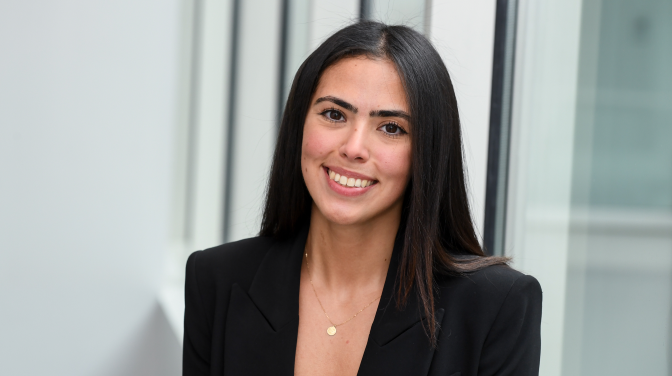
 Photo courtsey of Salma Mohamed
Proud first-generation Egyptian Moroccan American Salma Mohamed turned the impossible
into possible, building a legal career that honors her family values.
Salma Mohamed answered the phone from her honeymoon in Puerto Rico, newly married,
days away from graduating from Seton Hall School of Law and already reflecting on
how far she had traveled to arrive at this moment. Calling from Rio Grande, she spoke
with the calm certainty of someone who had spent years learning to trust her own place
in the world.
For Mohamed, the journey from a working-class home in Harrison, New Jersey, to a future
in big-law employment practice was never simply about personal achievement. It was
about honoring sacrifice, expanding representation and proving that belonging is not
something granted by others.
"I'm the eldest daughter of a Muslim Arab family," she said. "And that came with its
own challenges." Her father Ashraf emigrated from Egypt, her mother Jamila from Morocco.
They met in the United States, where they built their lives through hard work, faith
and an unwavering belief in education. "My parents always told me education is the
most important thing because no one can take it away from you," Mohamed said. "So
work hard for it."
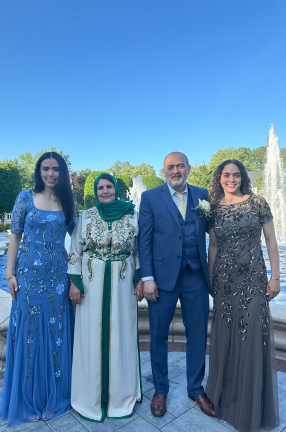
Salma Mohamed, far left, with her family: Jamila, Ashraf and Fatma.
Growing up, Mohamed was the only Muslim Arab girl in Harrison. At Rutgers University,
she majored in political science and communications and embraced the identity by joining
the Arab Cultural Club. Her interest in law sharpened at 16, during the first Trump
administration and the rollout of policies like the travel ban targeting several Muslim-majority
countries. "I started realizing how much the law impacts people's lives in ways people
don't even recognize," she said.
Rutgers eventually led her to Seton Hall's Pre-Legal Program, a summer immersion designed
to simulate the demands of first-year law school. For Mohamed, whose family had no
lawyers or judges, the experience changed everything. "It gave me confidence that
law was something I could actually do," she said. "As a first-generation student,
I was intimidated. It felt impossible at first."
After graduating from Rutgers and spending a gap year as a legal assistant, Mohamed
arrived at Seton Hall Law as part of the Legal Education Opportunity program, known
as LEO. The program's director, Assistant Professor Melanie Perez-Vellios, helped
demystify the mechanics of legal education before classes even began. "I don't think
I would have been as successful without LEO," Mohamed said. "It really set me up for
success."
Even so, law school tested her confidence. During her first year, she spent nearly
every day on campus while her family quietly built a support system around her. Her
mother cooked meals daily and kept her room in order. Her parents drove her to school
in the morning and picked her up at night. "They were my emotional anchor," she said.
"Whenever I panicked, they'd remind me that I'd overcome hard things before." She
still describes her family as her "why." "I'm working hard because I want to make
my family proud," she said. "That got me through the hardest moments."
When her first-semester grades arrived, Mohamed could barely look at them. "My hands
were shaking," she recalled. "Then I saw them and knew I made it." Her academic performance
quickly opened doors. She secured a law firm position after her first year, an opportunity
many students spend years pursuing. At Seton Hall, she found herself especially drawn
to constitutional law taught by Professor Jenny-Brooke Condon. Later, in Professor
Lissette Diaz's Family Law Clinic, she won a bench trial representing a client. "That
experience really affirmed my commitment to helping people," she said.
Outside the classroom, Mohamed served as vice president of the Muslim Law Student
Association, advocating for Muslim students to feel fully included in campus life.
When commencement was initially scheduled on Eid, student leaders raised concerns
and pushed the administration to reconsider. The organization also advocated for stronger
Ramadan accommodations, similar to those at peer law schools. "We have to be heard,
and we have to be seen," Mohamed said. "Progress has been made, but we can always
do better."
She is equally determined to challenge misconceptions about Muslim women. "My father
always wanted my sister Fatma and me to be educated, independent and financially self-sufficient,"
she said. "He's always encouraged me to have a career and be a working woman." To
Mohamed, that support is not unusual. "Some of the strongest women I know are Muslim
women in my family," she said. "They work hard, take care of their families and lead
in every part of their lives."
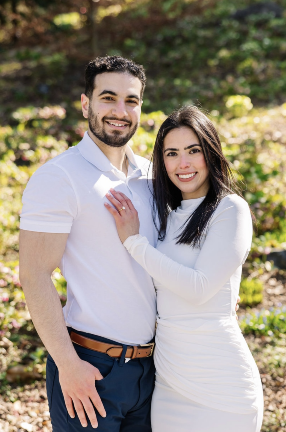
Salma Mohamed, right, with her husband, Dr. Osama Mahmoud.
Her husband Osama Mahmoud, a Muslim physician whose family is from Jordan and Palestine,
shares that same understanding of faith, education and service. Their marriage, Mohamed
said, feels like an extension of the values both families prioritized: professional
ambition grounded in community, compassion and cultural pride.
This fall, Mohamed will join Faegre Drinker Biddle and Reath LLP in Florham Park,
practicing employment law. She chose the field because it keeps her connected to the
human side of legal work. "It involves people at really important moments in their
lives," she said. "That's what drew me to it." She also plans to pursue pro bono work,
especially for people who lack access to legal knowledge or representation. "Knowledge
is power," Mohamed said. "I want to help make that accessible to people who don't
have it."
If she could change one thing from the world, she said, it would be imposter syndrome—the
quiet belief that some people do not belong in the rooms they fought to enter. Mohamed
understands that feeling intimately. She also understands now that it was never true.
Before beginning her legal career, she and her husband plan to travel to Jordan, Spain
and Morocco, reconnecting with both sides of their family history before returning
home to New Jersey. The timing feels fitting: law school completed, marriage begun,
and a future once unimaginable now firmly within reach.
She leaves Seton Hall Law carrying more than a degree. She carries the sacrifices
of two immigrant families, the expectations of a community often misunderstood and
the confidence to walk into every room knowing she earned her place there.
For more information, please contact:
Office of Communications and Marketing
(973) 642-8714
[email protected]