Photo courtesy of Wendy Xia.
Wendy Xia reflects on a path shaped by type A discipline, health law scholarship and
a commitment to expanding access to care.
Ask Wendy Xia how her fiancé Daniel Zhou proposed, and she will tell you she figured
it out before he could finish planning it. It was spring break in Hong Kong. Zhou
had arranged a romantic itinerary—two carefully chosen restaurants and a ring in his
pocket. What he did not account for was Xia.
“I can tell you booked two restaurants on this day, and that day I think we’re going
to be a little jet-lagged,” she told him, scanning the calendar. “So I’m pretty sure
the engagement is on the 16th, isn’t it?” He blinked. She was right. She usually is.
That is what it is like to be Wendy Xia: cheerful, self-aware and unapologetically
type A. She is speaking from Seoul, where she has squeezed in a trip to South Korea
and a visit with her grandparents in China during the 20 days between final exams
and graduation. It is early morning there, but she already sounds as if she has reviewed
her schedule twice. Her discipline—turning even a vacation into a logistical exercise—has
carried her through nine years of higher education, two advanced degrees and a career
path already taking shape in health law.
Xia grew up in Queens, N.Y., and later Livingston, N.J., the American-born daughter
of Chinese immigrants from Wenzhou who left China as teenagers, spent time in Brazil
and arrived in the United States with middle school educations and a firm belief that
their daughter would go further.
Her mother packed nutrient-dense food during exam weeks and sent articles about overworked
students who died young from exhaustion—a loving but unsettling reminder to slow down.
Her father worried that too much studying might drive a person crazy. When Xia complained
about the workload, her parents gave the same answer: "If it's too hard, you can quit.
We'll support you." Her answer never changed: "I can't quit."
She enrolled in a six-year pharmacy program at Rutgers University. In her final year,
she studied for the LSAT while working as a paralegal for Professor Satish Poondi,
who held both pharmacy and law degrees—proof, she recalls, that the combination was
possible.
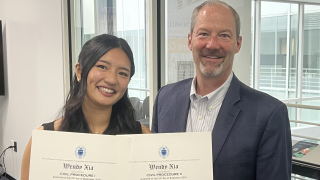
Wendy Xia, at left, with Professor Timothy Glynn.
She took her pharmacy boards the summer before law school and another licensing exam during her first year. None of it felt excessive. “I realized this was where I wanted to be,” she said. “I could make a bigger impact in a way that felt fulfilling.”
At Seton Hall School of Law, that conviction sharpened quickly. She earned an A-plus
in Civil Procedure and top marks in both Contracts and Lawyering. She credits Professor
Timothy Glynn with reframing Civil Procedure as strategy rather than doctrine. “Hearing
Professor Glynn talk so passionately about civil procedure, I knew I was in the right
place,” she said.
A common thread runs through her work: a law review note on Ozempic, a second-year
summer in pro bono health care work at Kirkland & Ellis and a health law concentration
under Professors Jacob Elberg and Anjali Deshmukh. For Xia, it all comes down to communication.
“A huge barrier to access is knowledge and the ability to communicate it to somebody
who might not have the background to understand,” she said. “They’re not incapable—they
just weren’t given the tools.” To students who assume health law requires a clinical
background, she is direct: “Health is everywhere in law. You can do anything you want,
and it can touch health.”

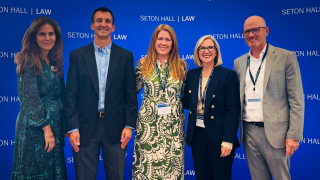
Wendy Xia, second from left, poses with Helena Rowe, Elyse Genrich and Julia Landi.
After the bar exam, Xia will join Kirkland & Ellis’ health care transactions team
in New York. Government service remains a longer-term goal. She is also building the
mentorship network she once had to assemble on her own. As one of relatively few East
Asian women in her cohort, she regularly hears from pharmacists, first-generation
students and Asian American professionals navigating law school for the first time.
The calls are scheduled for 30 minutes; they often last 90. “Passing that on only
serves to help people carry this forward together,” she said.
Even her type A tendencies, she has learned, have limits. Five days before finals,
her torts professor Abdul Khan told the class they would retain at most two or three
hours of new information that day. Eight-hour study marathons, he said, were counterproductive.
She agreed. “Your brain can only take in so much information,” she said. “Setting
goals and pacing yourself is important to avoid burnout.”
It is not a contradiction for Xia who reverse-engineered her own engagement proposal,
carefully planned a 20-day travel window and is already reviewing fertility benefits
in her future employer’s health plan. It is, in her view, the logic of sustainability.
“I treated it like my character arc period,” she said. “Everybody gets that moment
in the story. That was mine, so I could reach my goal.”
The call ends. Dawn is breaking in Seoul. Her grandparents in Wenzhou are waiting
for her visit. Graduation approaches. The bar exam follows. All of it mapped—right
on schedule.
For more information, please contact:
Office of Communications and Marketing
(973) 642-8714
[email protected]