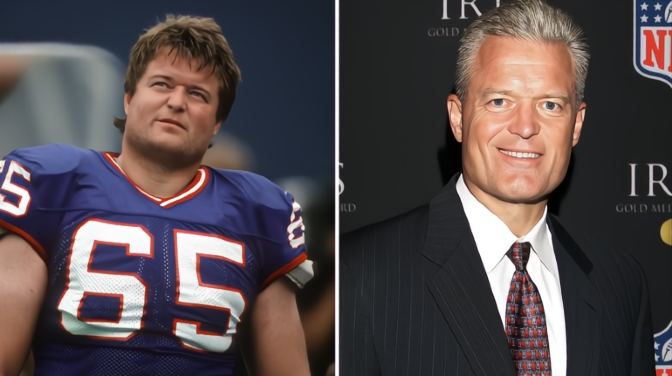
Credit: Getty
Three-time Super Bowl champion Bart Oates ‘90 built an unlikely second career while
still playing in the NFL — earning his law degree and launching a successful legal
practice. He reflects on preparation, perseverance and the purpose that shaped his
path from the football field to the courtroom.
Long before he became a three-time Super Bowl champion, Bart Oates ’90 was a quiet,
shy kid from southwest Georgia who never imagined he would play in the National Football
League (NFL).
“I was this little, chubby kid from Georgia who really had no business being in the
NFL,” Oates said. “And yet I found quite a bit of success.”
That success would include 11 seasons in the NFL, 172 games and three Super Bowl titles
— two with the New York Giants and one with the San Francisco 49ers. But football
was never the only path Oates envisioned. While anchoring offensive lines on Sundays,
he was also preparing for a second career.
“I didn’t think I would have the opportunity to play in the NFL for very long,” he
said. “so my education was always important.”
Oates earned an accounting degree from Brigham Young University and always planned
to attend law school, whether football worked out or not. The NFL, he said, provided
discipline and resources that helped him pursue both goals. For Oates, the transition
from NFL locker rooms to legal practice was never accidental. It was part of a master
plan he had been building throughout his life.
He enrolled at Seton Hall Law School in 1986 while playing for the Giants, completing
the program over five years and graduating magna cum laude in 1990. “I wound up going
to five years of law school, graduated, took the bar exam and practiced during the
offseason for five years,” he said. “The combination of accounting and legal training
gave me a strong foundation for life after football.”
During those years, Oates also played under legendary coach Bill Parcells, whom he
remembers as a great motivator — and a tease. “He wanted to make sure that when someone
was in a game, they wouldn’t fold under pressure. Everyone was held accountable,”
Oates recalled. “If I made a mistake, he’d tease, ‘Counselor, were you studying your
law books and didn’t have time to study your playbook?’ Parcells’ ribbing was his
way of showing respect for my academic pursuits. I missed the first two days of summer
camp because I was taking the bar exam, but when I arrived, Bill stopped the team
meeting to welcome me back,” he fondly remembered.
Balancing law school with professional football require extraordinary discipline.
Because his playing schedule prevented him from moving through classes with a consistent
group, Oates often attended alone — a “cohort of one,” as he described it.
Still, he formed lasting relationships, including fellow student Vince Reppert, who
played football at Syracuse University and is now his law partner. “I’ve been very
fortunate to be one of many, many people who have been positively impacted by Seton
Hall Law,” he said.

Bart and Michelle Oates
Amid the demands of football and law school, Oates praised his wife Michelle and family
for anchoring him through the juggling act. “She should really have gotten the degree,”
he complimented his wife. “She supported me and made sure there were a lot of things
I didn’t have to worry about at home.” Despite the packed schedule, those years allowed
him to spend meaningful time with his children.
The former center has since built an influential career in New Jersey as an attorney
and entrepreneur. His firm, Reppert Oates & Vytell, handles commercial matters, including employment and health law, and also assists
former players with navigating benefits.
Whether on the football field or in court, Oates attributes much of his success to
preparation.
“I would take game film home after the team review and spend hours each week looking
for small clues that might give me an edge over our opponents,” he said. “That attention
to detail allowed me to have a long, successful NFL career, even if I wasn’t as athletically
gifted as some of the other players I faced.”
He advises law students and young attorneys to focus on character as much as professional
skill. “Don’t let your ego get in the way. Never lose sight of your purpose. Don’t
compromise your integrity. And be grateful.”
Stress, he added, is inevitable—but it can also be a powerful driving force. “Stress
comes from a fear of failing. That fear can prevent you from pushing yourself and
growing,” he said. “Embrace it. Let it motivate you to work harder and be better prepared.”
Looking back, Oates recognizes that his journey — from a small Georgia town to the
NFL and the legal profession — may seem unconventional. Yet he believes every path
is unique. “Everybody’s journey is unique,” he said. “You have to ask, ‘What is my
purpose? What do I want to be remembered for?’”
For Oates, true accomplishment comes not from championships alone but from preparation,
perseverance and meaningful work beyond the final whistle. “I didn’t win every play
I was in, nor every case,” he said. “It’s about your preparation and being willing
to put it all on the line, give it your best, and never give up—that’s what matters.”
Oates said he hopes one day to return to the classroom. “If I could, I would still
like to teach on a professional level,” he said. “Sharing knowledge with the next
generation of lawyers would be the ultimate fulfillment. At the end of the day, success
is about being prepared, giving your best, and finding satisfaction in the work you
do.”
For more information, please contact:
Office of Communications and Marketing
(973) 642-8714
[email protected]