(c)Seton Hall University
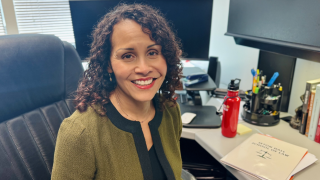
At Seton Hall Law, Elizabeth Carter is reshaping legal practice to center women —
especially Black women, youth, low-income and working-class people, and other marginalized
communities — as drivers of economic power. Through “rebellious lawyering” and community
wealth-building tools such as cooperatives and community investment vehicles, she
is expanding access, ownership and opportunity of business and real estate, showing
a path toward resilience, abundance and community ownership of neighborhood assets.
Professor Elizabeth Carter was 18 when she first started asking why. As a political
science student at the University of Michigan, she watched classmates from vastly
different economic backgrounds move through the same campus with unequal footing.
That early curiosity — about who benefits and who is left out — stayed with her through
law school, into transactional practice in New York City, Newark and Chicago and eventually,
back to Newark through Seton Hall University School of Law where she teaches as an
associate professor and founding clinical director of the school’s Community Wealth Building Transactional Law Clinic.
“I always had an interest in using the law to increase the agency of marginalized,
low-income people,” Carter said in a recent interview. “I found a way to do it through
transactional law.”
Her work sits at the intersection of legal practice, community organizing and what
she calls “rebellious lawyering,” a philosophy that treats clients as collaborators,
not recipients. In her clinic, students draft contracts, form businesses and advise
clients, but they also work alongside community organizers and organizations leading
socioeconomic movements tackling systemic inequities. “We’re combining our work with
people on the ground who are aiming to change their neighborhoods,” she said. “We
become part of the strategy with them.”
The clinic, capped at eight students, handles matters ranging from cooperative business
formation to neighborhood economic development. One current project supports a group
working to open a food cooperative in a community without a grocery store. Carter
is deliberate about how she frames that reality.
“‘Food apartheid’ reflects intentional divestment,” she said. “‘Food desert’ makes
it sound accidental.” That distinction is central to her work. Communities are not
bypassed by chance, she argues, but through systems that intentionally redirect investment,
limit access to capital, and extract resources from low-income, marginalized communities
without reinvesting or restoring resources back into those communities where residents
have an opportunity to lead, control and own community economic initiatives.
“When banks decide to fund businesses, they’re not in these neighborhoods,” Carter
said. “Or if they are, they’re there to get deposits, but they’re not lending.” Those
patterns hit Black women in these communities the hardest. Carter has spent years
studying and supporting self-employed Black women workers, a marginalized group navigating
structural barriers that shape both employment and business ownership at the local
and national level.
Black women are more likely to be heads of household and often face wage gaps, limited
advancement opportunities and workplace bias. Recent shifts in the labor market and
rollbacks of diversity initiatives have pushed many out of traditional employment.
Over the past year, employment among Black women professionals has fallen sharply,
according to The New York Times.
“You have a domino effect,” Carter said. “When Black women are disregarded in the
workplace, their households and communities feel it, too.”
Many turn to self-employment, but starting a business introduces another challenge:
access to capital. Without intentional networks or institutional backing, raising
funds can be difficult—nearly impossible.
“That’s not happening for women, period — but especially not for Black women,” she
said. “Even when they access capital, it’s often far below what they actually need.”
Carter’s response is rooted in rethinking ownership. Through her rebellious legal
work centering affected communities, she has helped develop a unique model known as
a holding cooperative — a hybrid structure that allows workers to pool resources and
share ownership of various businesses, simultaneously.
One example is a worker cooperative formed by a group of self-employed Black women
workers. They are combining and leveraging their business assets to form a holding
cooperative that will allow them to mitigate risks and secure funding collectively.
The model blends elements of a holding company with a worker cooperative, enabling
members to jointly own commercial space in their communities.
“In typical commercial real estate, you have landlords and tenants,” Carter said.
“In this case, the tenants are the landlords.” Ownership, she argues, is key to long-term
stability. When people have a stake in their neighborhoods, they are less likely to
be displaced and more likely to invest in sustaining them. “We’ve found that ownership
and control promote sustainability,” she said.
The results are not always easily measured. Financial hurdles remain, and scaling
these models takes time. But Carter points to less tangible outcomes: collaboration,
shared knowledge, and a reimagining of what is possible. “It gives women more than
hope,” she said. “It gives them a vision they can work toward — not just for themselves,
but for others.”
That vision carries into her classroom. At Seton Hall Law, Carter incorporates “case
rounds,” where students present real client issues and receive feedback from peers
acting as co-counsel. The approach builds practical skills while reinforcing collaboration.
Managing the clinic, she said, is akin to supervising a team of junior associates
— with an added responsibility to teach through mistakes. “In practice, it’s faster
— you fix it and move on,” she said. “Here, you have to slow down and help students
learn how to get it right.” For Carter, that teaching mission is inseparable from
a broader goal: expanding who the law serves—and who shapes it.
As conversations around equity and representation continue, she keeps her focus on
the gaps that remain, especially for women navigating systems never designed with
them in mind.
“We still have institutions that don’t reflect the communities they serve,” she said.
Her work offers a counterpoint: a model of law grounded in partnership, ownership
and access. It is not law from above, she emphasizes, but law built alongside the
people most affected by it.
That approach continues to define her work today and her vision for a legal system
that better represents, and responds to, the communities it serves.
For more information, please contact:
Office of Communications and Marketing
(973) 642-8714
[email protected]