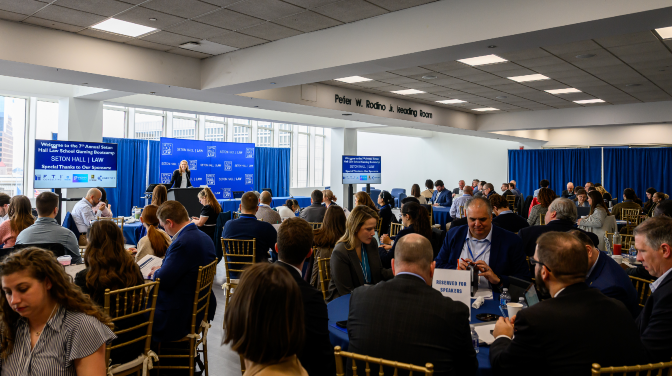
The Gaming Bootcamp attendees in the Peter W. Rodino, Jr. Law Library Center. Photo by Sean Sime
The annual Gaming Bootcamp convenes regulators, operators and lawyers from across
the country to examine compliance, ethics and consumer risks in the fast-changing
legal landscape of the multibillion-dollar sports betting industry.
The gaming industry is evolving rapidly, and the regulators, lawyers and operators
tasked with overseeing it are racing to keep up. At Seton Hall University School of
Law, a three-day intensive Gaming Bootcamp—now in its seventh year—has grown from a regional experiment into a national forum,
examining the legal and ethical stakes of modern gambling.
Participants this year traveled from across the country, including California, New
Mexico, Kentucky, Nevada, Illinois and Ohio. What began as a New Jersey–New York initiative
now convenes the industry’s finest to examine the changing landscape of legalized
sports betting. Professor Devon Corneal said the program has effectively become “a
national compliance program.”
The Bootcamp emerged after the U.S. Supreme Court’s 2018 decision in Murphy v. NCAA,
which struck down the federal Professional and Amateur Sports Protection Act, or PASPA,
and allowed states to legalize sports betting. Since then, the industry has expanded
dramatically.
“We’ve seen almost 40 states and territories allow sports betting,” Corneal said.
“It caused exponential growth in the gaming industry.” The ruling dismantled the long-standing
Nevada-centric model and replaced it with a patchwork of state regulatory systems
that operators must navigate.
Former Dean Kathleen Boozang recognized early that the shift would demand new compliance
expertise. Working with the law school’s advisory council, she launched the Gaming
Bootcamp to help operators build businesses that meet evolving regulatory expectations.
The aim, Corneal said, was to help the industry make “good, compliant and ethical
choices.”
Over three days, the Bootcamp brings together nearly every segment of the gaming ecosystem
to examine what a compliant industry looks like in practice. Panels explore licensing
across dozens of regulatory regimes, cross-border operations and the wide variation
in gambling laws—from states such as Utah and Hawaii that prohibit most forms of gambling
to jurisdictions that allow online betting, casinos and sportsbooks. Sessions also
examine practical issues including cybersecurity, data privacy, workplace culture
and consumer protection.
For companies operating nationwide—such as FanDuel, BetMGM and Penn Entertainment—the
regulatory burden can be substantial.
“They have to make sure they aren’t violating any of the rules in any of those states,”
Corneal said.
Behind the scenes, compliance systems have grown increasingly sophisticated. Panels
highlight anti–money laundering (AML) controls, “know your customer” verification
programs and geolocation technology that blocks bets from prohibited jurisdictions.
A modern sportsbook, Corneal noted, often collects extensive customer data. “They
might know more about you than your bank,” she said, emphasizing the need to protect
that information while using it responsibly to detect suspicious transactions, prevent
money laundering and identify problematic gambling behavior.
The Bootcamp also confronts the industry’s challenges, including youth exposure, addiction
and rapidly evolving products. Corneal said the ubiquity of smartphones and mobile
betting apps—often promoted through celebrity-heavy advertising—has made gambling
more accessible than ever. “I have an 18-year-old,” she said. “I wonder how addicted
he is to his phone and what the impact will be of having access to gambling 24/7.”
One of this year’s most discussed topics was the rise of prediction markets such as
Kalshi and Polymarket. These platforms allow wagers on future outcomes—including events
resembling sports bets—but operate under federal commodities regulation rather than
state gaming laws. That regulatory gap has raised concerns among industry experts.
"At the Bootcamp, you’re in a close-knit environment, where participants can find themselves bumping elbows with people at the top of regulatory and operating hierarchies across the country."
Drew Jacobs
Drew Jacobs, a Seton Hall Law alumnus and a consultant for the Bootcamp, called prediction markets a new challenge to the industry. “With so many alternatives to regulated gambling products,” he said, “it becomes a real gray area and it ends up hurting consumers.” Some platforms allow users as young as 18 to participate, even in states such as New Jersey where licensed sportsbooks require bettors to be 21.
Consumer protection remains central to the Bootcamp’s discussions. Sessions on responsible
gambling examine strategies to prevent addiction, sometimes featuring individuals
in recovery who share firsthand experiences. Corneal said the topic runs through broader
conversations about legislation and oversight.
“We’re talking about what states are doing to ensure minors are protected and not
doing things they shouldn’t,” she said, adding that the industry must balance the
entertainment value of sports betting with its responsibility to prevent harm and
support players who may need help.
The Bootcamp also serves as a learning laboratory for students. This year, 14 Seton
Hall Law students attended as part of a one-credit intensive course, exploring sports
integrity, regulatory enforcement and emerging legal theories in gaming law. Students
are intentionally integrated into the program’s networking environment. “We force
them to sit at a table with experienced professionals in the industry and get to
know them,” Corneal said.
Panelists are generous with students, often offering mentorship or career advice.
Jacobs said the setting differs from large industry conferences that can feel overwhelming.
“At the Bootcamp, you’re in a close-knit environment,” he said, where participants
can find themselves “bumping elbows with people at the top of regulatory and operating
hierarchies across the country.”
Speakers frequently pause to address the students directly, encouraging them to consider
careers in gaming law—from regulatory agencies and law firms to in-house positions
with operators or policy organizations shaping future rules.
The industry’s pace ensures the Bootcamp’s curriculum continues to evolve. During
a networking event this year, Corneal recalled, a Kentucky regulator leaned over to
note that a new gaming bill had been introduced in her state just an hour earlier.
Moments like that underscore how quickly the legal landscape can shift.
Future Bootcamps are expected to explore emerging issues such as tribal gaming, sweepstakes
models and new enforcement developments, and will continue to feature speakers from
federal investigators and state regulators.
For Seton Hall Law, the Gaming Bootcamp reflects a broader strategy of pairing professional
education with meaningful student engagement—an approach long used in the law school’s
healthcare compliance programs. “To be able to marry those together in one place is
really unique,” Corneal said.
As the gaming industry continues to expand—and confront new legal and ethical questions—the
Bootcamp has positioned Seton Hall Law at the center of the conversation.
For more information, please contact:
Office of Communications and Marketing
(973) 642-8714
[email protected]