Speakers at the Housing Justice Summit said New Jersey’s tenant protections are undermined
by rent-deposit requirements, screening databases and uneven enforcement. They called
for greater access to counsel and stronger legislation.
New Jersey has laws to protect tenants, but exercising those rights can be difficult.
On Friday, more than 100 lawyers, law students, advocates, tenants and policymakers
gathered at Seton Hall University School of Law for the first day of the fourth annual
Housing Justice Summit, co-hosted by Seton Hall Law and Rutgers Law School. The central message was clear: Legal protections mean little if tenants cannot enforce
them.
In his opening remarks, Seton Hall Law Dean Ronald Weich highlighted the difficulty
tenants face in affording and keeping their homes. “We all know there’s a housing
crisis in this country,” he said, pointing to law school clinics, advocacy and programs
such as the summit as ways to advance access to justice.
New Jersey Assembly Speaker Craig J. Coughlin praised students and advocates who assist
tenants facing eviction. He cited an additional $1 million appropriation for the Housing
Justice Project in this year’s state budget but acknowledged that more funding is
needed. “I’m sure that’s not enough,” Coughlin said. The state’s affordable housing
legislation is expected to produce about 50,000 units over a decade, but “that’s still
not going to be enough,” he said. “Standing up for people who need your help is what
we ought to do. I think that’s a moral obligation as well.”
Rights vs. Realities
The morning panel, “Rights versus Realities: The Current Status of New Jersey Tenant
Protections,” examined state safeguards against retaliation, the good-cause eviction
law, the implied warranty of habitability and local rent control ordinances. Seton
Hall Law Professor Lori Borgen and Managing Attorney Anne Kassalow placed those protections
in the context of New Jersey’s history of housing discrimination and segregation.
The discussion also covered recent changes to tenant-screening practices and eviction
records, as well as state restrictions on algorithmic rent-setting.
Seton Hall Law Professor Paula Franzese, a property law expert, questioned whether
the protections work in practice. “Housing is a human right. Full stop,” Franzese
said, arguing that addressing the crisis requires building more homes and removing
barriers that prevent tenants from asserting their rights.
New Jersey requires tenants raising certain habitability defenses to deposit with
the court the full amount of rent claimed by the landlord. Franzese said the requirement
can discourage tenants from challenging unsafe or unlivable conditions. She has spent
14 years urging lawmakers to repeal it. Citing a study of 40,000 eviction cases filed
in Essex County in one year, Franzese said tenants successfully raised habitability
as a defense in just 80 cases.
She also criticized private tenant-screening databases, warning that an eviction filing
can jeopardize a tenant’s ability to secure future housing even if the case is dismissed
or the tenant prevails. Access to counsel is another critical safeguard, Franzese
said, citing a report by Stout prepared for the Seton Hall Law Center for Social Justice
and ACLU of New Jersey. That report estimated that every dollar spent on eviction
right-to-counsel programs saves about $3. Franzese argued that tenants need practical
support to exercise their legal rights. “Right, without a champion, will ring very
hollow,” she said.
Shaping the Legislative Landscape
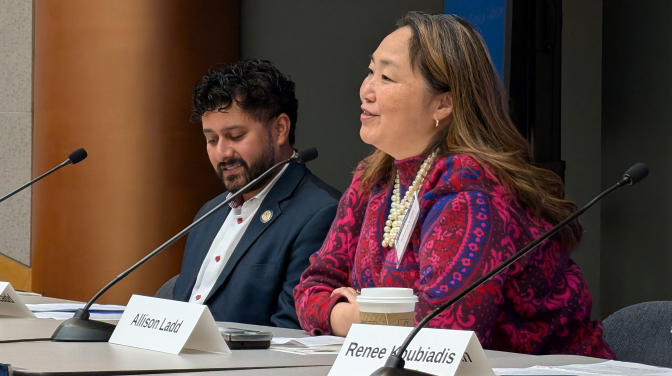
Associate Professor Khabirah Myers moderated a town hall featuring Assemblywoman Katie
Brennan, state Senator Raj Mukherji, Newark Deputy Mayor and Director of Economic
and Housing Development Allison Ladd, and Renee Koubiadis, senior policy adviser at
the New Jersey Department of Community Affairs. The panelists discussed two proposals
introduced during the 2026 legislative session. Neither had been enacted at the time
of the summit.
Assembly Bill A-3998 would require landlords claiming exemption from rent control
to provide supporting documentation and disclose the exemption’s expiration date in
leases. It would also establish a searchable public registry of exempt properties.
Brennan said tenants need clear information about whether rent control applies to
their homes.
A-5036, the “SLUMLORD Act” (Safeguarding Livable Units through Municipal Landlord
Oversight and Regulation by DCA), would establish a habitability enforcement and affirmative
litigation program within the Department of Community Affairs. It would also expand
remedies for serious housing violations, increase accountability for property owners
and agents, and appropriate $5 million. Mukherji sponsors the Senate companion bill.
Mukherji said complex corporate ownership structures can make it difficult to identify
those responsible for housing violations and secure repairs. He also discussed efforts
to require disclosure of beneficial owners. “At some point, there’s a human in the
chain,” he said.
Ladd described Newark’s enforcement efforts, including sending 1,400 noncompliance
letters and maintaining a public list of four property owners with repeated violations.
Landlords must resolve all outstanding violations to be removed from the list and
cannot receive city support while listed, she said. The City Council also unanimously
passed an ordinance allowing the city to recover code-enforcement costs from landlords.
Koubiadis said the Department of Community Affairs lacks direct legal authority to
enforce habitability standards. To help tenants navigate eviction proceedings, the
department launched an online guide connecting residents with information about their
rights, court procedures and legal service providers in all 21 counties. It is also
hiring staff for a centralized call center within its Division of Housing.
Panelists urged attendees to press elected officials for action. Mukherji said cases brought to him by attorneys have helped prompt changes to state law. “When we’re coming up with legislation, it’s really important that we hear from people who are doing the work,” he said.
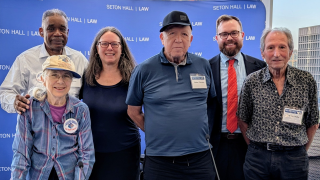
Second from Left, Center for Social Justice Director Lori Borgen poses with Bill Good, Nancy Zak, Felipe Chavana, Rutgers Law Professor Greg Baltz and Mitch Kahn.
Connecting Legal Advocacy and Community Action
Afternoon sessions explored how storytelling, appellate advocacy, education and tenant organizing can advance housing justice. Participants discussed how the experiences of Newark’s Terrell Homes community could inform advocacy, legal strategies to strengthen tenants’ rights, and education to help residents assert their rights.
Panelists represented Seton Hall Law’s Housing Justice Project, Community Health Law Project, Volunteer Lawyers for Justice, Essex-Newark Legal Services, Rutgers-Newark’s Cornwall Center, Homes for All Newark, the Newark Environmental Commission and the New Jersey Division on Civil Rights.
In the final session, veteran housing advocates Mitch Kahn of the New Jersey Tenants Organization, Felipe Chavana of Essex-Newark Legal Services, and Nancy Zak and Bill Good of the Greater Newark HUD Tenants Coalition shared lessons from decades of organizing, highlighting creative campaigns, collective action and coalition building to advance tenant protections.
Together, the sessions underscored the importance of effective enforcement, access to legal representation and sustained community advocacy in making tenant protections work in practice.
Day 2: Tenant Organizing and Legal Advocacy
For more information, please contact:
Office of Communications and Marketing
(973) 642-8714
[email protected]