Raised by Dominican immigrant parents, Professor Solangel Maldonado built a career
shaped by mentors who opened doors. Now, she is opening them for others.
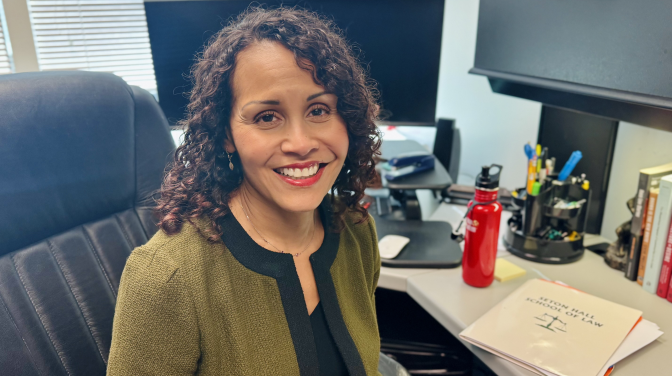
In her fourth-floor office at Seton Hall Law School, Professor Solangel Maldonado
keeps a photograph near her desk. Taken during her first year on the faculty, it captures
Maldonado with several fellow women faculty members. Twenty-six years later, it remains
a reminder of the people and opportunities that helped shape her path.
Today, Maldonado, the Eleanor Bontecou Professor of Law and former associate dean
for faculty research and development, is the law school’s only tenured Latina professor.
Her career has been defined by hard work and persistence, but also by mentors who
recognized her potential, sometimes before she recognized it herself.
Raised in Washington Heights by Dominican immigrant parents, Maldonado grew up in
a family of four daughters. Her father left school at 12 to work on the family farm.
Her mother came to the United States on a student visa but could not afford college.
The two met in an evening English class and married eight months later.
When Maldonado’s mother was pregnant with her younger sister, she took a bus down
Broadway to St. Luke’s Hospital, across from Columbia University. “That’s a very good
school,” she told her young daughter in Spanish. “Only white, rich kids go there.”
Maldonado, then about four, answered, “Well, I’m going to go there.” And she did.
Maldonado earned undergraduate and law degrees from Columbia, fulfilling what she
described as her mother’s dream. 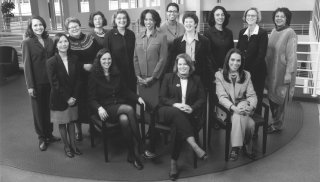 At Columbia Law School, Professor Carol Sanger invited her to a session for students
interested in becoming law professors. “I realized that I had not done the things
I needed to do,” Maldonado said. She had not served on law review or published, and
she had missed the deadline to apply for federal clerkships.
At Columbia Law School, Professor Carol Sanger invited her to a session for students
interested in becoming law professors. “I realized that I had not done the things
I needed to do,” Maldonado said. She had not served on law review or published, and
she had missed the deadline to apply for federal clerkships.
Following advice from a career services adviser, Maldonado called the office of Joseph
A. Greenaway Jr., then a judicial nominee for the federal bench who had not yet hired
a law clerk. She called at 6 p.m. expecting to get a voicemail. Instead, Greenaway
answered. Then they discovered they had attended the same elementary school years
apart. After interviewing her, Greenaway promised, “If I get confirmed, you have a
job.” When he asked why she wanted to clerk, Maldonado said she hoped to become a
law professor. “So, I’m a stepping stone?” he chuckled. Judge Greenaway became much
more than that. He is now one of Maldonado’s closest supporters.
His chambers also connected her to Seton Hall Law Professor Wilfredo Caraballo, who
later encouraged her to apply when the school needed a family law professor. Maldonado
was interested but told him she was not ready. “Opportunity only comes once,” Caraballo
responded. She began teaching in January 2001. Although she had studied family law
and completed a yearlong clinic, Maldonado had never practiced in the field. “It was
baptism by fire,” she said.
When Maldonado questioned whether she belonged in legal academia during her early
years on the faculty, Kathleen Boozang offered support. A member of the committee
that interviewed Maldonado for the position, Boozang encouraged her to present a paper
in Cuba and later urged her to teach trusts and estates, a course Maldonado had never
taken. “You can figure it out,” Boozang told her. Maldonado did—and came to love teaching
it.
Caraballo also helped Maldonado navigate the challenges of teaching family law at
a Catholic institution. When a colleague cautioned her against writing about assisted
reproduction, she shifted her research toward questions of parenthood, including how
the law can separate divorced and unmarried fathers from their children. The work
expanded her scholarship on race, adoption and family law. Maldonado later became
an adoptive parent herself. 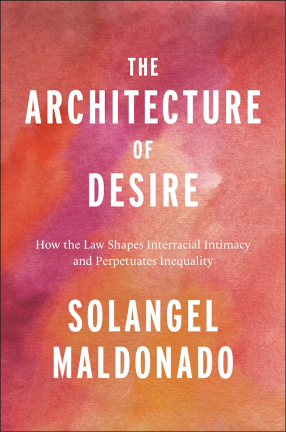 Nancy Dowd, a series editor, approached Maldonado at a conference and asked whether
she had considered writing a book. Dowd guided her through the process, resulting
in The Architecture of Desire: How the Law Shapes Interracial Intimacy and Perpetuates
Inequality, published by NYU Press in 2024.
Nancy Dowd, a series editor, approached Maldonado at a conference and asked whether
she had considered writing a book. Dowd guided her through the process, resulting
in The Architecture of Desire: How the Law Shapes Interracial Intimacy and Perpetuates
Inequality, published by NYU Press in 2024.
Michael Olivas, a University of Houston Law Center professor who championed Latino
representation in legal academia, nominated Maldonado for membership in the American
Law Institute (ALI). She later became the first Latina to serve as an associate reporter
on an ALI Restatement project. “I’ve been so honored to represent Seton Hall Law and
the Latino community,” Maldonado said. “I believe I am Michael Olivas’s legacy.”
Now, Maldonado is helping open doors for others. In 2022, she helped found Graciela
Olivárez Latinas in the Legal Academy, or GO LILA, which supports Latinas pursuing
or working in legal education through mentorship, professional preparation and community.
Before earning tenure, Maldonado wanted to teach Latino critical race theory, or LatCrit,
but colleagues advised against it, arguing that critical race theory was “not rigorous.”
She understood their concern but taught it anyway. She also built a teaching portfolio
that balanced foundational courses—including torts, family law and trusts and estates—with
electives such as race, ethnicity and the law, as well as gender and the law. “I
think I struck that balance,” she said.
The biggest misconception about Latino communities, Maldonado said, “is that we are
monolithic.” Latinos differ by race, immigration status and language. “People assume
that all Latinos speak Spanish, which I do, but many do not,” she said.
"Representation matters," Maldonado said, "because students need to see people like
themselves leading the classroom." Maldonado, who grew up in what she described as
a very modest home in Washington Heights, said her presence allows students from similar
backgrounds to see themselves in the profession. “It allows for students to see that
they can be anything,” she said. Here is a list of books and articles Maldonado recommends as essential reading for a better understanding of Hispanic
heritage.
For Maldonado, success is not defined only by titles or publications. “To me, this
is being able to do something that you love every day, being able to mentor the next
generation,” she said. “That is success.”
For more information, please contact:
Office of Communications and Marketing
(973) 642-8714
[email protected]