From Bombay, India to Seton Hall Law, Professor Emeritus Robert A. Diab overcame decades
of obstacles to build a distinguished teaching career. This year’s St. Thomas More
Medal honoree, he reflects on a life defined by resilience, scholarship and service.
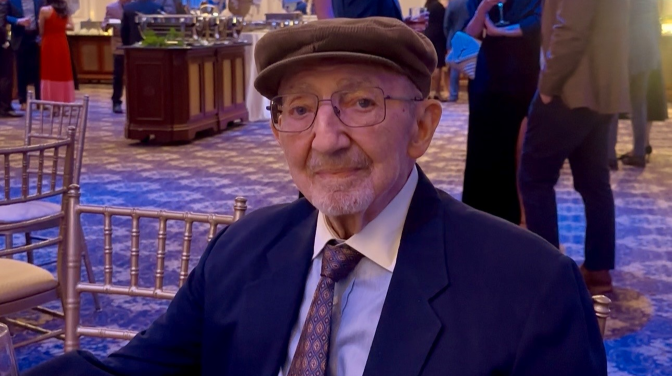
At 98, Professor Emeritus Robert Diab still approaches life with the curiosity of
someone discovering what comes next. His eyes sparkle when he talks, especially about
law, history and the improbable journey that took him from Bombay to New York and
London, and ultimately to Seton Hall Law School.
Twice a month, Diab teaches chair yoga alongside his daughter, Claire, to a class
of about 25 students. It is far removed from the law school classrooms where he taught
for more than four decades, but the purpose feels familiar: bringing people together
on a path toward transformation—this time through health and wellness.
Born and raised in Bombay, Diab was sent at age eight to a Catholic boarding school
in the Himalayas, where he studied alongside his siblings under the Irish Christian
Brothers. After graduating at 16, he returned to Bombay—now Mumbai—and spent a year
working in his father's textile business. He quickly realized it was not the life
he wanted. "I wasn't interested in the business," Diab recalled. "I told my father,
'I want to be a lawyer.'"
That determination eventually carried him to the United States, where two elderly
family friends from Goa, India offered him a place to stay in Brooklyn. The women
knew Father Ryan, a Jesuit priest at Fordham College, and arranged a meeting. After
reviewing Diab's background, Father Ryan was decisive about his potential. "He's in,"
Diab recalled him saying.
Diab enrolled at Fordham, completed his undergraduate degree in three years and went
on to Fordham Law School, graduating in 1952. "Dollars were scarce," he said. Although
he could have attended Harvard or Yale, his family in India could not easily obtain
the U.S. currency needed to support his education.
After law school, Diab encountered another obstacle. As a noncitizen, he could not
take the bar examination. "At that time, you had to be a citizen in 49 of the 50 states
to take the bar exam," he recalled. "I wasn't even allowed to sit for it." So, he
found another route. Diab went to London, joined Lincoln's Inn and trained as a barrister.
His Fordham education though did not count toward the British requirements. "I got
no credit for my work at Fordham," he said.
He spent four years in London, including time completing Lincoln’s Inn’s then-required
dining terms, formal meals and professional gatherings that were part of the traditional
route to becoming a barrister. He later returned to New York with experience in two
legal traditions.
In 1973, the U.S. Supreme Court ruled in In re Griffiths that Connecticut could not deny a lawful resident the opportunity to take the bar
examination solely because the applicant was not a U.S. citizen. By then, Diab had already established himself as a law professor at Seton Hall Law
School. Years later, when he was told he was eligible to sit for the bar, he chose
not to do so.
After returning to New York, Diab learned that Miriam Theresa Rooney, then dean of
Seton Hall Law, had previously hired another barrister from Lincoln's Inn. He met
with Rooney and later with the university's rector. "I got the job," Diab recalled
with a grin. He joined Seton Hall Law as an assistant professor. "I did pretty well
in the classroom, as it turned out," he said.
Over 43 years, Diab taught generations of students and served as assistant dean, associate
dean and acting dean, helping guide the school through much of its early growth. In
1980, Seton Hall University awarded him the Bishop Bernard J. McQuaid Medal for Distinguished
Service, recognizing University community members who have served with selfless dedication
and distinction.
Diab became known for his clear analysis, urbane wit and gift for storytelling—a raconteur
equally comfortable quoting Shakespeare or case law. His experiences in India, the
United States and England gave him a perspective shaped by different cultures and
legal systems that enriched his teaching.
Family has remained a constant source of joy. Diab is the father of six children:
Madeleine, Rob, Claire, Helen, Jennifer and Julia. The family has grown to include
six granddaughters and, most recently, five great-grandchildren, with two more on
the way. He counts conversation, laughter and time with family among life's great
pleasures, along with a lifelong love of travel that, even at 98, still takes him
to new places. He also credits an active lifestyle—walking, yoga, movement and healthy
habits—balanced with good food, a spoonful of honey in his coffee, and an occasional
glass of wine for his secret to longevity.
On Sept. 25, Diab will receive the St. Thomas More Medal during Seton Hall Law's annual
Red Mass at the magnificent Cathedral Basilica of the Sacred Heart in Newark. The
St. Thomas More Society presents the medal to lawyers who exemplify professional excellence
and the Catholic faith, recognizing their contributions to the legal profession and
the broader community.
The honor has particular resonance for Diab. St. Thomas More was a member of Lincoln's
Inn—admitted in 1496 and later serving as a Bencher, Reader and eventually Lord Chancellor
of England. Nearly five centuries later, Diab became a barrister at the same London
institution.
He has also established the Diab Family Endowed Scholarship for students from traditionally disadvantaged
backgrounds. He and his family hope to expand the fund and extend educational opportunities
to future law students. For Diab, the scholarship reflects a lesson shaped by experience:
Education can open doors that might otherwise remain closed.
His life has crossed continents, legal systems and generations. Yet the thread running
through it is consistent: curiosity, determination, faith, family and service. The
young man who left Bombay determined to become a lawyer encountered obstacles at nearly
every turn. Each time, he found another way forward.
At 98, Diab is not finished. He remains active and connected to the Seton Hall Law
community—still learning, teaching, giving and helping others find their way.
For more information, please contact:
Office of Communications and Marketing
(973) 642-8714
[email protected]