Seton Hall Law’s U.S. Healthcare Compliance Certificate Program brought together industry leaders, government attorneys and professionals from as far away as Japan, South Korea, and Poland for four days of sessions on the legal and practical challenges facing health care compliance. Held Oct. 5-8, the Program covered topics ranging from the Foreign Corrupt Practices Act to artificial intelligence (AI), with a recurring emphasis on human judgment and a culture of ethical decision-making.
“You should never use AI to do anything you can’t do yourself.” That caution from Terra Buckley, J.D. ‘18, Chief Compliance and Ethics Officer at Bristol Myers Squibb, captured a theme that ran through the program: As technology and regulation evolve, effective compliance still depends on people who understand the work and its risks.
Participants represented both the pharmaceutical and medical device industries, as well as attorneys and doctors in the private sector. Through expert presentations, case studies and discussions with industry leaders, they explored both the legal foundations of compliance and the practical demands of managing risk.
“Compliance professionals are being asked to anticipate risks that the rules haven’t
caught up with yet. This program gives them both the legal grounding and the practical
judgment to do that well,” said Jacob Elberg, professor of law and faculty director
of Seton Hall Law’s Center for Health & Pharmaceutical Law, which oversees the compliance
certificate programs.
Compliance as a Strategic Business Partner
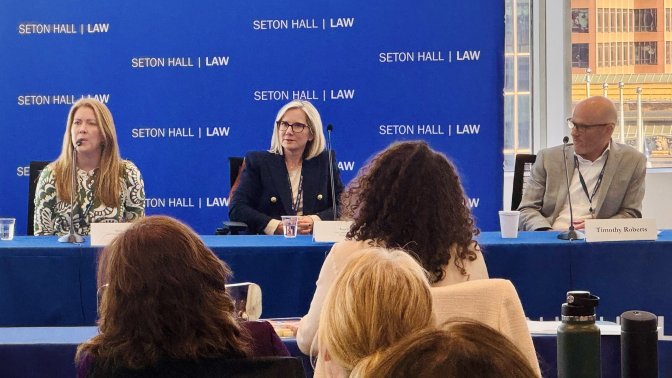
The Compliance Officers Panel, moderated by Elberg, featured Buckley; Melissa Lozner, Senior Vice
President and Chief Compliance Officer at Regeneron; and Timothy Roberts, MLS ‘16, former global chief compliance officer at Legend Biotech. Buckley and Roberts are Seton Hall Law graduates, who are themselves alumni of the U.S. Healthcare Compliance Certificate Program (HCCP). Panelists said clear responsibilities and open communication are essential when compliance and legal teams address high-risk issues, including potential violations of the Anti-Kickback Statute or the False Claims Act.
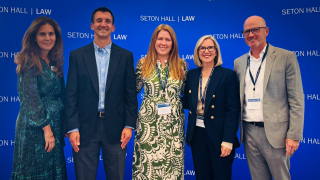
From left, Associate Dean Rosa Alves, Professor Jacob Elberg, Melissa Lozner of Regeneron, Terra Buckley, J.D. ’18, of Bristol Myers Squibb, and Timothy Roberts, MLS ’16, former global chief compliance officer at Legend Biotech.
Lozner emphasized the importance of defining roles early and communicating compliance concerns in ways that help business leaders understand the risks and make informed decisions. Buckley urged compliance professionals to approach colleagues with “curiosity, not judgment” and help them find responsible ways to achieve business goals. Compliance, she said, should be the “office of how and not the office of no.” That approach requires understanding the business, building relationships and finding workable solutions. Panelists identified communication, leadership, intellectual curiosity, and emotional intelligence as essential skills.
Elberg kicked-off the week with a discussion of the relationship between ethical culture and compliance, a theme the compliance leaders echoed throughout the panel. A strong compliance culture, they noted, depends on more than written policies. Leaders reinforce expectations through their actions, employee recognition and opportunities for staff to raise concerns. Roberts emphasized that workplace culture is shaped by leaders’ actions and the behaviors they permit or overlook, noting that it reflects “what we allow, what we tolerate.”
The panel also explored AI’s growing role in compliance, including monitoring, policy
review and investigations. Technology can support that work, Roberts said, but professional
expertise remains essential.
Using AI and Analytics to Identify Risk
Those themes continued in an Oct. 7 session on data analytics and AI in compliance, led by Elberg and Stacy Aiken, Director for Global Assessments and Consulting Services for Health Care Compliance at Johnson & Johnson.
Elberg explained that government investigators use data to identify unusual patterns and build cases, and that companies can apply similar methods to identify and investigate potential concerns proactively. He described a case from his time at the Justice Department in which a life sciences company had identified a suspicious correlation in Open Payments and Medicare data, investigated it, and documented a legitimate explanation. When investigators later asked questions about the pattern, the company was prepared to respond.
“If there’s data out there, the government and potential whistleblowers are going to be looking,” Elberg said. Proactive analysis, he explained, can help companies address
concerns before they become more costly and disruptive investigations. He also discussed the Justice Department’s expectation that companies investing in data and AI for sales and marketing make comparable investments in compliance.
Aiken said organizations must assess whether their compliance programs are effective, not simply whether policies and training exist. Data can move programs beyond periodic reviews toward continuous insight, she said, allowing teams to ask: “Is our program effective? Is it breaking down somewhere?”
Connecting information on payments, travel and expenses, speaker programs, research relationships and investigations can reveal patterns that reviews of individual transactions might miss. AI can also support document review, summarization, training, policy development and monitoring. But Aiken emphasized the need for “a human in the loop” to review results and assess whether they make sense.
“The value doesn’t come just from having it. It really comes from how intentionally
and effectively you use it,” she said. Data quality, safeguards for confidential information
and human oversight remain essential.
Practical Insights for a Changing Field
Sessions throughout the four-day program addressed regulatory challenges involving fraud and abuse, pharmaceutical and medical device oversight, data privacy, marketing practices, and government pricing. Case study workshops connected these issues to real-world compliance decisions, while the Program’s closing sessions on Oct. 8 examined health care fraud enforcement and investigations. A panel, “Being the Focus of a Government Investigation,” brought together government and private-practice attorneys to discuss the challenges organizations face when under scrutiny.

Across the Program, a central message emerged: effective compliance takes more than
rules and controls. It requires sound judgment, collaboration across an organization
and the responsible use of data and technology—all grounded in a culture of ethical
decision-making.
“Seton Hall brought together outstanding speakers, substantive content, and an impressive
community of healthcare professionals. I especially valued the practical discussions
about how compliance professionals can be effective business partners and help organizations
adopt AI responsibly," said Andrew Kirk '27, part-time Weekend J.D. student at Seton Hall Law who is an executive
director at a Fortune 100 healthcare company. "As both a business leader and a law student, I appreciated the balance of legal depth
and real-world experience, along with the thoughtful organization that made it easy
to connect with speakers and fellow attendees. I highly recommend the program to industry
professionals and students alike.”
The Program is offered through Seton Hall Law’s Center for Health & Pharmaceutical
Law, which advances education, research and dialogue on legal and policy issues affecting
health care and the life sciences. Through its U.S. and international compliance programs, the Center connects legal experts and industry practitioners to examine emerging
challenges and develop practical approaches to managing risk worldwide.
For more information, please contact:
Office of Communications and Marketing
(973) 642-8714
[email protected]