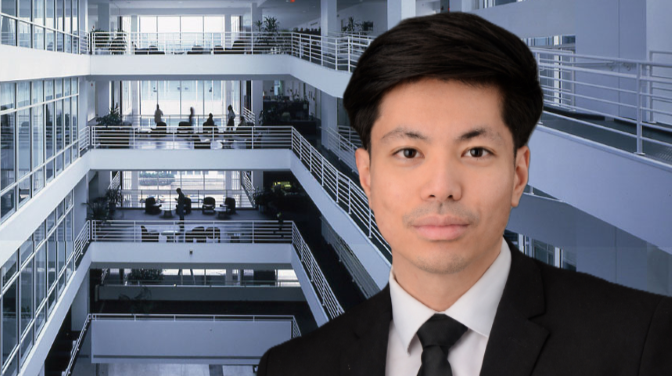
 Photo courtesy of Joachim Mikel Icasiano
Inspired by his parents’ sacrifices and shaped by philosophy, faith and hard-earned
resilience, Joachim Mikel Icasiano is entering prosecution determined to pursue justice
with humanity.
The first thing Joachim Mikel Icasiano understood about the law was what it cost.
His father, an attorney in the Philippines, arrived in the United States ahead of
the family and rebuilt his career from scratch—repeating his legal studies before
returning to the family law practice. His mother worked as a nurse while raising a
young family that carried its American dream across an ocean.
Growing up in Central New Jersey, Icasiano always knew the law was in his DNA—even if his father envisioned a different path. "He wanted me to be an accountant or a doctor," he said with a laugh. Instead, he chose law—specifically the kind centered on justice rather than profit. "I decided on my own to be a lawyer," he said.
At Seton Hall, where he earned a political science degree with a philosophy minor before going on to law school, Icasiano said his Catholic education shaped him long before he set foot in a courtroom. Political science taught him how institutions and power operate. Philosophy taught him how to navigate human nature. His intellectual touchstones ranged from Plato's "Laws" to St. Thomas Aquinas, St. Augustine and Søren Kierkegaard.
By his own admission, his first year of law school wasn't a cakewalk. "I put so much pressure on myself that I nearly collapsed toward the end," he said. Kierkegaard's line—"Anxiety is the dizziness of freedom"—became a working philosophy for surviving it. "You become anxious because you want success in your life," Icasiano said. "If you have greatness in you, anxiety is a side effect of greatness." The solution, when pressure mounted, was surprisingly simple: returning to the gym five days a week, a routine he had abandoned to devote every waking hour to school. "Having that time in the gym was so valuable. It gave me time to reset."
Looking back, he said, he would have been kinder to himself. "Those little mistakes—bad cold calls, not understanding a rule the first time—they do not matter in the long run. What matters is getting to the finish line." He also found at Seton Hall Law a culture that defied the cutthroat stereotypes of legal dramas. "People were willing to help each other, share notes and support one another," he said.
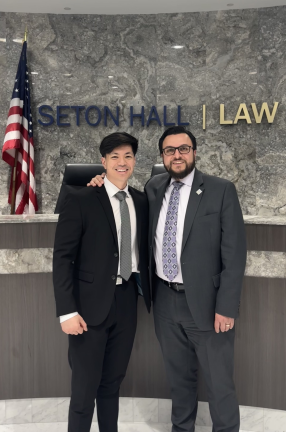
Joachim Mikel Icasiano with Justice Michael Noriega.
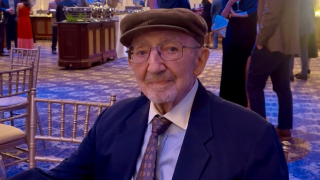
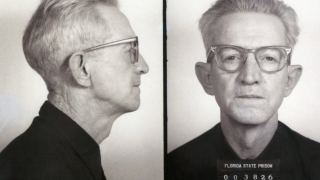
Among the professors who left a lasting mark, none had a deeper impact than Adjunct Professor William Baroni, whose course on prison law drew on experience no textbook could replicate. Baroni, a former New Jersey state senator who served time in federal prison in connection with the Bridgegate scandal before being vindicated by the U.S. Supreme Court, taught the subject from the inside out. "He used his own experiences to teach us," Icasiano said. "I now understand how difficult prison really is. That is always going to stay with me."
His path to the prosecutor's office ran through three formative placements. First came an immigration clinic with Catholic Charities, where Seton Hall Law alumnus Roberto Hernandez led El Centro, a program providing immigration representation to those in need. The work was meaningful, but it pointed him elsewhere. "I enjoyed it," Icasiano said, "but I knew I wanted to carry out justice another way."
That pursuit led him to the Mercer County Prosecutor's Office, where he drafted memos and briefs, observed courtroom arguments and immersed himself in New Jersey criminal law. The following summer, after his second year of law school, he clerked for Justice Michael Noriega of the New Jersey Supreme Court, gaining hands-on experience with appellate cases and tracking high-profile matters from filing to resolution. Justice Noriega, a former public defender, deepened his understanding of criminal practice from both sides of the courtroom.
He returned to the Mercer County Prosecutor's Office in the fall of his third year as a certified legal intern through the New Jersey Supreme Court. Across two stints there, he presented six grand jury cases involving domestic violence, sexual assault and serious collisions—securing indictments in each—and argued in opposition to a post-conviction relief motion before a Superior Court judge. In the months before graduation, he conducted his first direct examination of a witness and successfully argued a procedural motion under Rule 104(c) to admit a defendant's jail calls into evidence. "When the case eventually goes to trial, the evidence I argued to admit will be used," he said.
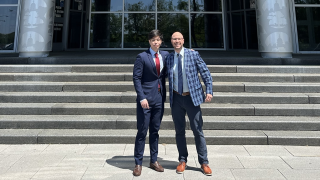
Joachim Mikel Icasiano with senior assistant prosecutor Scott Gershman.
He credits senior assistant prosecutor Scott Gershman with giving him trust and room to grow. "He's one of my biggest inspirations," Icasiano said. The work, he added, is about more than securing convictions. "It is about giving justice to victims and their families." His view of justice still leaves room for humanity. "You want defendants to be held accountable, but not beyond what is fair," he said. "A lot of the time, these are not terrible people. They made terrible mistakes."
It is the kind of measured conviction that takes years to develop—and in Icasiano's case, the moral framework runs through everything that shaped him: his immigrant upbringing, philosophical studies and Catholic sense of obligation to the community he came from. "Whenever you see something in the world you do not like, it is easy to ignore it," he said. "Or you can try to do something about it. Some people do not have the tools to navigate the criminal justice system. They rely on people who understand it to help them find justice."
After graduation, the bar exam comes first. Then Icasiano will clerk for Judge Pedro Jimenez in Middlesex County before joining a prosecutor's office—a career shaped by service, sacrifice and the example set by his family.
His father crossed an ocean and started over. Icasiano is building his own path—in the state where he grew up, carrying forward the faith and work ethic his family brought with them to America.
For more information, please contact:
Office of Communications and Marketing
(973) 642-8714
[email protected]