Photo by Sabina Lee
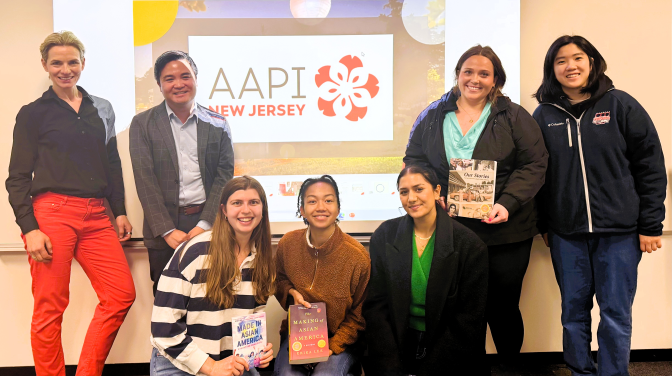
AAPI New Jersey’s Jeffrey Chang visited Seton Hall Law’s first Asian American law
class to discuss how community advocacy, landmark cases and coalition-building have
shaped Asian Americans’ fight for visibility.
What if the problem isn’t that Asian Americans are absent from the law, but that the
law has told their story without context?
That was the point of a recent Asian American law seminar—the first of its kind—at Seton Hall School of Law, where Professor Maggie Lewis invited Jeffrey Chang, policy and advocacy advisor for Asian Americans and Pacific Islanders (AAPI) New Jersey.
For Lewis, who collaborated with a coalition of civil society organizations to help end the China Initiative, the class was a chance to bring scholarship and community advocacy into the same room. “You guys are so fortunate to have her at Seton Hall,” Chang told students. “She is not just a scholar. She has really worked directly with impacted people to effectuate change.”
AAPI New Jersey began in 2021 as AAPI Montclair, formed by Asian American mothers after the Atlanta spa shootings, and grew when anti-Asian hate and bullying reached its peak during the pandemic. Today, it is the state’s largest and only statewide AAPI advocacy organization.
New Jersey is home to roughly 1.07 million Asian Americans, accounting for about 11.1% of the state’s population—the fourth-largest Asian population in the United States. The state also has the largest proportion of Indian Americans of any state. But representation lags. The scale of the community has never matched its political power. “We are the fastest-growing demographic,” Chang told the class, “but we’ve never had that power in government, in discourse, in policy.”
AAPI New Jersey works on three fronts: advocacy, education and community organizing. One of its earliest wins helped make New Jersey the second state to require Asian American history in public school curricula. The mandate, though, has gone unfunded for five years. To fill the gap, the organization has trained teachers, provided community education through its Teach Asian American Stories initiative, the Asian American Foundation’s history hub and the TAAF AANHPI Heritage Month toolkit.
Throughout the lecture, Chang kept returning to one word: context. Without it, Asian American legal history can look like a footnote. He walked students through a few landmarks. In United States v. Wong Kim Ark (1898), the Supreme Court affirmed birthright citizenship. In Yick Wo v. Hopkins (1886), it struck down a San Francisco ordinance enforced against Chinese laundry owners with “an evil eye and an unequal hand.” In Lau v. Nichols (1974), the Court recognized that denying meaningful access to education because students do not speak English can amount to national-origin discrimination. And the 1982 murder of Vincent Chin, followed by a sentence of three years’ probation and no jail time, became a national catalyst for Asian American organizing. The judge’s line still stings: “You don’t make the punishment fit the crime; you make the judgment fit the criminal.”
Chang also pushed back on the idea that Asian Americans have only recently turned to the law. During the Chinese Exclusion era, the Chinese Consolidated Benevolent Association and other community groups filed thousands of cases. “You think it’s just one Wong Kim Ark and one case,” he said. “But you have no idea that there were thousands and thousands of case.
The 14TH AMENDMENT & BIRTHRIGHT CITIZENSHIP
That legacy shapes AAPI New Jersey’s work now. The group filed an amicus brief in Kim v. Hanlon, the challenge to New Jersey’s county-line ballot system, which critics said pushed non-party endorsed candidates to the margins. The line has since been eliminated. The organization is also fighting a broader voting-rights battle, opposing the Trump administration’s demand for New Jersey’s full voter-registration data in a civil rights lawsuit. Seton Hall Law’s weekend J.D. student and Jeopardy! champion Jamie Ding also joined in the legal intervention. For more on Asian Americans in the legal profession, see the National Asian Pacific American Bar Association (NAPABA)’s A Portrait of Asian Americans and the Law and Harvard Law School’s analysis.
Community organizing sits at the center of that work. Staff canvass neighborhoods, host candidate forums and run Know Your Rights trainings on immigration. Last year, they sent close to one million texts to eligible Asian American voters in New Jersey. The goal is modest and strategic: move turnout, even slightly. “If every single attorney in New Jersey did pro bono work, things would be so much better,” Chang said.
That push matters because invisibility still has consequences. Asian Americans make up 11 percent of New Jersey’s population, yet hold only 3 percent to 5 percent of seats in the state legislature. Asian Americans remain underrepresented in leadership roles despite their outsized presence in professions such as law and medicine.
AAPI New Jersey has built coalitions across racial lines, drawing inspiration from Yuri Kochiyama’s activism with Malcolm X and from Asian American farmworkers who organized alongside Latino farmworker activists. The message is simple: Asian American history is not separate from broader civil rights history. It is part of it.
Asian Pacific American Heritage Month arrives this May amid real strain. The group’s social worker fields calls each week from people facing domestic violence, immigration detention and fear about leaving home. Some are too afraid to even go out to buy groceries. The urgency is clear in the organization’s work.
Lewis, who will teach the seminar again in the fall, put the larger lesson plainly: “These issues wax and wane, but they don’t go away.”
Chang closed with a challenge to the next generation of lawyers. Join the Asian Pacific American Law Students Association (APALSA) or NAPABA. Run for office. Serve on boards. Do pro bono work. The legal system, he suggested, does not change only through landmark cases. It changes when people insist on being counted. “Sometimes you just don’t know what’s going to happen,” he said, “and you just stick with it.”
For more information, please contact:
Office of Communications and Marketing
(973) 642-8714
[email protected]