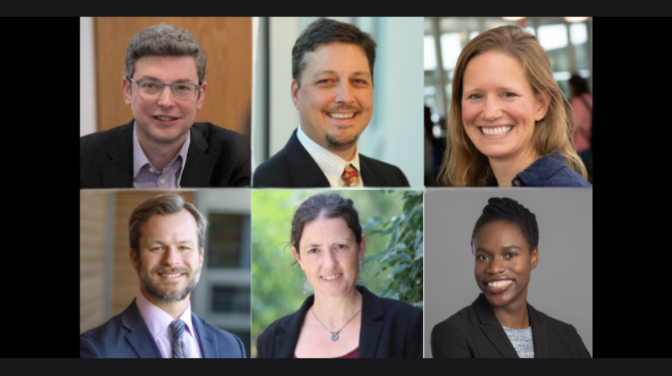
 Photo composite by Sabina Lee
From artificial intelligence and academic freedom to international law and expert
evidence, Seton Hall Law’s Spring 2026 Faculty Colloquium Series convened leading
scholars from across the country for a semester of cutting-edge legal research and
intellectual exchange.
Each spring, Seton Hall School of Law's Faculty Colloquium Series brings leading legal
scholars to campus for a semester of presentations and discussion around emerging
research. Curated this year by Professor Doron Dorfman, the Spring 2026 series featured
six presentations spanning constitutional law, international law, artificial intelligence
(AI), evidence, health law and higher education.
"It's important for us at Seton Hall Law to bring in nationally recognized experts in areas that are relevant, cutting-edge and affecting our lives today," Dorfman said.
The series opened Jan. 22 with Harlan Grant Cohen, professor of law at Fordham University School of Law, who presented "The International Order, International Law, and the Definition of Security." His work examined how shifting geopolitical pressures are redefining the concept of security and straining the frameworks that govern international relations.
On Feb. 3, Seton Hall Law Professor David Opderbeck presented "Faithful Exchange: The Economy as It’s Meant to Be," exploring the intersection of law, economics and moral responsibility. His talk examined how legal and economic systems shape human behavior and public life.
Two days later, Jill Wieber Lens, the Dorothy M. Willie Professor in Excellence at the University of Iowa College of Law, presented her book "Stillbirth and the Law." Her research examines how the law treats pregnancy loss and what inconsistencies in that treatment reveal about the rights of patients, families and the medical profession.
Brian Soucek, the Martin Luther King Jr. Professor of Law and Chancellor's Fellow at the University of California, Davis School of Law, presented on March 19, "The Opinionated University: Academic Freedom, Diversity, and the Myth of Neutrality in American Higher Education." His work interrogates whether universities can—or should—remain neutral on social and political questions, and what the First Amendment demands of institutions navigating pressure from students, faculty and lawmakers.
Edith Beerdsen, associate professor of law at Temple University Beasley School of Law, presented "Expert Evidence in Times of Skepticism and Distrust" on March 26. Her scholarship addresses how eroding public trust in expertise is challenging courts in evaluating scientific testimony, qualifying expert witnesses and maintaining evidentiary standards. The International Order, International Law, and the Definition of Security
The series concluded April 9 with Ngozi Okidegbe, associate professor of law and assistant professor of computing and data sciences at Boston University School of Law. She presented her forthcoming article "The Outsiders of Algorithmic Governance." Her presentation examined how artificial intelligence systems are developed, whose interests they serve and how communities historically excluded from technological development can gain a meaningful role in shaping AI's future.
For Dorfman, the colloquium serves a dual purpose: advancing Seton Hall Law's academic culture while contributing to scholarship beyond campus. Presenters share works in progress and receive feedback from Seton Hall faculty—input that often finds its way into future drafts of articles and books.
"What's really great about our faculty is that we are very engaged and curious about new scholarship and research," Dorfman said.
Now a fixture of Seton Hall Law's academic calendar, the Faculty Colloquium Series reflects the school's commitment to interdisciplinary dialogue and legal scholarship across a broad range of fields.
For more information, please contact:
Office of Communications and Marketing
(973) 642-8714
[email protected]