Photo by Sean Sime
New Jersey Supreme Court Justice Michael Noriega ’02 reflects on diversity, belonging
and the responsibility to create opportunities for those who follow, drawing on his
experience as the son of Peruvian immigrants and a first-generation law student.
The Diversity Speaks Distinguished Speaker Series, established in 2008, brings the
Seton Hall Law community together to examine diversity, inclusion and equal opportunity
in the legal profession. At the Oct. 26 program, sponsored by Porzio, Bromberg & Newman,
P.C. and Seton Hall Law’s Office of Equity, Justice & Engagement, New Jersey Supreme
Court Justice Michael Noriega ‘02 drew on his experience as the son of Peruvian immigrants
and a first-generation law student.
Noriega reflected on his second-grade classroom in Union City, New Jersey, where children
from Puerto Rico, Cuba, Peru, the Dominican Republic, Chile and Argentina argued over
the right Spanish word for the bathroom sink. Each insisted theirs was correct. He
came away knowing five versions.
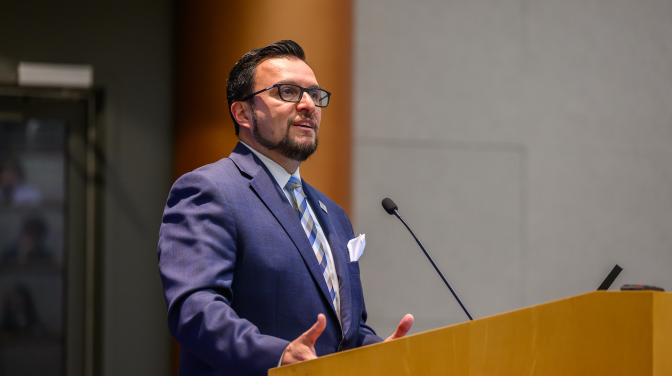
"Diversity in my neighborhood meant something completely different from what most
people think," Noriega told students, faculty and guests at Seton Hall Law School
on Oct. 26. "It was often as specific as which word you would use for the bathroom
sink."
Noriega, a Seton Hall Law graduate who joined the New Jersey's highest court in 2023
as associate justice, began with an admission. "Any time I'm asked to speak on the
topic of diversity, I struggle more than with most any other topic," he said. "My
relationship with the theme of diversity is a complicated one."
In Noriega's class of 27, all but two students spoke Spanish. Even within that community,
he said, economics, politics and race shaped who lived where. A driveway signaled
prestige; his family of five shared a two-bedroom apartment. The lesson he took was
"to respect and appreciate the differences not only between cultures but within them."
Both of his parents were medical doctors in Peru— his father a cardiologist and his
mother an obstetrician. In the United States, they took licensing exams in a foreign
language, then set aside their medical licenses to work for others while raising three
sons. "In many ways, they gave up their own sense of belonging so they could give
us a chance to find ours," Noriega said. The lecture fell on what would have been
his parents' 50th wedding anniversary.
Though he was born in North Hudson County, Noriega said he has often been asked where
he is from. His cousins in Peru saw it differently: "You're not Peruvian, you're American."
He spoke openly about a harder question: whether others would credit his accomplishments
to merit or to an institution's wish to become more diverse. Sometimes, he said, the
question is "whether you can quiet the voice that asks whether you are here entirely
because of your own merit."
Noriega said practicing immigration law became a way to honor his parents' sacrifice.
He helped families secure documents and navigate the system until they held their
certificates of citizenship. He recalled "the pride in their eyes when they clutched
that envelope to their chest."As a justice, he has presided over five naturalization
ceremonies, including one aboard the battleship USS New Jersey in Camden.
Being the first in his family to study law meant no roadmap and constant pressure,
"as though my family, my community, my culture were all somehow on my shoulders."
Once he made it into the room, he said, his goal changed. He wanted to leave the light
on for those who followed, not to dictate their path but to let them choose their
own. "Eventually, if we're doing this right, there will be fewer and fewer firsts,"
he said.
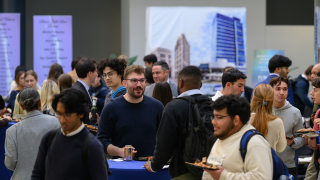
Noriega asked the students to look around the room. Some, he said, may be first-generation
lawyers carrying the same weight he once did. He urged them not only to enter influential
institutions but to help change them. "Opening the door is only the beginning," he
said. Newcomers should feel welcome and heard, with room "to disagree, to succeed
and even fail" without the whole enterprise resting on their shoulders.
He encouraged students to mentor, sponsor and make introductions, but not "simply
to demonstrate a commitment to diversity." Instead, he said, do it "because you recognize
talent, because you recognize potential," and let those you help define success for
themselves.
Speaking on behalf of the students, Student Bar Association President Jason Galek
noted that Noriega once sat in the same seats as a Seton Hall Law student and later
taught appellate advocacy at the school for eight years. “Success isn't just about
the doors we open for ourselves,” Galek said, “but the doors we open for those who
come after us.”
In his closing remarks, Noriega did not claim to have settled the questions he raised.
“I do not offer these reflections because I found the answers,” he said. “I offer
them because I believe we should be able to have these conversations honestly.”
He underscored how his generation should be judged — not by what it inherited, but
by the opportunities it creates for those who follow. “Perhaps the greatest measure
of our success will not be how well we represent the people who came before us,” he
said. “It will be how much freedom we give to the people who come after us.”
For more information, please contact:
Office of Communications and Marketing
(973) 642-8714
[email protected]