 Photo courtesy of Cienna Alam.
Seton Hall Law Leadership Fellows spent five weeks teaching constitutional law to
high schoolers in Union County. Their capstone project ends Nov. 10 with a mock constitutional
convention at the law school.
On Nov. 10, a room of high school students will take their seats as U.S. senators
at Seton Hall University School of Law. Each will represent a different state, introduce
a constitutional amendment from that senator’s point of view and try to win enough
votes to pass it before the session ends.
The mock constitutional convention is the final stage of a capstone project led by
this year’s Leadership Fellows. For five weeks, the Fellows taught a constitutional
law curriculum to students in the Academy for Law & Justice at Union County Vocational-Technical
Schools (UCVTS) in Scotch Plains, New Jersey. The project grew out of work by last
year’s Fellows. Nicholas Webb and Mary Grace McNamara ran a mock trial program with
UCVTS and connected this year’s team with the school and its lead instructor, Dina
Violante.
Violante said she wanted students to see their coursework as more than material for
an exam. “I wanted my students to see that a career in law is attainable and that
there are many different paths they can take to get there,” she said.
UCVTS uses an academy-based model that prepares students for careers in fields, including
health care, design, law and the sciences. Its Academy for Law & Justice builds coursework
around social issues, human relations, law and government.
The Fellows designed the curriculum with three goals: give students a crash course
in constitutional law, sharpen their public speaking and get them thinking about how
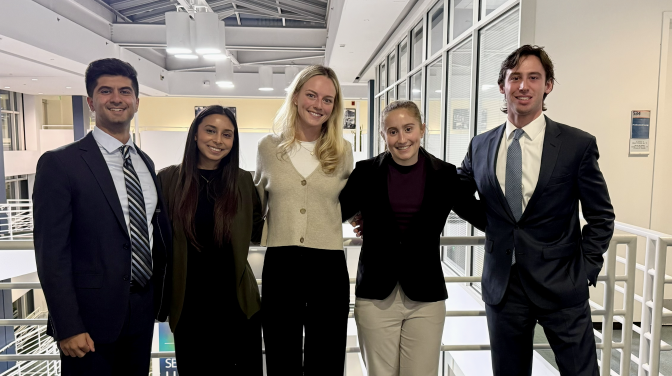
they can improve the world around them. Each of the five Fellows, all members of the
Class of 2027, took on a different period of constitutional history.
Owen Dowd laid the foundation, covering the drafting of the Constitution and early
questions such as judicial review. Lauren Geiger examined how Congress and the president
have asserted their enumerated and implied powers. Cienna Alam taught the incorporation
of the Bill of Rights. Sam Vazquez walked students through the watershed amendments
that reshaped the Constitution. Nikhil Sadaranganey will close the series by tying
those lessons to present-day issues, including political polarization.
Dowd, whose lessons included a close reading of Marbury v. Madison and Cooper v. Aaron, said the students exceeded his expectations. “I was really impressed
with the students’ level of engagement and ability to synthesize dense case law,”
he said. “Their understanding was well beyond what I would have expected at their
grade level.”
Violante said having law students in the room changed the classroom dynamic. “I also
think there is something powerful about students interacting with law students who
are closer to them in age,” she said. “It makes the idea of attending law school and
entering the legal profession feel much more realistic.”
The convention will put that groundwork to the test. Students will debate one another
and work toward passing at least one amendment by the end of the day. Seton Hall Law
Professors Thomas Healy and Fareed Nassor Hayat will also give brief remarks on different
aspects of the Constitution. The Fellows see the convention as a way to pull the five-week
curriculum together. It is also meant to train students in respectful, productive
debate and introduce them to constitutional law concepts taught at the law school
level.
The project was made possible by the Leadership Fellows program, led by Professor
Paula Franzese and Fellow Stephanie Caravela. The Fellows also credit Violante, who
welcomed them into her classroom and offered guidance throughout.
The program’s aim is to teach students what it means to be an engaged citizen, while
laying the groundwork for a long-term partnership between Seton Hall Law and UCVTS.
Violante hopes the partnership will grow to include mentorship, mock trials, legal
workshops and campus visits. “I want students to leave the Academy not only with an
understanding of the law, but also with the confidence to pursue opportunities they
may have once believed were beyond their reach,” she said.
For more information, please contact:
Office of Communications and Marketing
(973) 642-8714
[email protected]