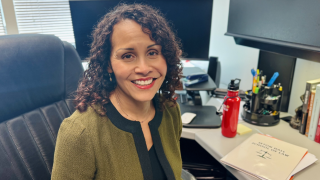
 Photo courtesy of Gaia Bernstein
Gaia Bernstein, a Seton Hall law professor and author of "Unwired," spent a month
at the Rockefeller Foundation's Bellagio Center working on her next book, which argues
that technology has become a public health crisis.
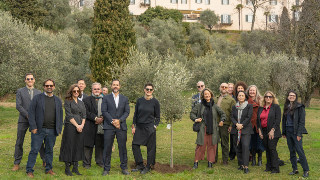
Professor Gaia Bernstein is a leading scholar on technology law at Seton Hall School
of Law. She spent February at the Rockefeller Foundation's Bellagio Center in Italy
as part of the residency program's first cohort of 2026—joining a legacy of fellows
that includes Nobel laureates, MacArthur Fellows, Ruth Bader Ginsburg and Maya Angelou.
The Bellagio Center, which has hosted residents since 1959, selects scholars and artists
whose projects demonstrate potential for significant social change. Each cohort consists
of 14 fellows; the center selects approximately 94 residents annually across seven
cohorts, hailing from around the world.
“I believe they are looking for projects that they think could make social change
on a global level,” Bernstein said. “Seeing these big projects people were working
on—it felt very intentionally curated.” Bernstein’s cohort included scholars working
on technology, food policy, and political biography. Fellows came from the United
States, Australia, South America and Europe.
Bernstein’s sabbatical year has kept her busy with the residency and also as a visiting
fellow at the Brookings Institution. The residency gave her something she said is
difficult to find even during a sabbatical—uninterrupted time to think and write,
surrounded by intellectually engaged peers.
“To set aside time in advance and commit simply to doing your work is something very
different,” she said. “When you get stuck, you take a walk, talk with someone interested
in your work, and it helps ideas flow. I made much more progress in that one month than I would have if I had just
stayed home.”
At Bellagio, Bernstein worked on her forthcoming book, tentatively titled “Technologies
of Loneliness.” She is building on the theme of 'human connection' from her 2023 book,
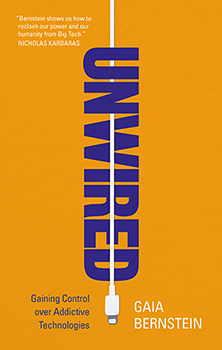
“Unwired: Gaining Control Over Addictive Technologies,” recently released in paperback
by Cambridge University Press.
“Unwired” grew out of a program Bernstein launched at Seton Hall Law’s Institute for
Privacy Protection in 2017, in which law students visited schools to speak with children
who had just received their first cellphones. The book examined addictive design features
in technology platforms, drawing parallels to past public health battles against tobacco
and alcohol. It reached a wide audience, earning Bernstein invitations to address
the Federal Trade Commission, the World Economic Forum and universities across the
country.
“Technologies of Loneliness” takes a broader view, examining how technology across
all aspects of daily life—from hotel check-ins and grocery self-checkout to AI companion
apps and even smart cities—is eroding human connection and contributing to a public
mental health crisis.
“We already have evidence from excessive screen time and social media showing the
serious harm they can cause to children’s mental health,” Bernstein said. “We need
to start treating this as a public health problem —and the solution has to come from
public health tools.”
She said the book is prescriptive as well as analytical, exploring how regulatory
frameworks, including tools from the Food and Drug Administration, could be applied
to technology design. The Bellagio residency allowed her to work through that section
in depth. Bernstein is also preparing a policy brief to be published by Brookings on AI companion
apps and the public health risks they pose—most alarmingly for children. She cited
documented cases where companion bots encouraged self-harm and social isolation, in
part because of design features that make the apps highly addictive for users.
“If your kid is talking with an AI companion bot, you may have no idea what’s going
on because it’s done in isolation,” she said. “That’s what makes it much harder for
parents.” The brief is expected to be published next month, accompanied by a webinar.
Bernstein said she plans to adapt the policy proposal for multiple audiences, including
law review publication.
Her scholarship informs her teaching methods directly. In her property course, Bernstein
has asked students to voluntarily pledge not to use Wi-Fi during class, an exercise
she said more than half the class embraced.
“We have the ability to structure technologies,” Bernstein said. “We should be able
to use them for us, not have them control the way we live.”
She is developing “Technologies of Loneliness” as a book that targets a general audience,
hoping it will anchor a broader public conversation about technology’s toll on public
health and how society can strike a better balance.
For more information, please contact:
Office of Communications and Marketing
(973) 642-8714
[email protected]