Photo by Sabina Lee
Former Gov. Jim McGreevey shared with Seton Hall Law students an honest account of
what failure teaches, urging them to embrace setbacks, define their values and build
careers rooted in purpose and second chances.
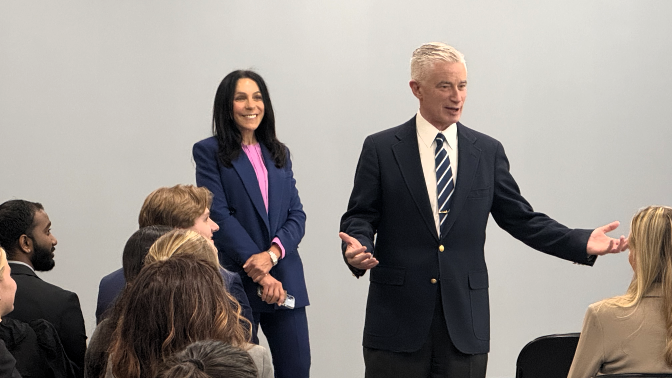
Jim McGreevey walked into Seton Hall Law's Franzese Faculty Library on March 27 not
as a cautionary tale, but as something rarer: a man who excavated his own wreckage
and built something worth keeping.
McGreevey—who resigned as New Jersey governor in 2004 and later worked in prisons
and reentry programs—spoke to students through the law school’s Leadership and Professionalism
Lecture Series with the authority of someone who has failed publicly and rebuilt deliberately.
Professor Paula Franzese, founder and director of the Leadership Fellows Program,
introduced him as someone who believes “each of us is better than our mistakes” and
that “what matters most is not a setback—it’s the comeback.” Coming from a man speaking
from lived experience, the words carried unusual weight.
McGreevey opened with humor and Jersey City pride before arriving at a provocation
most law students don't expect in a professional development lecture: success, he
suggested, might be the wrong thing to chase. Without a clearly defined internal value
system, even talented people make decisions by accident. "If you don't have a value
system, you're spitballing," he told the room, urging students to adopt a personal
moral compass against which every action and intention could be measured. Professional
achievement without that foundation, he warned, leads not to fulfillment but to drift.
Much of McGreevey's post-political life has been spent in spaces most people avoid
thinking about: correctional facilities, reentry programs, the patient work of helping
people rebuild after incarceration. What he found there deepened his understanding
of autonomy in ways that translated directly to a room full of future attorneys. He
described people emerging after decades behind bars who struggle to make even ordinary
decisions, their capacity for independent choice quietly eroded by years inside a
system that made every choice for them. "You lose all sense of agency," he said—an
observation that carried an implicit challenge to his audience, since lawyers help
design and interpret the systems that shape those outcomes.
He was careful to note that recovery is never simply a matter of willpower. Housing,
treatment and job training are necessary, he said, but insufficient on their own.
"At the end of the day, it's what happens from the neck up." That conviction led him
to one of the lecture's defining themes: the discipline of responding rather than
reacting. "You don't want to be reacting. You want to be responding," he said, describing
the practice of creating space between a difficult moment and the decision that follows.
That space, he argued, is where accountability actually takes root.
Drawing on Joseph Campbell's concept of the hero's journey, he mapped a universal arc of support, struggle, failure and return—one he applied
not as metaphor but as practical guidance. Failure, in that framework, is not an ending
but an education. "It's when you mess up—that's when you learn," he said, adding that
meaningful growth rarely happens in comfort.
He spoke candidly about his own turning point in 2004, when he resigned as governor
and publicly came out as a gay man—a moment that forced a complete reassessment of
purpose and led him toward ministry and service. "Part of it is being truthful about
who you are," he said. "Life is short." His reflection was neither confessional nor
self-congratulatory; it was an honest account of how profound disruption can become
the beginning of a more intentional life.
In the discussion that followed, he offered students practical counsel: find a mentor,
step outside your comfort zone, travel, and invest in relationships. "All of life
is about relationships," he said. When asked how he found the courage to remain in
public life after personal and political upheaval, he returned to the principle that
had anchored the whole lecture. "Am I speaking with truth? You just let it go."
Franzese closed the program where McGreevey had begun—with the weight of choice. "Our
greatest power resides in the space between stimulus and response," she said. "Think
less about credentials and more about legacy."
As McGreevey put it, the task is to "start with the end in mind"—and build a life
that honestly reflects it. In the end, a career is just a series of decisions, and
the quality of a life depends on how deliberately you make them.
For more information, please contact:
Office of Communications and Marketing
(973) 642-8714
[email protected]