Photo by Sean Sime
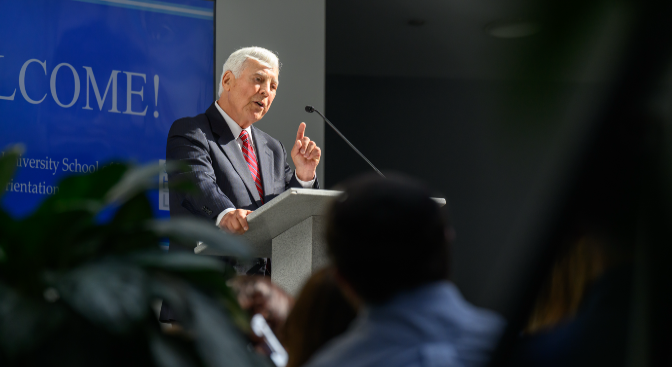
In a moving orientation address, Professor Denis McLaughlin urged the Class of 2029
to see orientation as the first day of their lives as lawyers—and to use that privilege
to improve the lives of others.
For the Class of 2029 at Seton Hall University School of Law, orientation was more
than the first day of law school. It was, Professor Denis McLaughlin told them, the
first day of their lives as a member of the legal profession.
Reflecting on the 56 years since he was a first-year law student, McLaughlin shared
the winding path that led him to a career in law. It was shaped less by careful planning
than by uncertainty, self-discovery, service—and ultimately—a commitment to work that
mattered to him.
He began with humor, recalling a law school experience far different from the one
awaiting the incoming class: two sections of 100 students seated alphabetically, with
“no escaping.” The system, he joked, was designed to “instill terror”—and “it worked.”
But his message went beyond the anxiety of starting law school.
“You must see today not as your first day as a Seton Hall Law student, but as your
first day as a member of the legal profession,” McLaughlin said. “It is this mindset
that is most critical in your professional development as a lawyer.” Students, he
explained, had not come simply to study law. They had come to become lawyers—people
entrusted with the administration of justice, the preservation of the rule of law
and the public’s confidence in both.
“Being a lawyer is a special privilege,” he said. “And you must ask yourself—what
are you going to do with this opportunity?”
At the same time, McLaughlin urged students not to lose sight of who they are as they
take on the demands of legal education. “You are a person first,” he said, reminding
them that they come to the legal profession with “values, beliefs and aspirations
that are personal to you.” He added, “The law is a wonderful profession, but only
if it is what you want for yourself.”
After graduating from Villanova Law School, McLaughlin clerked in federal court in
Philadelphia. As many of his classmates and fellow clerks moved onto large firms,
he realized that path was not right for him. At 26, he wondered whether he had made
a mistake in becoming a lawyer. He stepped away from the profession, first working
as a kindergarten teacher and later moving to Los Angeles, where he became a social
action director at a Catholic church.
While helping with a carpentry project at an orphanage in a Mexican border town, he
realized that he had no special talent for carpentry. “But it also hit me,” he said,
“that I did have a special talent—a talent that I could use to help others. And it
was a talent that I was wasting.”
He returned to New Jersey and began working at a local legal services office. He
loved the work so much he stayed for 10 years. Through his work, he also met his wife,
Barbara, a social worker. Their marriage has lasted nearly 50 years. “I think she
did a nice job with me,” he said, prompting laughter from the audience.
McLaughlin’s point was not that students should follow his path into public-interest
law. Rather, the breadth of the profession gives each lawyer the opportunity to find
meaningful work. “There are many paths to fulfillment in the law,” he said. “You must
find yours.”
He also challenged students to bring their own sense of justice and fairness into
the classroom and to question what others accept as settled. He pointed to Thurgood
Marshall’s advocacy in Brown v. Board of Education as an example of a lawyer willing to challenge the status quo. “Be that advocate
for justice,” he said.
Near the end of his address, McLaughlin drew on a career spent representing people
who needed a lawyer. He recalled representing more than 2,000 clients and said few
things compared with helping someone who had nowhere else to turn—and hearing the
words that made the work worthwhile: “Thank you, Mr. McLaughlin.”
He then told students about a small yellowing card with a four-leaf clover, wrapped
in plastic, that still hangs on his office bulletin board. A client gave it to him
after he represented her for three years. She had come to the United States from South
Korea after marrying an American serviceman, only to be left with five children and
a home in foreclosure while battling cancer. She gave McLaughlin the card as a gesture
of gratitude and good fortune. He has kept it ever since.
Her gift captured what McLaughlin wanted the Class of 2029 to understand: A legal
career is not measured only by cases won, positions held or titles earned. It is measured
by the lives a lawyer touches and the difference that work makes to someone who needs
help.
As he closed, McLaughlin returned to the habits he hoped students would carry with
them. “Study hard. Study to learn,” he said. “And don’t be afraid to someday be the
one who stands up and says, ‘No, it may be the law, but it’s wrong.’” He urged them
to trust their judgment and remain true to themselves. “Don’t be afraid to follow
your heart, even though others may tell you you’re wrong. Don’t be afraid to be the
lawyer and to be the person you feel you were meant to be.”
He left the Class of 2029 with a challenge that reached beyond law school, a first
job or any title they might eventually hold: “Let it be said of you some day that
you were a person who affected the quality of life of your day.”
For more information, please contact:
Office of Communications and Marketing
(973) 642-8714
[email protected]