Photo by Brett Canaval
Seton Hall Law School hosted the inaugural Faith, Values and the Rule of Law Conference, examining how religious and philosophical traditions shape modern ideas of justice and human dignity.
More than 30 multifaith religious scholars from around the globe converged at Seton
Hall Law School to discuss how the world’s great religious, theological and philosophical
traditions have shaped humanity’s understanding of the rule of law at a time when
it is under attack.
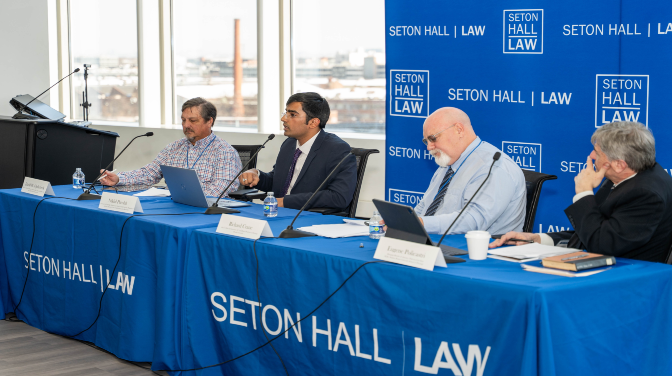
Seton Hall Law School hosted the inaugural Faith, Values and the Rule of Law Conference on Feb. 4–5, 2026. Bringing together a diverse and interdisciplinary group of theologians, scholars, researchers, law and religion professors, and doctoral and graduate students from the United States and around the world, the conference examined how the world’s great religious, theological and philosophical traditions have contributed to contemporary understandings of justice and human dignity that underpin the rule of law.
David Opderbeck, a law professor, theologian and director of the Program on Faith, Values and the Rule of Law at Seton Hall Law School, kicked off the conference by saying: “As a legal scholar, I’ve noticed that ‘law and religion’ in the legal academy tends to center, understandably perhaps, on First Amendment questions. As a scholar in religion and theology, I’ve noticed that political theology and theological ethics often proceed as if the practical difficulties of the law don’t matter.”
He continued, “We gather at a dangerous moment. Democracy and the rule of law in the United States and around the world are under threat.”
The conference aimed to retrieve, in a robust and critical manner, the deep insights of religious and philosophical traditions as a restorative response to these challenges.
Four keynote speakers from various faiths and perspectives provided an overarching framework for the discussions. Imam Mohamad Jebara, an Islamic scholar and author of Life of the Qur’an, delivered the first keynote. He opened with an Islamic chant of the Lord’s Prayer, focusing on interfaith solidarity and ways to repair society.
Cristina Traina, a professor of theology at Fordham University, spoke on Catholic ethics and examined unjust laws and tyranny from a Roman Catholic perspective.
In the afternoon, Rabbi Shai Held, president and dean of the Hadar Institute and author of Judaism Is About Love, discussed a biblical-Jewish approach to human dignity.
Quinta Jurecic, a staff writer at The Atlantic, delivered the final keynote, focusing on the current state of the rule of law in the United States and the role of shared values, civic virtue and public engagement.
During the conference, more than 30 scholars presented works in progress on topics including the Vatican’s view on religious freedom, how Christian values can mask criminal misconduct by church officials in Kenya, narrative ethics in Islamic civilization, Jewish human dignity, and the recovery of faith-based values as essential to sustaining the rule of law.
“As we expand the Program on Faith, Values and the Rule of Law from Seton Hall Law
School into the community, this conference has encouraged us that these difficult
but necessary conversations matter,” Opderbeck concluded. “Our interfaith solidarity
can help us achieve a more virtuous and lawful society.”
 Brett Canaval is the executive director of the Institute for Privacy Protection; the
Gibbons Institute of Law, Science and Technology; and the Program on Faith, Values,
and the Rule of Law at Seton Hall University School of Law. He has held multiple staff
roles at the law school since 2018, including assistant to the dean and legal support
specialist for healthcare and gaming compliance programs. Previously, he served as
manager of administrative operations in Governor Chris Christie’s Appointments Office
and holds a B.A. in elementary education from Kean University.
Brett Canaval is the executive director of the Institute for Privacy Protection; the
Gibbons Institute of Law, Science and Technology; and the Program on Faith, Values,
and the Rule of Law at Seton Hall University School of Law. He has held multiple staff
roles at the law school since 2018, including assistant to the dean and legal support
specialist for healthcare and gaming compliance programs. Previously, he served as
manager of administrative operations in Governor Chris Christie’s Appointments Office
and holds a B.A. in elementary education from Kean University.
For more information, please contact:
Office of Communications and Marketing
(973) 642-8714
[email protected]