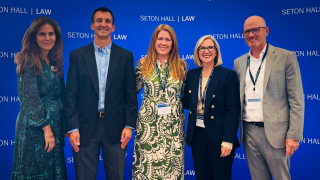
Photo by Sean Sime
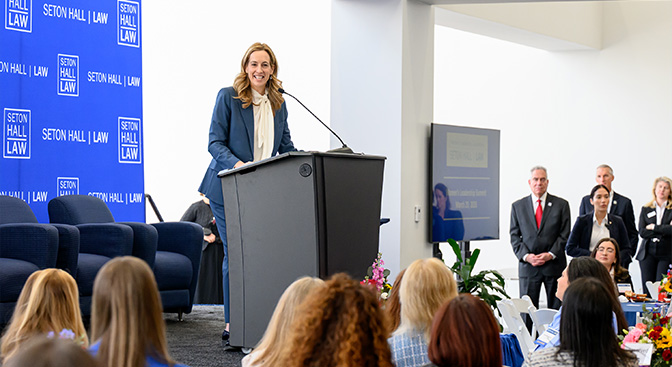
New Jersey Gov. Mikie Sherrill electrified the audience at the Women’s Leadership
Summit, delivering remarks that blended personal experience, policy urgency and a
call to action. Drawing on her path through male-dominated institutions, she urged
attorneys, judges and students to reject the myth of “having it all,” confront persistent
barriers and actively lift the next generation of women leaders.
New Jersey’s 57th governor, Mikie Sherrill, commanded a packed Rodino Library at Seton
Hall School of Law on March 20 with remarks at the Women’s Leadership Summit. Marking
Women’s History Month and the law school’s 75th anniversary, Dean Ronald Weich said
the event drew one of its largest audiences, crediting the guest of honor—a former
Navy pilot, federal prosecutor, congresswoman and now governor.
“This is a law school that has graduated pioneering women,” Weich said. “Those women
paved the way for the next generation of leaders, including the new attorney general
of New Jersey, Jennifer Davenport. I have to thank our special guest speaker for that
excellent appointment.”
Weich traced the school’s trailblazing history: founding dean Miriam T. Rooney was
the first female dean of an ABA-accredited law school in the U.S.; three of the deans
in the school’s 75 years have been women; and nearly 55% of current students are women,
many leading the law review, legislation journal and moot court team.
He highlighted alumnae who broke barriers: Judge Katherine Hayden, the first Seton
Hall graduate appointed to the federal bench; Paulette Brown, the first African American
president of the American Bar Association; and Karol Corbin Walker, the first African
American president of both the New Jersey State Bar Association and the Association
of the Federal Bar of New Jersey.
“A law degree is a license to help people,” Weich said. “Governor Sherrill is using
hers to defend institutions and help the people of this state thrive.”
Sherrill opened with candor and humor, reflecting on her early career in the male-dominated
Navy. “I knew I would be graduating in a class with under 10% women and going out
into the fleet with very few women,” she said. That experience shaped her entry into
another male-dominated arena—the law firm—after attending Georgetown Law.
She drew laughter recounting tone-deaf advice at firm events, including a partner
telling women they could “have it all” while employing three round-the-clock nannies.
“It didn’t sound like having it all to me,” Sherrill said. She offered a more honest
take: “Sometimes I’m a great parent, and sometimes I’m really good at my job. And
oftentimes, those two things don’t intersect very well.”
Tying her personal story to broader national themes, Sherrill spoke of opportunity
and mobility. Drawing on her Irish American family roots—immigrants who lost everything
in the Great Depression and rebuilt through unions and pensions—she said the country’s
promise rests on keeping the ladder accessible. “It was that opportunity available
to him that went from my family having nothing to me being the governor of New Jersey
in just two generations,” she said of her grandfather. “That’s what this country has
traditionally offered.”
She warned of forces narrowing opportunity, recounting an exchange in Congress with
Defense Secretary Mark Esper over dismissals of senior military officials—accusing
him of targeting one because he was Black and another because she was a woman, leaving
him silent.
The story underscored her central argument: that having women, especially mothers,
in positions of legal and political authority is vital. During COVID, it was the mothers
in the House of Representatives who best understood families’ struggles, she said.
“If you are going to legislate for families, you need to have an understanding of
what’s going on in people’s lives.”
Sherrill concluded with a call to mentorship, sharing the story of her neighbor Jill,
a fellow lawyer she recruited as her campaign’s first supporter when she ran for Congress—a
race everyone told her she couldn’t win. Jill became her district director and now
leads the New Jersey Sports and Exposition Authority as the state prepares to host
the FIFA World Cup at the Meadowlands.
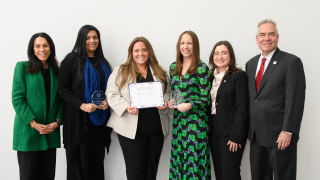
From left: Prof. Paula Franzese; Women of Substance award honorees Pavithra Angara and Megan Monson; Women's Leadership Forum (WLF) student honoree Melissa McGloin; Priscilla Febus, WLF president; and Dean Ronald Weich.
“Find your Jill,” Sherrill urged. “Look around and find her, because that is going to be the person who grows with you.”
She closed with a charge to law students: “The practice of law is not a job, it’s
a calling. And when you do it right, it truly is.”
The summit drew practitioners, judges and students from across the state to explore
leadership, work-life balance, mentorship and the evolving landscape for women in
law through panels and workshops organized by committee chair Suzanne Midlige. Pavithra
Angara and Megan Monson were honored at the Woman of Substance awards.
“Every woman I speak to says, I want to make sure that the people coming up behind
me have it better than I had it,” Sherrill said. “There’s no one path, no how-to book,
but all of us together can make sure everyone has a seat at the table.”
Seton Hall Law’s Women’s Leadership Summit is an annual event celebrating women in
law and public service. Information on the Women of Substance program is available
through the university’s GiveCampus platform.
For more information, please contact:
Office of Communications and Marketing
(973) 642-8714
[email protected]