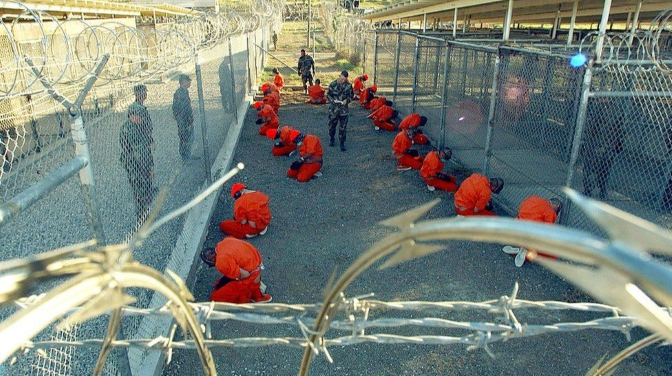
 Detainees in orange jumpsuits at the detention camp at Guantanamo Bay, in January
2002. (Photo by Getty Images)
Detainees in orange jumpsuits at the detention camp at Guantanamo Bay, in January
2002. (Photo by Getty Images)
Joshua Colangelo-Bryan and Eric Lewis discussed their recent books on Guantanamo Bay
detention, diplomacy and the lawyers who challenged one of the most consequential
prison systems in recent history, amid the enduring costs of fear.
What began as a book event at Seton Hall University School of Law became something
deeper—a reckoning with a system of indefinite detention that, its participants argued,
never truly ended.
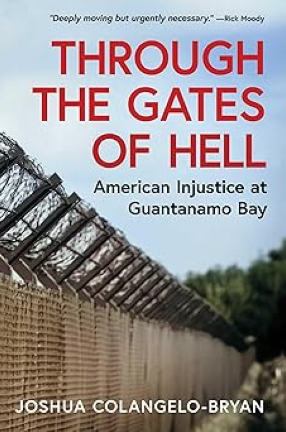
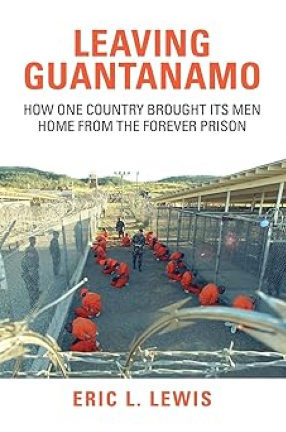
Moderated by law professors Marc Falkoff and Jonathan Hafetz, the panel featured attorneys Josh Colangelo-Bryan, author of Through the Gates of Hell: American Injustice at Guantanamo Bay, and Eric Lewis, author of Leaving Guantanamo: How One Country Brought its Men Home from the Forever Prison. The conversation quickly moved from legal history to present-day relevance. “We are literally seeing now a repeat of the U.S. administration transferring people to Guantanamo that it calls the worst of the worst,” said Hafetz.
Colangelo-Bryan recalled the hopeful moment after the Supreme Court’s 2004 ruling in Rasul v. Bush, which affirmed that U.S. courts had jurisdiction to hear detainee claims. “That sounded like, OK, let’s get ready for some habeas hearings,” he said. “Let’s see what the government’s evidence is.” Instead, years of litigation over procedures followed, with the government relying on “threshold non-merits defenses that seemed kind of silly on their face, given Rasul, but that had to be litigated nonetheless.”
Even as cases stalled, lawyers became the only consistent human contact many detainees had. Colangelo-Bryan’s book centers on Jaber, a Bahraini detainee held in near-total isolation—confined 23 to 24 hours a day in solid-wall cells without windows. “The only book he was allowed to have was the Quran, which he had memorized,” his lawyer said. During one visit, Jaber asked, “What do I do to keep from going crazy?” Colangelo-Bryan paused. “There’s really no good answer to that question given his situation.”
The charges against Jaber were thin. He was accused of firing a rifle in Afghanistan in 1989 at age 16 during a Saudi-sponsored school trip, and of traveling to Bosnia in 1995, a visit motivated by what he was told was “a place you could meet a blonde Muslim woman and potentially marry her.” “He did not succeed,” Colangelo-Bryan added wryly. The most serious allegation—that Jaber was “present at Tora Bora”—traced back to a mentally unstable Yemeni detainee who told interrogators he had given them 100 names. “The military had completely disbelieved this Yemeni man because he was telling incredible stories,” Colangelo-Bryan said.
Patterns like these, panelists argued, repeated across detainee cases. Lewis described representing Kuwait’s last two detainees around 2013. Their review board—made up of officials from the Defense Department, CIA, Joint Chiefs of Staff, Justice Department, and Office of the Director of National Intelligence—required unanimous consent to release anyone. “This was not the most inherently sympathetic tribunal, I think we could say,” Lewis said. His clients had entered Guantanamo in their 20s and were nearing 40. “They had kids who were 4 or 5 years old that they had never met.”
Lewis worked to structure a rehabilitation framework through Kuwait’s judiciary, which demanded evidence before continued confinement. “They said, ‘You don’t need evidence, just leave them in jail,’” he recalled of U.S. positions. “But Kuwait’s courts took a different view: no evidence, no case—there’s no basis to hold them.”
 Seton Hall Law’s research played a pivotal role in shaping public understanding of
Guantanamo. Its Center for Policy & Research analyzed thousands of pages of government
documents and found that up to 86% of detainees were sold for bounties and 95% were
never captured by American troops. “Only one in 10 of the detainees was even accused
of being associated with al-Qaida,” Falkoff said, “when the public imagination had
them all gnawing through hydraulic lines of jets.” The center’s findings were later
cited in the Supreme Court’s 2008 Boumediene v. Bush decision affirming detainees’
constitutional right to habeas corpus. “It almost never happened, and the report was
a critical factor that prompted the Court to hear the case,” Hafetz noted.
Seton Hall Law’s research played a pivotal role in shaping public understanding of
Guantanamo. Its Center for Policy & Research analyzed thousands of pages of government
documents and found that up to 86% of detainees were sold for bounties and 95% were
never captured by American troops. “Only one in 10 of the detainees was even accused
of being associated with al-Qaida,” Falkoff said, “when the public imagination had
them all gnawing through hydraulic lines of jets.” The center’s findings were later
cited in the Supreme Court’s 2008 Boumediene v. Bush decision affirming detainees’
constitutional right to habeas corpus. “It almost never happened, and the report was
a critical factor that prompted the Court to hear the case,” Hafetz noted.
Panelists reflected on how those rulings might fare today. Colangelo-Bryan suggested changes in the judiciary have shifted the legal landscape for detainee claims. “My strong suspicion is that we would never have gone to Guantanamo at all as lawyers because the Supreme Court, as it’s constituted now, would have laughed the detainees out of the building,” he said.
Lewis expanded the discussion to the broader impact of Guantanamo on American attitudes toward interrogation. “Torture was normalized in American life through Guantanamo,” he said, recalling Donald Trump’s 2016 campaign statement supporting waterboarding. “He said basically that even if it doesn’t work, they deserve it—and their families, too.”
Both speakers argued that similar logic still drives policy today. “The ideology underpinning both eras is the idea that if you demonize a group of people, you tell the dominant group of Americans that that demonized group is a dangerous threat and you’re going to have to deal with them outside the niceties of law,” Colangelo-Bryan said. “It’s literally the same base, the same verbiage, the same cruel political theater.”
Lewis closed with a historical analogy that underscored how the era is likely to be remembered. “I thought when Guantanamo happened that this was the Korematsu for our generation,” he said, referring to the now infamous internment of Japanese-Americans during World War II. “And I still think that.”
The discussion ended not with resolution, but with recognition that the legal and moral questions raised by Guantanamo remain unsettled—and that their consequences continue to shape debates over detention, due process and wartime authority.
For more information, please contact:
Office of Communications and Marketing
(973) 642-8714
[email protected]