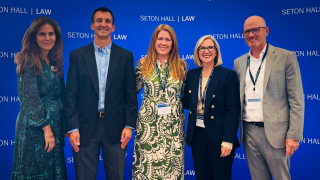
From left: Matthew Borowick, vice president of University Relations; Dean Ronald Weich;
Rep. LaMonica McIver; and Professors Lissete Diaz and Lori Borgen. (Photo by Sabina
Lee)
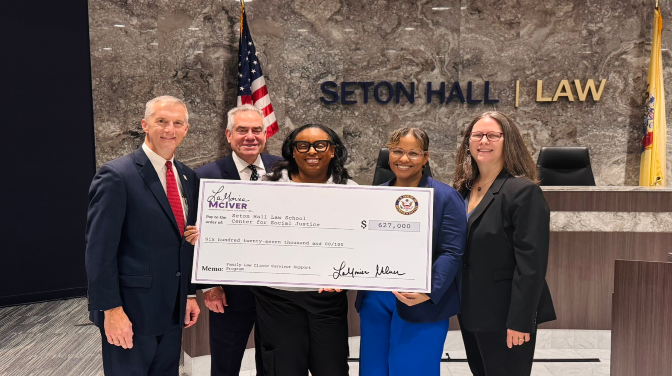
Congresswoman LaMonica McIver presented new federal funding to strengthen the Family
Law Clinic’s work preventing domestic and sexual violence and supporting survivors.
She reaffirmed her commitment to fighting for investments that protect local communities,
highlighting the program’s life-saving and generational impact.
Students, faculty and community partners gathered Feb. 18 at Seton Hall Law School
for a check presentation ceremony with LaMonica McIver, recognizing new federal funding for the Family Law Clinic. The funding will expand the clinic’s community-based work to prevent domestic and
sexual violence, strengthen legal services for survivors, and deepen hands-on training
for students preparing for public service careers.
Speakers emphasized a shared commitment to community-centered justice, noting that
the clinic’s impact extends beyond the courtroom to protect lives, educate young people
and interrupt cycles of abuse.
Dean Ron Weich opened the program by underscoring that the clinics are central to
Seton Hall Law’s public service mission. He highlighted the Family Law Clinic’s role
in providing critical legal representation to survivors of domestic and sexual violence—many
of whom face significant barriers to accessing the justice system—while preparing
students to serve with empathy, skill and purpose. The clinic’s success, he said,
is measured not only in cases won, but in lives stabilized and futures reclaimed.
Lori Borgen, director of the Center for Social Justice, who led the research compiling legal resources on access to justice for New Jersey residents, introduced Professor Lissete Diaz.
Diaz illustrated that impact through a case that revealed family law’s generational
reach. She recalled a case involving a man seeking to vacate a final restraining order
so he could gain custody of his grandchildren, who were at risk of entering foster
care. The case, she said, prompted her to reflect on the power of early education
and intervention. “What if instead of a final restraining order at 19, he had taken
our workshop at 16 or 17?” Diaz asked. “What if he had learned the tools to regulate
his emotions and recognize the red flags of an unhealthy relationship?”
“Family law is generational,” she said. “When you look at it from that larger scope,
you really begin to understand how much impact we can make—and how much this funding
will matter in the lives of our clients.”
Diaz expressed her gratitude to McIver for her leadership and advocacy on behalf of
survivors and marginalized communities. “We exist at a time when so many people don’t
fight for those with different identities or life experiences,” she said. “You’ve
led by standing up for this community—the one we serve and live in.”
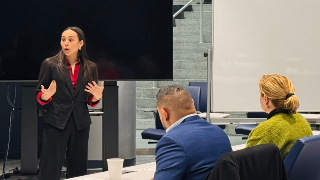
Former clinic student Kayla Bowie '26, speaks about how the clinic shaped her legal education and sense of purpose.
That mission was brought into focus by former clinic student Kayla Bowie, Class of
2026, who described how the clinic reshaped her legal education and sense of purpose.
“It made me not just a student learning the law, but someone who was actually there
for another person,” Bowie said. “Being a hand for someone to hold in the courtroom
was incredibly rewarding.” Bowie described representing clients seeking restraining
orders, navigating custody disputes, and helping individuals leave long-term abusive
relationships. Many clients, she said, were unfamiliar with their legal rights. “Being
able to explain the process and provide a sense of calm when they feel scared and
alone is something I’ll always take with me,” she said.
She also highlighted the clinic’s outreach efforts, including virtual domestic violence
forums and presentations to local high school students on recognizing warning signs
of abuse. Early education, she noted, can help prevent harm before it escalates.
McIver closed the program by emphasizing the importance of directing federal resources
to programs with measurable, life-saving impact. Her office, she said, was delivering
approximately $10 million back into the district that day. “It’s important to bring dollars back to our communities,
especially for programs like this one; it saves lives—literally,” McIver said.
She praised the Seton Hall team for navigating the competitive federal funding process
and spoke candidly about the urgent need for services that support survivors and young
people in unhealthy relationships. McIver reaffirmed her commitment to the clinic’s
mission. “I’m going to continue to fight for every penny I can to support our community,”
she said. “This work matters, and it protects people when they need it most.”
Following the remarks, McIver posed for photos with attendees and the ceremonial check,
marking not just a funding milestone, but a collective investment in justice, safety
and the power of early intervention.
For more information, please contact:
Office of Communications and Marketing
(973) 642-8714
[email protected]