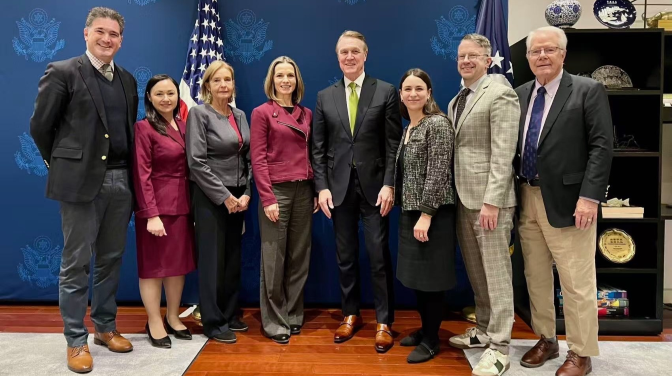
Margaret K. Lewis and other members of a U.S.-China Education Trust delegation meet
with Ambassador Perdue and staff at the U.S. Embassy in Beijing, December 2025. (Photo
courtesy of Lewis)
In an era of profound international competition and shifting paradigms, Professor
Margaret K. Lewis examines how law shapes civil liberties, research security, and
transnational engagement in the U.S.-China relationship and beyond.
The upcoming Trump–Xi summit will surely make headlines for its politics, but its
significance also lies in the legal frameworks shaping a tense bilateral relationship—from
sovereignty to technology governance to civil liberties to scientific collaboration.
A recent panel at the University of Pennsylvania, in which I participated, underscored how U.S.-China
competition and broader global dynamics reverberate through domestic law and individual
rights. As the rivalry deepens, legal institutions increasingly mediate collateral
effects, whether through export controls, research security scrutiny, or examination
of their impact on Asian American communities.
Those themes have come to life this spring at Seton Hall Law through Law, Geopolitics
and the Asian American Experience, a new seminar that examines how foreign policy
tensions shape domestic understandings of race, rights and belonging. Built on traditional
courses addressing Asian Americans and the law, the seminar is distinctive in integrating
geopolitical analysis into legal education, including U.S.-China relations, the broader
Indo-Pacific and transnational identity. Drawing on constitutional, criminal and immigration
law, it examines how global concerns can blur the line between legitimate security
interests and civil rights protections. Guest speakers like Gisela Kusakawa, executive
director of Asian American Scholar Forum (AASF), have deepened the conversation by showing how law can both reflect and resist geopolitical pressures.
Outside the classroom, I contribute to policy discussions through service with the
National Committee on U.S.-China Relations, the NSF-funded Safeguarding the Entire Community of the U.S. Research Ecosystem (SECURE) Center, and AASF, which advances Asian American contributions in science, engineering, technology,
and medicine while promoting academic belonging, freedom and equality for all.
A recent letter from Representatives Ro Khanna and Grace Meng of California and New York, respectively,
captured a central point: the United States needs robust, data-driven approaches to
strengthen the research ecosystem while sustaining the talent pipeline. Policies that
create chilling effects on Asian American communities undermine American values and
leadership.
The course also situates Asian American legal history within broader transnational
contexts. Discussion of Korematsu v. United States, which upheld the wartime internment of Japanese Americans, connects civil liberties
in wartime to contemporary questions of national loyalty. That history resonates in
New Jersey, which annually observes Fred Korematsu Day on January 30. The aim is not only to remember injustice, but to examine how fear
and foreign policy repeatedly intersect with our legal system.
The U.S.-Japan relationship is also instructive. As a fellow in the U.S.-Japan Leadership
Program through the U.S.-Japan Foundation, I have seen how cooperation between the two countries matters not only for military
security, but also for trade, technology and supply chains, including critical minerals
and semiconductors. Japan is a vital partner in shaping resilient, rules-based economic
relations in the Indo-Pacific.
The course has also benefited from a conversation with Jennifer Smith of the International Legal Foundation, whose work in Afghanistan illustrates another dimension of international engagement:
expanding access to justice through criminal defense. That discussion helped students
see that law’s global reach is not limited to great-power competition. It also includes
the patient, practical work of building fairer institutions where the rule of law
remains fragile.
Work on these issues extends across the university. Seton Hall Law’s collaboration
with the School of Diplomacy and International Relations on projects that keep open channels with Chinese thought leaders—including candid exchanges about
Taiwan and evolving regional dynamics—demonstrates the value of principled dialogue
even in tense moments.
The scholarship and research students engage in today will be vital to how the United
States grapples with these issues. The U.S.-China Education Trust working group emphasized
that China expertise must be treated as a national resource. Our report on America’s China Talent Challenge, now resonating in The Chronicle of Higher Education Latitudes newsletter, argues that deeper understanding of China is a strategic necessity. Likewise, the
combination of understanding Asia, geopolitics and law is not optional; it is essential.
As the world watches the Trump–Xi summit, the deeper challenge lies in ensuring that
legal principles endure amid political flux. Preparing the next generation of lawyers
to navigate that challenge is central to Seton Hall Law’s mission: leading with purpose
For more information, please contact:
Office of Communications and Marketing
(973) 642-8714
[email protected]