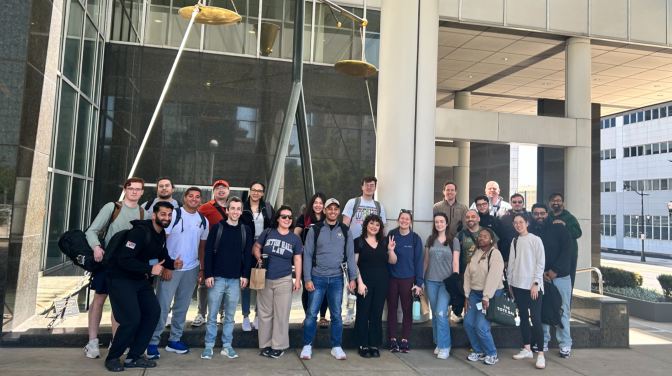
 Seton Hall Law's "weekend warriors" pose on campus. (Photo courtesy of Tinamarie A.
Guzman)
Seton Hall Law's "weekend warriors" pose on campus. (Photo courtesy of Tinamarie A.
Guzman)
Seton Hall Law’s Weekend J.D. hybrid program—the only one of its kind in the tri-state
area—offers New York Bar-compliant legal education for working professionals balancing
demanding careers and family life.
For working professionals seeking a legal career without stepping away from their
jobs, Seton Hall University School of Law’s hybrid Weekend J.D. program is gaining
momentum—and national recognition. The program climbed to No. 11 in the 2026 U.S.
News & World Report part-time law rankings, reflecting both rising demand and stronger
incoming credentials.
“The weekend program jumped this year,” said Peter Eraca, dean of admissions. “Our LSAT median rose four or five points, which helped drive the move to No. 11—historically where we belong.”
Launched in 2016, the Weekend J.D. builds on a longer history. Seton Hall’s original part-time program dates back to the law school’s founding in 1951 but was particularly valuable to veterans returning from Vietnam, AT&T scientists pursuing intellectual property law and others needing a flexible path to the bar.
Founding Dean Kathleen Boozang, together with the faculty led by Professors John Kip Cornwell and Maggie Lewis, shaped the modern program around three priorities: access, rigor and outcomes. “Access was first. Quality was second,” said Boozang, who teaches in the program. “We wanted graduates who would pass the bar, be accepted by employers and learn from the same faculty, with the same curriculum as full-time students.”
The four-year hybrid model delivers about two-thirds of coursework in person every other weekend in Newark, with the remainder completed asynchronously online. The structure complies with New York Court of Appeals distance-learning rules, among the nation’s strictest, preserving eligibility for the New York bar.
“Many students plan to sit for the New York bar, so compliance was nonnegotiable. We remain one of the few hybrid programs nationwide that meet those rules,” Eraca said. “Our admissions standards are not relaxed.”
Cohorts are intentionally small, about 35 to 40 students, creating a close-knit academic
environment. Students, typically in their 30s, bring significant professional experience,
including pharmacists, corporate executives, academics, veterans and international
professionals working in the United States.
“They broaden classroom discussions in meaningful ways,” Boozang affirmed. “When they’re
here on weekends, they’re prepared, engaged and fully present. Our weekend students
perform on par with full-time students.”
Reigning Jeopardy! champion Jamie Ding ‘27 and graphic designer-turned-attorney Lizz
Lesso ‘25 found their calling in Seton Hall Law's Weekend J.D. Program—without giving
up their day jobs. Learn more.
Unlikely Weekend Warriors

Results reflect that focus. First-time bar pass rates for July 2025 reached 87.2%
in New Jersey and 86.5% in New York. Employment for the Class of 2025 was 97.6%, with
90.8% in full-time, long-term jobs requiring or benefiting from a J.D.
Seton Hall’s early investment in online instruction years before the COVID-19 pandemic proved critical. “Before COVID, we had already figured out how to deliver high-quality online education,” Boozang said. “We didn’t miss a single class.”
The alternating-weekend format remains distinctive in the tri-state area, preserving the workweek in a way few competing programs can match. "Our students can still have dinner with their families during the week," Eraca said. "That time matters."
Career outcomes mirror the academic results. Weekend students are included in overall employment reporting and perform comparably to full-time peers. “They’re passing the bar and getting the jobs they want,” said Jacqueline C. Pirone, assistant dean of career services. “Within 10 months, they’re typically fully employed—either advancing where they started or moving into new legal roles.”
Clerkships remain a defining strength. Seton Hall ranks No. 1 nationally for placing graduates in state and local judicial clerkships, with more than 40% of each class entering those roles. “Each year, four to eight students clerk at the New Jersey Supreme Court,” Pirone said. “About half the state judiciary are alumni, and even judges who didn’t attend Seton Hall are looking for our students. It's hard to attend a legal event and not run into Seton Hall Law alumni," Pirone emphasized the strength of the network.
Weekend students have secured top clerkships and positions at major New York law firms. Overall, 15% to 20% of graduates enter firms with 500 or more attorneys, and nearly all receive return offers after their summer associate roles.
Career services are tailored to working professionals, offering virtual counseling, judicial networking events with more than 80 judges and access to clinics and externships. The weekend program has also expanded to include a cohort for international professionals working in the United States on visas, a population often underserved by traditional LL.M. programs.
While school officials are watching the impact of artificial intelligence on legal practice, they see limits to its reach. "AI can't replace the human side of lawyering," Eraca said. "Sitting across from a client, understanding their problem and earning their trust—that's core to the profession."
Among the 207 graduates in the Class of 2025, 72.5% remain in New Jersey and 18.4% in New York. Clerkships accounted for 44% of employment outcomes; private practice 38.2%, nearly half in firms with more than 250 attorneys; corporate and business roles 8.2%; and government and public interest 6.3%. Just 2.4% reported being unemployed, including those not seeking employment.
For students balancing work, family and legal study, Seton Hall Law's Weekend J.D. does not require putting their lives on hold. It offers a chance to expand their horizons and pursue legal education on their own terms. The discipline it demands makes the payoff all the more meaningful. Year after year, Seton Hall lawyers deliver strong results, forging thriving careers across the bench, bar and business.
For more information, please contact:
Office of Communications and Marketing
(973) 642-8714
[email protected]