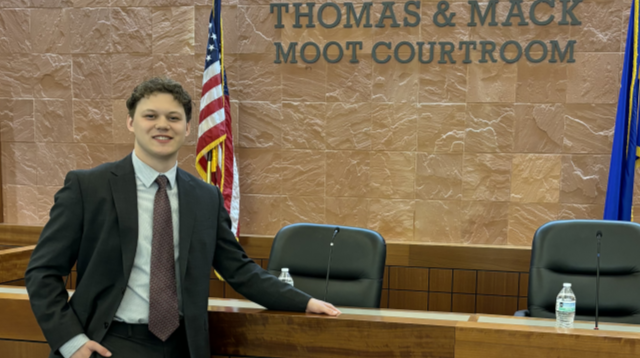
Army first lieutenant and Seton Hall Law student Trevor Johnson draws on his family’s
legacy of service as he prepares for a career in military law.
For Trevor Johnson, service is a family legacy. His father spent 30 years in the Army
but rarely talks about his military career. Growing up, Johnson saw how his father’s
service shaped their family’s life and came to appreciate the sacrifices that came
with it. “When I reflect on Veterans Day, I think of the people who don’t get the spotlight
but have contributed so much,” he said.
Now an Army first lieutenant and third-year student at Seton Hall University School
of Law, Johnson is preparing to fulfill his military service commitment as an attorney
in the Army Judge Advocate General’s Corps (JAG). His journey from a childhood spent
abroad to studying journalism in New York and pursuing a law degree reflects his interest
in understanding people and serving his community.
Born in Vicenza, Italy, Johnson moved with his father’s Army assignments through Germany,
a brief stay in Belgium, Hawaii, Texas and Virginia. Each arrival meant learning a
community’s traditions and finding his place within it. Germany introduced him to
folklore and the Brothers Grimm. In Hawaii, he learned about ocean currents, local
customs and making leis. Texas introduced him to football culture, while living in
Virginia near Washington, D.C., sharpened his interest in American history and politics.
Being the newcomer taught him to listen, observe and ask questions: “What place am
I in? Who are these people? How can I fit in?” Military life provided continuity.
Army after-school programs, friendships with other military children and gatherings
at the base bowling alley created familiar surroundings. “Hail and farewell” events
marked the arrivals and departures that defined the community.
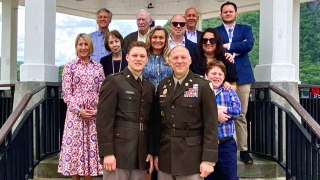
At home, public service was a shared commitment. His father, retired Army Col. Mark
Johnson, served for 30 years. His mother, Maida Johnson, immigrated from Bosnia and
Herzegovina in the late 1990s and serves as race director of the Army Ten-Miler in
Washington. His brother, Ethan, works for the U.S. Department of Agriculture. “My
family has just taken that to the degree that we think the best way to help is to
be a part of the system that’s helped us,” Johnson said.
An Army ROTC scholarship made his undergraduate education at New York University possible.
Studying journalism and politics, he turned his childhood curiosity into reporting,
knocking on doors, approaching strangers and finding stories on city streets. The
work taught him to gather information, synthesize different accounts, and explain
what he learned. His interest in the First Amendment led him to constitutional law
and, ultimately, to law school.
With a four-year Army service commitment ahead, Johnson needed military approval to
continue his education. Seton Hall Law offered proximity to New York, a substantial
scholarship and a strong bar passage rate—important considerations for an aspiring
Army attorney.
At Seton Hall Law, faculty helped him translate that ambition into advocacy. Professor
Jenny-Brooke Condon’s constitutional law class challenged him to deepen his understanding
of the Constitution, and her mentorship extended to his moot court work. He was also
selected for the Equal Justice Clinic, led by Condon, where he will work with incarcerated
clients in post-conviction work. Condon had “a very profound impact” on him, Johnson
said, citing her perspective and the intellectual demands of her class.
He also credits Professor Jonathan Barrera, who taught appellate advocacy, with helping
him develop his first appellate brief. Barrera offered detailed feedback and brought
enthusiasm to students’ writing and oral arguments. Together, these experiences connected
legal principles to the responsibilities of an advocate. “They were phenomenal in
teaching me how to actually write, argue and learn about the Constitution and my role
in it,” Johnson said. 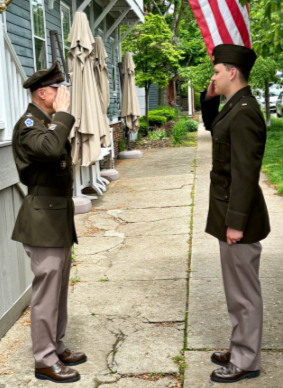 Johnson pursued opportunities beyond the classroom with the independence he developed
growing up. “If I want something, I have to go out and get it.” During his first year,
he advanced to the semifinals of the Ronald J. Riccio First-Year Moot Court Competition and
earned a place on the moot court team. Internships with the U.S. Attorney’s Office
and the federal public defender’s office allowed him to explore litigation from different
perspectives while reinforcing his interest in public service.
Next, Johnson expects to learn whether he has been selected for the JAG Corps by Thanksgiving.
He then will take the bar exam after graduation and when accepted into the JAG Corps,
complete the Army’s initial legal training at the University of Virginia, with training
expected to conclude in late 2027.
This Veterans Day, Johnson also recognizes service within the Seton Hall Law community.
He points to fellow students Bradley Mikinski, whom he described as having recently
transitioned from an Active Duty Officer to the reserves, and Josh Cho, who served
as both an enlisted service member and an officer. Like his father, they contribute
without seeking recognition.
Johnson’s gratitude extends to his mother, whose sacrifices helped sustain his father’s
career and the family’s many moves. Their example gave him more than an appreciation
for military life. It shaped his sense of responsibility to others.
Growing up in military communities taught him to adapt, build relationships, and work
alongside people from different backgrounds. As he anticipates a future in the military,
Johnson hopes to extend to others the care and opportunities he received. For him,
service means “helping people and giving back to the community in anyway, no matter
how large or small the impact.” His path ahead is still taking shape, guided by his
family’s legacy and gratitude for the communities that helped raise him.
For more information, please contact:
Office of Communications and Marketing
(973) 642-8714
[email protected]