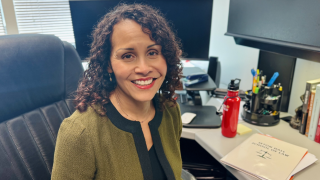
Associate Professor Amy Mary Saji argues that what is designed to protect students
with disabilities from exclusionary discipline is flawed. She proposes replacing it
with a proactive behavioral services framework in her forthcoming article in the Maryland
Law Review.
For years, Associate Professor Amy Mary Saji sat in meetings where, she says, the
outcome seemed decided before she walked through the door. As a special education
parent attorney, Saji represented students at Manifestation Determination Reviews,
or MDRs. These meetings are required when a school seeks to remove a student with
a disability for violating its code of conduct.
An MDR is meant to determine whether the student’s behavior was related to the disability or resulted from the school’s failure to implement the student’s Individualized Education Program, or IEP. If so, the conduct must be considered a manifestation of the disability, subject to certain exceptions. “On paper, the process is a safeguard. In practice, it often felt like the opposite," Saji says. "The children and parents were already losing. They were being set up to lose.”
That gap between the law’s promise and families’ experiences is at the heart of Saji’s forthcoming article, “Manifesting Exclusion?” It will appear in the Maryland Law Review, Volume 86, in April 2027. “What we see intended by federal special education law is not what is happening in practice,” Saji says. Her article traces that gap to an earlier era, when exclusion was built into the education system.
Fifty years ago, school districts could legally exclude children with disabilities from public education. Millions were denied an appropriate education. Many were separated from their nondisabled peers and placed in facilities with inadequate services. Children of color with disabilities were disproportionately affected.
The civil rights movement helped disability advocates challenge that system. Their efforts helped lead to the Individuals with Disabilities Education Act, or IDEA. The law established the right to a free appropriate public education in the least restrictive environment and created procedural safeguards for students and families. The MDR was one of them.
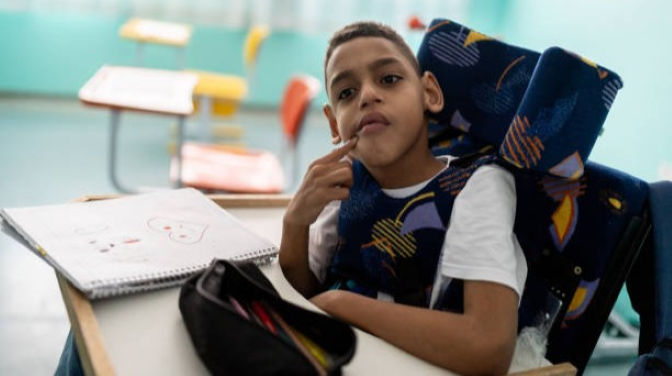
Yet students with disabilities are still disciplined at nearly three times the rate of their nondisabled peers, Saji notes. The disparity is greater for students of color with disabilities. Exclusionary discipline can also contribute to lost educational progress, school dropout and involvement in the school-to-prison pipeline.
For Saji, the problem is not simply how MDRs are implemented. It is the structure of the process itself.
By the time an MDR takes place, a disciplinary incident has already occurred and the school is seeking removal. “MDRs are built on a process that is reactive, and they’re adversarial,” Saji says. That drives the central argument of “Manifesting Exclusion?” The answer is not to improve MDRs. It is to eliminate them.
Saji proposes replacing the IDEA’s MDR requirements with a “behavioral services” framework. Rather than waiting for a disciplinary crisis, schools would use proactive, collaborative and restorative interventions to address the causes of behavior.
Her approach draws on transition planning, another area of special education law. Schools already work with students and families to set goals for life after high school and create plans to achieve them. Saji proposes applying a similar model to behavior. Parents, educators and, when appropriate, health professionals could develop individualized de-escalation and support strategies before a crisis occurs.
Her perspective is also personal. As the daughter of South Indian immigrants, Saji saw how difficult it can be for families to navigate the education system, particularly when English is not their first language or they do not know how to access services their children need. Those experiences shaped her understanding of how much a child’s educational opportunities can depend on ZIP code, resources and a family’s ability to advocate. “My experience would have looked very different from one neighborhood to the next,” she says. That understanding has stayed with her throughout her legal career.
Ultimately, Saji sees the issue as one of equal rights and dignity. “Children with disabilities deserve to be supported in school.”
That commitment will shape Saji’s teaching and scholarship at Seton Hall this academic year. This fall, she will teach the Health Advocacy and Collaboration Law Clinic, which she founded as the law school’s first medical-legal partnership. The clinic addresses legal issues that affect health and well-being, including education.
She is also exploring special education through a broader children’s health justice framework and was selected for the 2026 Health Law Scholars Workshop.
In spring 2027, Saji will bring Special Education Law back to the law school curriculum. She says the course has not been offered at Seton Hall in several years. It is already generating interest among current and prospective students.
For Saji, the question is not whether the law promises inclusion. It is whether that promise reaches the students it was written to protect.
For more information, please contact:
Office of Communications and Marketing
(973) 642-8714
[email protected]