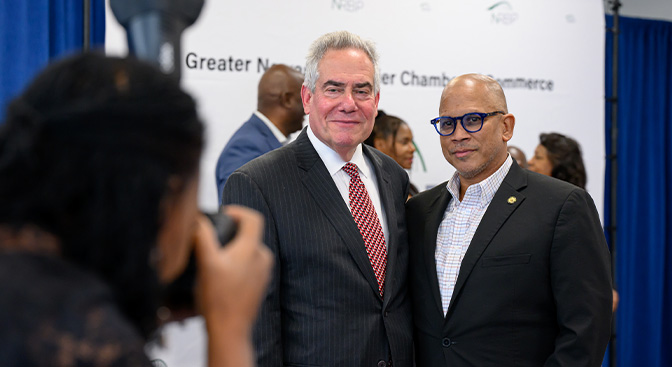
Dean Ronald Weich at NRBP Summit. (C)Sean Sime
Seton Hall Law Dean Ronald Weich told business and civic leaders that the rule of
law is essential to economic stability and public trust during a keynote address at
the Newark Regional Business Partnership’s Leadership Summit. Speaking at the law
school on Jan. 16, Weich pointed to Newark’s history and the legacy of Congressman
Peter Rodino as examples of principled leadership during periods of national strain.
Dean Ronald Weich spoke about the rule of law at a moment when the phrase is often
invoked but less frequently examined. His keynote, delivered Jan. 16 at the Newark
Regional Business Partnership (NRBP)’s Leadership Summit, set out to do the opposite:
to consider what the rule of law actually does, why it matters, and what happens when
it is tested.
The event was hosted by Seton Hall University School of Law at its Newark campus, a setting Weich used to frame much of his talk. Relatively new to Newark, he described his return to the region after a career that included public service in Washington D.C. and as dean of the University of Baltimore School of Law. Praising NRBP as an influential force in sustaining the region’s economic life, he noted that education is part of that infrastructure.
Founded in 1951 and marking its 75th anniversary this year, Seton Hall Law made a consequential decision decades ago to remain in Newark when many institutions were leaving. That choice, Weich said, positioned the law school as an anchor during a period of transformation that continues today.
The city, in many ways, functions as the law school’s campus. Through the clinics within its Center for Social Justice, students work under faculty supervision on cases involving immigrants, tenants, criminal defendants, and small businesses. The work reflects the school’s broader commitment to civic engagement.
Emphasizing the importance of the rule of law, Weich described it not as a slogan but as a set of conditions: laws that are publicly known, stable, and enforced fairly; courts that operate independently; and procedures that allow people to be heard before decisions are made about them. The rule of law, he said, is what separates governance by institutions from governance by individuals.
The Constitution sits at the center of that system. It does not resolve every dispute, but it establishes the rules by which disputes are resolved. That is why public officials swear to uphold it, and why its endurance depends less on any single actor than on the willingness of institutions to respect its limits.
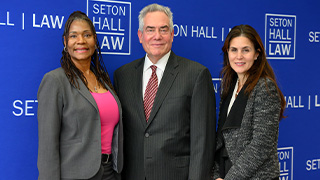
From left to right: NRBP President and CEO Viviana Lamm, Dean Ronald Weich, and Assistant Dean for Global Compliance & Programming Rosa Alves.
For the business community, Weich argued, the rule of law is not abstract. Predictable rules allow businesses to plan and invest. Property rights, both physical and intellectual, are protected. Disputes are resolved through courts rather than power. When laws apply evenly, competition is fairer, risk is lower, and economic activity is more stable.
To give those ideas historical context, Weich pointed to the legacy of Congressman Peter W. Rodino Jr., in whose honor the law school library is named. The son of Italian immigrants, Rodino rose from modest circumstances to become chair of the House Judiciary Committee and a central figure in mid-20th century U.S. legal developments, including immigration reform and civil rights legislation.
Rodino is best remembered for his role during Watergate. As chair of the Judiciary Committee, he oversaw the impeachment inquiry into President Richard Nixon. At a time of intense political pressure, Rodino insisted on procedure—clear rules, a deliberate pace, and bipartisan participation. The process mattered as much as the outcome. Nixon resigned before the House voted, but the legitimacy of the inquiry rested on the care with which it was conducted.
Rodino’s example, Weich suggested, offers a way to think about leadership during periods of stress. The rule of law does not prevent conflict; it provides a structure for managing it.
Turning to the present moment, Weich described a political environment in which executive power has expanded and many of the boundaries envisioned by the Constitution are being tested. Courts, he said, are now being asked to decide questions that go to the heart of that balance.
Whether the system holds depends on institutions doing their jobs and on citizens paying attention. For business leaders, the stakes are not theoretical. A legal system perceived as arbitrary or politicized undermines confidence, investment, and long-term growth.
The rule of law, Weich concluded, is not self-enforcing. It endures only if leaders—public and private—treat it as something more than a backdrop. In times of change, it becomes the central concern.
For more information, please contact:
Seton Hall Law Office of Communications
973-642-8714
[email protected]