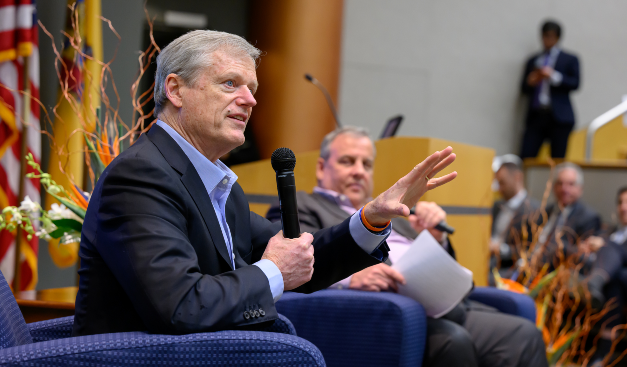
NCAA President Charlie Baker takes the center stage while Gov. Chris Christie observes (c) Sean Sime
Former governors Chris Christie and NCAA President Charlie Baker spoke about the forces
reshaping college athletics, from lawsuits and the transfer portal to sports betting
and the growing tension between amateur ideals and a multibillion-dollar industry.
Former Republican Governors Chris Christie of New Jersey and Charlie Baker of Massachusetts
gathered Feb. 12 at Seton Hall Law School to discuss the turbulent landscape of college
athletics. During the 90-minute conversation, they examined lawsuits, revenue disputes,
the transfer portal and student-athlete welfare, while reflecting on leadership and
the human side of college sports.
Baker, who has served as president of the National Collegiate Athletic Association (NCAA) since March 2023, described the $20 billion–plus industry as undergoing “a complete sea change.” He cited the transfer portal and a “win-at-all-costs” culture as major threats to the student-athlete experience.
The discussion, hosted by The Christie Institute for Public Policy, opened with remarks from Dean Ronald Weich, who described college athletics as both a cultural institution and a legal enterprise operating “at the intersection of business, law and public trust.”
Christie, a Seton Hall Law alumnus, supported Baker through his political career. Baker joked that his father would have called it “a checkered career,” recalling early stints at small newspapers before realizing journalism was not hiring. “That was a really bad labor market and a bad time to want to get into journalism,” he said. Baker later earned a Master of Business Administration from Northwestern University’s Kellogg School of Management and held leadership roles in business and state government before entering politics.
The conversation then turned to Baker’s NCAA tenure, where he inherited legal and operational challenges, including disputes over name, image and likeness rights, revenue-sharing negotiations and transfer rules. One of his first steps, he said, was meeting with all 97 athletic conferences and about 1,000 student-athletes.
“If you really want to know what’s on people’s minds, you can’t expect to get the unvarnished truth through your staff,” Baker said. “The biggest issue they raised wasn’t compensation; it was harassment tied to sports betting.”
When Christie asked what single issue he would change with a “magic wand,” Baker pointed
to the transfer portal, saying the open system undermines academic progress and personal
development.
“It’s incredibly disruptive,” Baker said. “I liked the old rule — you could transfer
once and play right away. The portal is destabilizing. It’s not just a rule; it affects
real people, real teams, real lives.”
Those conversations led to changes involving health insurance, guaranteed scholarships and mental health requirements. “It reminded me that leadership isn’t about policy in a vacuum,” Baker said. “It’s about understanding the people the system serves.”
Christie noted that policy often lags behind technology and culture. “Technology is always going to go much quicker than the law,” he said, adding that rules adopted just a few years ago can quickly become obsolete.
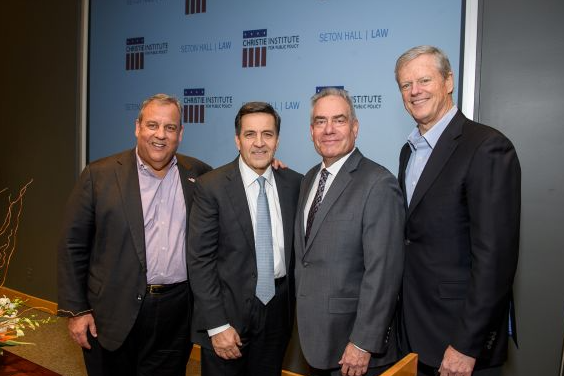
From left: Gov. Chris Christie '87, Christie Institute Board Chair William Palatucci '89, Dean Ronald Weich, and NCAA President Charlie Baker. (c)Sean Sime
Baker said commercialization has fueled an unhealthy obsession with winning at the expense of athlete well-being, when highlighting tension between the traditional amateur model of college sports and its modern reality as a multibillion-dollar industry. “If people worried a little less about winning, it would dramatically improve a lot of things,” he said, calling many current challenges “self-inflicted wounds” the NCAA is now trying to heal.
Beyond sports, the Governors reflected on their political careers as Republicans leading Democratic-leaning states. Baker said losing his first gubernatorial race in 2010 was “incredibly educational.” “If you ever run again, go campaign in places you know you’re going to lose,” he told students, noting the approach helped him win his next race by the smallest margin in Massachusetts history before securing a 67% reelection victory.
Christie emphasized the lasting value of personal relationships over political power. “The things that last are the friendships,” he said. “Power is temporary. Influence is temporary. They’re in love with the job, not you.”
Audience questions focused on challenges facing the NCAA. A Rutgers football season ticket holder asked whether name, image and likeness spending could be capped to promote parity. Baker said revenue-sharing limits reflect legal realities as much as competitive goals, noting that without settlements, the NCAA faced potential exposure of $15 billion to $18 billion. Other questions centered on sports betting and mobile wagering. Baker said prop bets tied to individual athletes have fueled harassment and threats. “I just think it stinks that kids have to deal with that,” he remarked.
Christie said spreadsheets cannot capture the full impact of policy decisions. “Athletes, parents and coaches all have perspectives you won’t see in a board report,” he said. “You have to hear them directly.”
Baker said the NCAA is expanding resources to help student-athletes manage modern pressures, including education on sports betting risks and professional representation. He also discussed what truly matters beyond the scoreboard—his work with Team IMPACT, which pairs children facing serious illness with college athletic teams.
Growing emotional, Baker described how children become full team members — receiving jerseys, lockers and travel privileges — and often inspire the athletes themselves. “These kids aren’t there for a photo,” he said. “They’re there to be part of something. You walk out of those rooms and realize pretty fast what actually matters.”
Christie closed by returning to leadership. “When you’re running a system this big, the headlines matter,” he said. “But the small details — how people experience it every day — often matter more.”
A video of the full event will be posted in the coming weeks on the Chris Christie Institute on Public Policy website for those unable to attend in person: www.christieinstitute.com.
For more information, please contact:
Office of Communications and Marketing
(973) 642-8714
[email protected]