(c)Seton Hall University
Setting a precedent for inclusive leadership, Seton Hall University School of Law
broke barriers in 1951 by appointing Miriam Theresa Rooney as the first female dean
of an ABA-accredited law school in the United States. 75 years later, the law school
continues to honor Rooney’s vision through expanded access and academic innovation.
When Seton Hall University School of Law was first accredited by the American Bar
Association in 1951, there were about 120 ABA-accredited law schools in the United
States. Not a single one was led by a female dean.
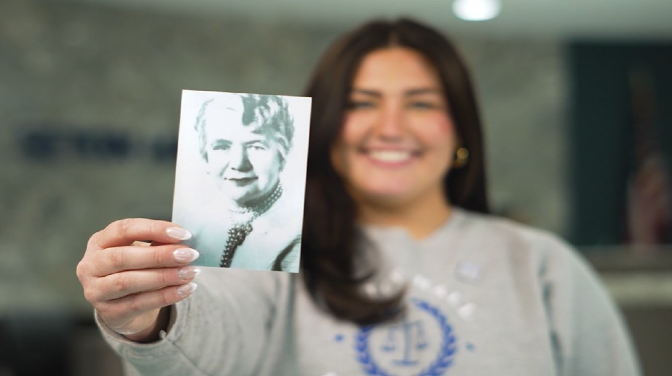
Seton Hall, named for the first American-born Catholic saint, Sister Elizabeth Ann Seton, chose a different path. The university set a precedent of inclusivity and promoted female leadership by appointing Miriam Theresa Rooney as founding dean. Rooney, a pioneering American legal educator, led the law school with commitment and relentless dedication.
Rooney was born and raised in Charlestown, Massachusetts. Her intelligence and early academic ambition laid the foundation for a remarkable career in legal education. She earned her bachelor’s, master’s and Ph.D. in philosophy from the Catholic University of America, then earned her law degree from George Washington University in 1942. Rooney’s career combined scholarship, public service and teaching. She worked in the U.S. State Department, served as a law librarian and taught jurisprudence—experiences that shaped her disciplined approach to legal education. Known by students and colleagues as a stern but deeply passionate leader, she held high expectations for academic excellence and institutional integrity. The letters, notes and papers she left behind reveal a thoughtful, determined leader whose upbringing and values carried her to the historic milestone of becoming the first woman dean of a U.S. law school.
The 72 students she welcomed in the inaugural class were mostly white men. Imagine what it must have been like for those students to be welcomed by Rooney at orientation, her guiding voice setting the tone for their legal education at a time when societal expectations limited women’s roles to homemaking and domesticity.
In a 1959 memorandum, Rooney introduced three required courses at Seton Hall Law. The principles behind them are still taught 75 years later: jurisprudence, legal writing and trial moot court. In jurisprudence, students learned the philosophical principles that underline judicial opinions and the common law, including the Socratic method, a foundation of all doctrinal courses at the law school. The legal writing course has expanded to include the introduction to lawyering course, where students are taught negotiation, counseling and advocacy—far beyond just legal writing. Finally, the trial moot court has evolved into the required persuasion and advocacy and appellate advocacy courses. This now includes the nationally top-ranked moot court team and the McLaughlin Advanced Trial Advocacy program.
She also emphasized the importance of an equally rigorous part-time evening program that accommodated students with varying availability. Since 2017, the program has evolved into an innovative part-time weekend program, which was among the first in legal education to incorporate distance learning while preserving eligibility for bar admission in all 50 states, including New York, where distance education rules are more restrictive.
Rooney undoubtedly would be proud of her law school today. Classes are often quadruple
the size of the inaugural class and are majority women. Since she stepped down, Seton
Hall Law has had two additional female deans and now has its first dean who is not
Catholic, reflecting the school’s bold steps forward while remaining grounded in its
Catholic roots. Seton Hall Law honors her legacy by continuing to expand access to
legal education, uphold the highest standards of scholarship, and prepare generations
of lawyers who serve with purpose and integrity across New Jersey and beyond.
 Peter M. Eraca is the assistant dean for J.D. and graduate admissions at Seton Hall
University School of Law. He received his J.D., magna cum laude, from Roger Williams
University School of Law and his M.A. and B.A. in political science from Binghamton
University, State University of New York. He is a recognized expert in law school
enrollment management and serves as chair of the Law School Admission Council’s Newcomers
Planning Work Group.
Peter M. Eraca is the assistant dean for J.D. and graduate admissions at Seton Hall
University School of Law. He received his J.D., magna cum laude, from Roger Williams
University School of Law and his M.A. and B.A. in political science from Binghamton
University, State University of New York. He is a recognized expert in law school
enrollment management and serves as chair of the Law School Admission Council’s Newcomers
Planning Work Group.
For more information, please contact:
Office of Communications and Marketing
(973) 642-8714
[email protected]