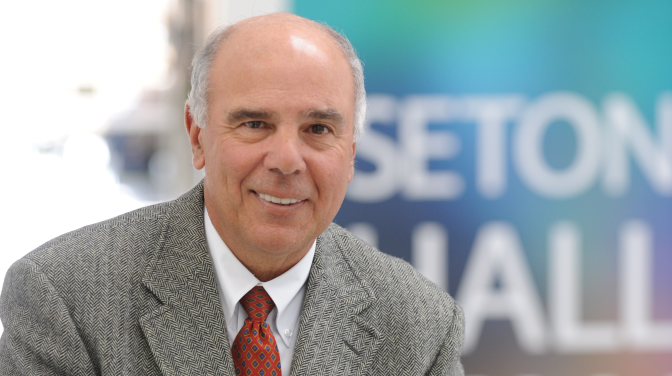
Photo provided by Ronald Riccio
Dean Emeritus Ronald Riccio steered Seton Hall Law through one of its most consequential
chapters—anchoring the school in Newark, raising its landmark building and shaping
an institution built to last. As the school marks 75 years, his legacy of vision,
service and purpose remains woven into its foundation.
Before Ronald Riccio found his way to Seton Hall School of Law, he was a Jersey City
kid whose world revolved around sports, not schoolbooks. In his neighborhood, there
was no premium placed on education—what was valued was athletic ability, physical
toughness, independence and the ability to make friends and keep them. A baseball
scholarship brought him to Seton Hall University and to the mentors who recognized
an intellect waiting to be unlocked.
"I had a couple of teachers who were instrumental in putting me on the right track and tapping into my academic abilities, which had been pretty much ignored growing up," Riccio said.
That early shift set the course for a remarkable career. Riccio entered Seton Hall Law in 1968, during a turbulent era marked by the Vietnam War and national unrest. The school occupied a modest building on Clinton Street, complete with an elevator operator, a small library and no air conditioning. Riccio remembered not the limitations, but the resolve of his classmates.
"The common characteristics of the students were resiliency, determination, pursuit of improbable dreams, willing to work hard, wanting to prove the skeptics wrong, overcoming the odds," he said.
Riccio graduated in 1971 after serving on Law Review and clerking for U.S. District Judge Lawrence A. Whipple. He spent 16 years in private practice before returning to Seton Hall Law in 1988 as dean, but only on one condition. When the school weighed a move from Newark to the suburbs, Riccio refused to budge.
"If we were going to truly make a difference in underserved communities, we needed to be present, not in the suburbs," he said. "We had to be right there."
That decision helped define a transformative era. The most visible symbol of his tenure is the current law school building, the fifth in the school's history. The five-story, approximately 200,000-square-foot facility at One Newark Center was developed by Bellemead Development Corp. and designed by the Grad Partnership of Newark. Construction began in May 1989, and the building opened in 1991.
The move replaced the school's former two-building complex at 1010 Raymond Blvd. with a modern downtown campus. A land-swap agreement helped finance construction and generated additional lease revenue for Seton Hall. During construction, students attended classes in trailers and temporary space across the street. The school nonetheless ranked No. 2 nationally for student satisfaction in a Princeton Review survey conducted in the 1991-92 academic year.
The Buildings Behind Seton Hall Law's 75-Year Rise
Riccio envisioned the building as more than a facility. He wanted it to foster connection. "I want a building where people walking through can see one another," he said. "I want them to encounter activity and feel a sense of connection." The result is an open design anchored by a large, sunlit atrium, with ramps winding through glass sightlines that encourage interaction—a visible expression of the institution's commitment to Newark.
"Not only are we not leaving, we're going to build a landmark here," Riccio said. "And we did."
His leadership extended well beyond bricks and mortar. Riccio taught constitutional law, civil procedure, business associations and introduction to lawyering, and was voted Professor of the Year five times. He ate lunch with students, walked the halls daily and kept his focus squarely on the people he served. "If you're going to be a good dean, you need to be present at the school and not feathering your own personal ambitions," he said.
Riccio unified a divided faculty, strengthened academic programs and reestablished the Center for Social Justice. He expanded moot court opportunities and created the Health Law program alongside then-faculty member Kathleen Boozang, who later became one of the law school's three female deans. His guiding principle was simple: "Everything else was subordinated to the students."
Today, Riccio serves as professor emeritus and general counsel to McElroy Deutsch, focusing on complex litigation, appeals and alternative dispute resolution. Selected as Attorney of the Year by the New Jersey Law Journal in 2016, he has mediated more than 100 cases since 1990. As lead counsel for Monmouth Park before the U.S. Supreme Court, he helped build the constitutional argument that the federal government could not force states to keep sports betting illegal—a strategy that led to the 2018 decision in Murphy v. NCAA, which struck down the Professional and Amateur Sports Protection Act and opened sports wagering to states nationwide.
As Seton Hall Law marks its 75th anniversary, Riccio's legacy remains central to the school's story. Dean Ronald Weich called him "a towering figure in the history of Seton Hall Law," crediting him with shaping the school's facilities and long-term direction. Riccio, in turn, credited autonomy and ambition grounded in purpose. "If I was successful as a dean, it's because I had the autonomy to make decisions," he said.
Looking back, he sees a clear arc from modest beginnings to institutional strength. "When you look at where Seton Hall Law School is today, compared to where it began, it's a phenomenal success story," he said.
For Riccio, that success is measured not by buildings or rankings, but by the people
the school has served and the opportunities it has opened up. He is proud of his lifelong
Seton Hall Law friends, who helped him along the way, including Ed Deutsch, Joe LaSala,
U.S. District Judge Dennis Cavanaugh and Frank Pomaco. Decades after his time as dean,
he remains an active presence—a steady source of advice, connection and support for
the institution he helped shape.
In a message to the Seton Hall Law community, Riccio reflected on what has always set the school apart. "The story of Seton Hall Law is an enduring one," he wrote. "Our success is rooted in who we are and have always been for generations of students, faculty, administration and staff. This is a place where values and principles have mattered more than status or prestige, where academic rigor is coupled with sensitivity and compassion, and where students are taught that service to others is more important than service to self."
For Riccio, the school's 75th anniversary is not a tribute to any one person—it belongs to everyone who has walked its halls.
"We, Seton Hall lawyers, are a family," he wrote. "We are bound together by our resilience, our determination, our courage in the face of adversity and our willingness to pursue improbable dreams only to see those dreams become realities."
As the law school enters its next chapter, Riccio's story embodies what it means to lead with purpose and stands as a reminder of what Seton Hall Law has always stood for: opportunity, resilience and service to community. Alumni are invited to celebrate that enduring legacy at the annual gala on May 8, an evening to honor the past and invest in the future.
For more information, please contact:
Office of Communications and Marketing
(973) 642-8714
[email protected]