 Photo by Sean Sime
New students begin their legal education with a call to uphold the rule of law, pursue
justice and contribute their distinct experiences to the Seton Hall Law community.
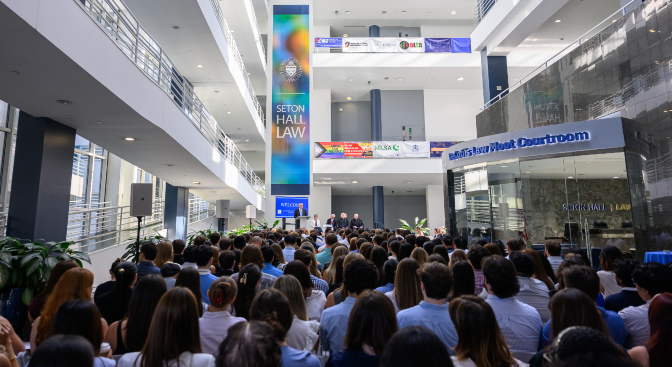
Seton Hall Law welcomed the Class of 2029 at Orientation Day, marking the beginning
of legal study for 327 new students.
In his opening remarks, Dean Ronald Weich welcomed the class to the law school, the university and Newark, emphasizing that students join the legal profession from their first day—not upon graduation—and challenging them to embrace their responsibility to advance justice. “As law students, you join the profession,” Weich said. “From this very first day, I want you to think of yourselves and conduct yourselves as members of this noble profession.”
Weich emphasized the enduring importance of the rule of law and the responsibility attorneys have to preserve it. “The rule of law is the set of rules by which we govern ourselves as a country,” he said. “It is the framework that determines how we resolve disputes peacefully.” Through their education, he told students, they will gain the knowledge and skills to uphold the law, serve others and help solve complex problems.
The dean also highlighted the law school’s 75th anniversary and its longstanding commitment to preparing ethical, effective and successful lawyers. He recognized the faculty’s excellence as teachers, scholars and mentors, the support of administrators and staff, and the professional achievements of Seton Hall Law graduates. “Lawyers have a special role in our society,” Weich said. “This is a moment when we need lawyers more than ever.”
Father Nicholas Gengaro, Seton Hall Law’s chaplain, reflected on the university’s Catholic heritage and its commitment to a community that respects and values people of every faith tradition and background. In welcoming students of all faiths, he said, “While Seton Hall is proud of its Catholic identity, I assure you that women and men of all faiths—as well as individuals professing no faith—are valuable members of this law school community. Mutual respect is essential to a community.”
Drawing on the Second Vatican Council’s Nostra Aetate, Father Nicholas noted that the Catholic Church “rejects nothing of what is true and holy” in other religions and respects beliefs and ways of life that illuminate truth. He encouraged students to bring their individual talents and perspectives to a larger purpose. “Seton Hall promises not only to educate you and teach you information you do not already know, but also to form you—to show you how to view the world through the prism of law,” Father Nicholas said in his invocation. “Starting today, you begin to come alive to a larger purpose, one that serves the cause of a freer and more just society.”
Monsignor Joseph R. Reilly, president of Seton Hall University, welcomed the entering class into what he described as a lifelong university community. He encouraged students to embrace the relationships they will build with classmates, faculty, staff and alumni during law school and beyond. “We become who we are through our relationships,” Reilly said. “Some of the people sitting next to you, in front of you and behind you will become part of your circle of friends—perhaps even for life.”
Reilly also reminded students that lawyers are called to serve others, care for their clients and demonstrate courage when clients may be unable to do so for themselves. He described a Seton Hall Law education as rooted in faith, ethics and the Catholic intellectual tradition, with a focus on justice for all. “Every woman and man is made in the image and likeness of God,” Reilly said. “At the heart of that belief is the acknowledgment that all people bear the imprint of God.” He added that the university seeks to educate lawyers who “seek justice in all things and for all people.”
Admissions Dean Peter Eraca introduced students to the breadth of experiences and perspectives represented in the Class of 2029. The 327-member class was selected from the law school’s largest applicant pool in more than a decade, with 2,850 applications. It includes 283 full-time students and 44 students in the weekend division.
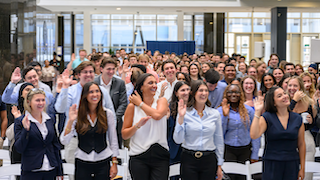 The class is 60% women, with students ranging in age from 18 to 59. Members come from
25 states, the District of Columbia, two Canadian provinces and South Korea, and represent
citizenships from countries around the world. They attended 143 undergraduate institutions,
speak more than 40 languages other than English and bring graduate-level training,
professional experience, military service and a wide range of personal interests to
the law school. Eraca told the class that these varied experiences and perspectives
will strengthen their collective learning experience.
The class is 60% women, with students ranging in age from 18 to 59. Members come from
25 states, the District of Columbia, two Canadian provinces and South Korea, and represent
citizenships from countries around the world. They attended 143 undergraduate institutions,
speak more than 40 languages other than English and bring graduate-level training,
professional experience, military service and a wide range of personal interests to
the law school. Eraca told the class that these varied experiences and perspectives
will strengthen their collective learning experience.
“You are not here by happenstance or mistake,” he said. “You belong at Seton Hall. You belong in the law. Your admission was real. You can do the work to be successful, and you earned your place in the legal profession.” The class, he said, “is not defined by any single hobby, background or experience, but by curiosity.” Their experiences and perspectives, he added, “will make our classrooms richer and our law school community stronger.”
Professor Jenny-Brooke Condon, associate dean for academic affairs, introduced the Class of 2029 to the faculty members who will guide them through their foundational first-year courses, including contracts, torts, civil procedure and legal research and writing. She also recognized faculty members students will encounter throughout their legal education. A Seton Hall Law graduate herself, Condon reflected on her decision to attend the law school and the professional path it made possible. “I love being a lawyer, but I’m grateful for this institution that has allowed me to fight for justice, to help my clients and now to help train the next generation of lawyers,” Condon said.
On becoming a lawyer, Seton Hall Law’s longtime professor Denis McLaughlin urged the Class of 2029 to see themselves as members of the legal profession—and to use that privilege to improve the lives of others. Reflecting on the 56 years since he earned his J.D., McLaughlin shared the winding path that led him to a career in law. It was shaped less by careful planning than by uncertainty, self-discovery, service and, ultimately, a commitment to work that mattered to him.
Orientation also featured keynote remarks from alumna Margo Chaly, J.D. ’13, New Jersey’s acting secretary of higher education. Drawing on her experience cheering runners through 5Ks and marathons, she encouraged the Class of 2029 to embrace the challenges ahead, run their own race and keep their eyes on the finish line.
For more information, please contact:
Office of Communications and Marketing
(973) 642-8714
[email protected]