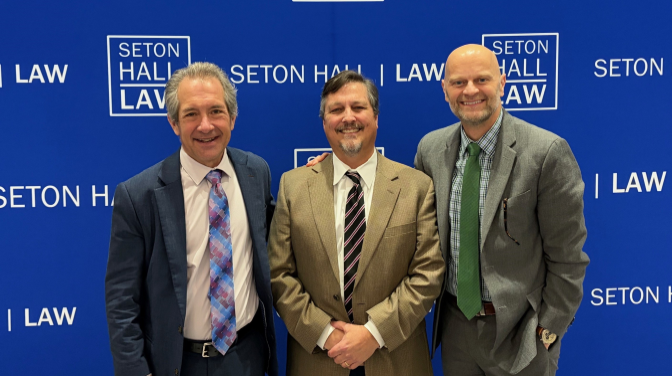
Left to Right: Professors Stephen Long, David Opderbeck & Rev. Brent Strawn
Theologians D. Stephen Long and Rev. Brent Strawn join David Opderbeck to explore
Faithful Exchange, a provocative look at how Scripture and ethics intersect with today’s
economy.
Seton Hall Law community, along with theologians and others, gathered to celebrate
Law Professor David Opderbeck’s recently published book Faithful Exchange: The Economy
as It’s Meant to Be (Fortress Press). Opderbeck, who also holds a doctorate in theology,
is the founder and director of the program on Faith, Values and the Rule of Law at
Seton Hall Law School. He concurrently serves as the co-director of the Institute
for Privacy Protection and co-director of the Gibbons Institute of Law, Science &
Technology.
Faithful Exchange takes a deep dive into the economy through the unique lens of a theologian, examining money, profit, technology, politics and markets in contexts where justice and human dignity are marginalized. The book offers an analysis of biblical and religious traditions in connection with various economic systems to provide moral clarity.
The evening featured two theology educators and scholars, D. Stephen Long, Ph.D., Cary M. Maguire University Professor of Ethics at Southern Methodist University’s Perkins School of Theology, and Rev. Brent A. Strawn, Ph.D., D. Moody Smith Distinguished Professor of Old Testament and Professor of Law at Duke University, who provided commentary on the book.
“The breadth of knowledge, its readability, and Opderbeck’s way of framing matters are truly exceptional,” said Long. “A close and comprehensive reading of Scripture, along with profound reflections on theology, ethics and law, makes this one of the most important contributions in economic theology to date.” He later cited Opderbeck’s use of practical reasoning, narrative format, and thoroughness. Long suggested the book opens new avenues of inquiry “as an exercise in practical reasoning—no work on biblical interpretation, ethics or economics ever comes to end.”
Long recommended that fruitful avenues for further work might include the Apostle Paul’s understanding of sharing practices in the early church and the contemporary problem of Christian nationalism. Strawn added, “This remarkable book succeeds where so many have failed. Opderbeck argues with the clarity and acumen of a top-notch law professor and controls an immense range of biblical and theological data, like a first-rate theologian.” Strawn noted that he is inspired and encouraged each time he reads a work by Opderbeck. At the same time, Strawn explored how the biblical texts do not always form a clear narrative but rather offer glimpses of truth akin to poetry.
The discussion concluded with remarks and responses from Opderbeck. He began by tracing some of his own theological journey and laying out the inspiration for the book. He stated, “As theologians or biblical scholars, we hope something we write will find its way into sermons or denominational decisions or seminary classrooms or kitchen tables.” While he admits these things often do not happen, “we want to help prepare new generations of leaders who will move the church and the world more deeply into God’s love and peace.”
A central concern, he noted, was to explore all the facets of economic thought in
the Bible and the Christian tradition, which do not always map neatly onto modern
paradigms such as capitalism and socialism. He took time to address the narrative
format structure, and his decision not to focus more on Paul or Reconstruction, and
his engagement with the comments of Long and Strawn. He also emphasized his commitment
to inter-religious dialogue, especially a reading of the biblical texts that reflects
both the Jewishness of the New Testament and the radical nature of Jesus’ teachings
about wealth. “The diversity of the biblical witness, the various Jewish and Christian
traditions, the ancient Greek and Latin sources, the Hindu and Islamic traditions,
and ancient indigenous cultures—cannot be ignored if we hope to bear good fruit,”
he concluded.
 Brett Canaval is the executive director of the Institute for Privacy Protection; the
Gibbons Institute of Law, Science and Technology; and the Program on Faith, Values,
and the Rule of Law at Seton Hall University School of Law. He has held multiple staff
roles at the law school since 2018, including assistant to the dean and legal support
specialist for healthcare and gaming compliance programs. Previously, he served as
manager of administrative operations in Governor Chris Christie’s Appointments Office
and holds a B.A. in elementary education from Kean University.
Brett Canaval is the executive director of the Institute for Privacy Protection; the
Gibbons Institute of Law, Science and Technology; and the Program on Faith, Values,
and the Rule of Law at Seton Hall University School of Law. He has held multiple staff
roles at the law school since 2018, including assistant to the dean and legal support
specialist for healthcare and gaming compliance programs. Previously, he served as
manager of administrative operations in Governor Chris Christie’s Appointments Office
and holds a B.A. in elementary education from Kean University.
For more information, please contact:
Office of Communications and Marketing
(973) 642-8714
[email protected]